The topic of this article will be screws. In this article, we’ll explain concepts such as what a screw is, screw geometry, helix, lead of the helix, internal and external thread, stud, nut, elements of a screw, pitch. Right-hand and left-hand thread. Screws according to thread profile. Metric and Whitworth thread systems. The content menu is below:
General Information About Screws
Helical grooves cut on cylindrical or conical surfaces with equal pitch and the same profile are called a screw thread.
Screws can be used as fasteners, as well as for transmitting motion and force.
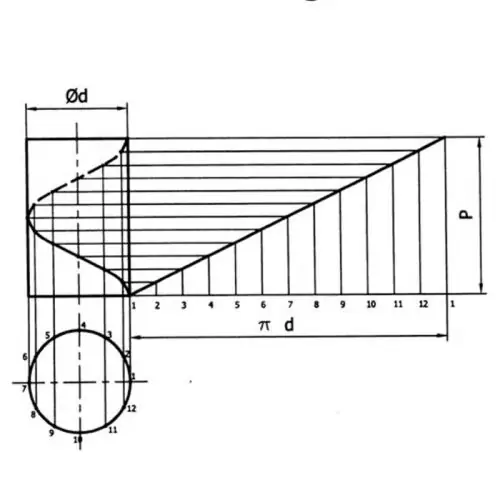
Helix: When a cylinder is made to complete one revolution starting from a certain point at a certain angle, the resulting winding path is called a helix. Since the base of the triangle equals the circumference of the cylinder, after one revolution edge BC arrives back at point A; the (p) height is the lead of the helix.
If the helix angle, meaning the pitch, is small, the screw’s self-locking property increases. Fastening screws with a small helix angle (pitch), meaning triangular-profile screws, don’t easily loosen on their own from potential shocks after being properly tightened.
There are also screws with a large helix angle (pitch). But these aren’t used as fastening screws — they’re used as motion (lead) screws.
Internal Thread and External Thread
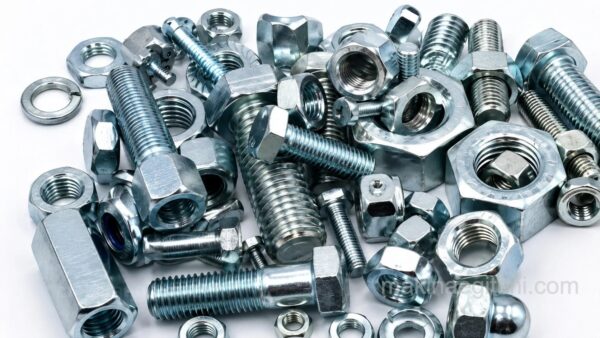
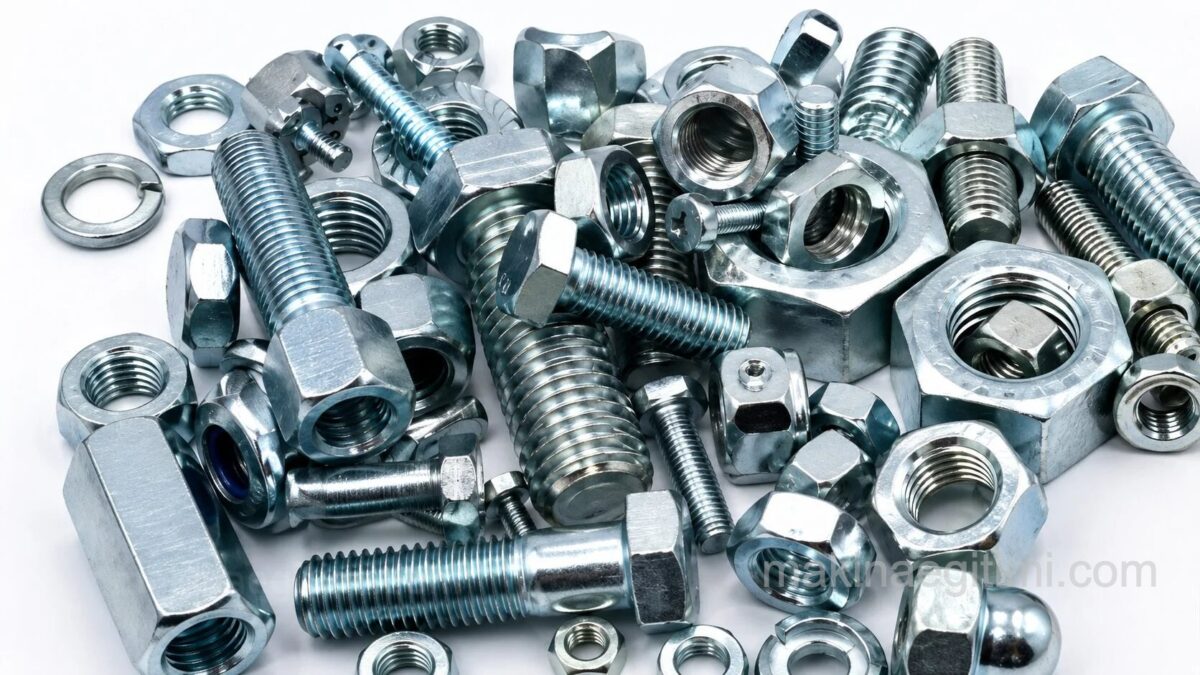
Fasteners with a thread cut on their outer surface are called BOLTS if they have a head, or STUDS if they don’t.
Fasteners with a thread cut on their inner surface are called NUTS.


Elements of a Screw

Pitch: The name given to the distance between one full tooth and the next tooth gap on a screw. Two screws that will work together (such as a nut and a bolt) must have the same profile type and pitch.
For metric screws, the nominal diameter equals the major (crest) diameter. In other words, a metric screw with a major diameter of 30mm is called M30.
What Are Right-Hand and Left-Hand Threads?

How do we tell if a screw has a right-hand or left-hand thread?
Screws take their name based on the direction they advance when tightened. If it advances to the right when tightened, it’s called right-hand, and if it advances to the left, it’s called left-hand.
In other words: if it tightens clockwise, it’s a right-hand helix. If it tightens counterclockwise, it’s a left-hand helix screw.
Thread Profiles in Screws
Screws can be manufactured with different thread profiles for different purposes. These different thread profiles are given below.

A- Metric triangular thread: Thread angle is 60 degrees. Used for fastening purposes.
B- Whitworth triangular thread: Thread angle is 55 degrees. Generally a fastening screw used for sealing purposes.
C- Square thread: Used for transmitting motion and force.
D- Trapezoidal (ACME) thread: Preferred for transmitting motion.
E- Buttress thread: Used for transmitting one-directional forces and motion.
F- Round thread: Mostly used for transmitting motion and force in dusty environments.
Number of Starts in Screws

If more than one start is visible when looking at a screw from the front, it’s called a multi-start screw.
Multi-start screws are used in places where a low rotational speed but a large amount of travel is desired. In one full turn, the linear advance of a 3-start screw is 3 times that of a single-start screw.
Screw press spindles, clamp screws, the screws of some vises, pulling fixtures, and camera focusing mechanisms are examples of multi-start screws.
Screw Thread Function
Screw threads convert rotational motion into linear motion, fastening parts tightly together.
ISO Metric Standard
Today, the most widely used screw standard is the metric thread system defined by ISO.
Importance of Thread Pitch
Thread pitch determines how far a screw advances in one full turn, and affects the tightness of the fastening.
Standardization of Screws – Thread Systems

Let’s say a fastening screw in any machine breaks or gets lost. For the screw we buy to fit in the machine, it will need to be exactly the same dimensions as the lost screw. Otherwise the screw won’t seat properly, won’t tighten, or won’t work as efficiently as before.
To prevent such problems, screws have been standardized. There are two worldwide standard systems for screws: METRIC and WHITWORTH
Metric System Screws
In metric screws defined by TS 61/1, the dimensional unit for screw elements is mm. In the most commonly used triangular-profile screws, the thread crest angle of a metric screw is 60°. Pitch, the most important element of a screw, is the distance between two adjacent thread crests. In metric screws, pitch is specified in millimeters. The screw’s elements are calculated based on the pitch, and a metric screw’s size is given based on its major (crest) diameter.
Whitworth Screws
Whitworth is also known as the imperial (inch) system. It’s based on the British unit of measurement, the INCH. In the INCH system, 25.4 mm = 1 INCH.
1 INCH is expressed in short as 1”.
In the Whitworth system, the screw’s pitch = the number of threads per inch (TPI).
The thread crest angle is 55°. In Whitworth threads, the apexes of the triangle forming the threads are truncated and rounded by 1/6 of the triangle’s theoretical height. There’s no clearance. For this reason, pipe threads requiring a seal are manufactured according to the imperial system.

Thread Cutting Methods
Have you ever wondered how screws are manufactured? There are several different ways to manufacture a screw. We’ll cover these below.
Thread Cutting on Lathes and Automatic (Screw Machine) Lathes
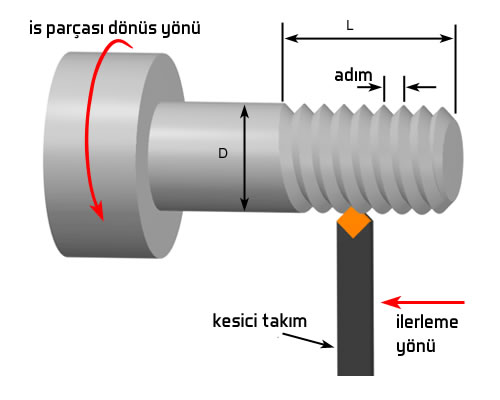
The part to be threaded is cut to the appropriate length, mounted on the lathe, and the thread is cut by removing chips. A cutting tool (thread cutter) advancing at a constant speed matched to the thread pitch cuts a helical path on the workpiece rotating at a constant speed.
Thread cutting can be done on universal or CNC (computer-controlled) lathes, and when serial production is involved, it’s done on machines called automatic (screw machine) lathes.
For detailed information, see: Thread Cutting on a Lathe
Thread Cutting Using a Tap and Die

This is a method mostly used when cutting small-diameter threads. In this method, threads are cut using tools called a die and a tap.
A die is used to thread holes, while a tap is used to thread cylindrical outer surfaces. The tap and die are made of HSS steel, and are cutting tools whose built-in cutting teeth cut a groove in the desired pitch and profile.
For detailed information, SEE: Tapping
Thread Rolling

The material to be made into a bolt is squeezed and rolled between grooved dies that give it the desired thread profile. This process is done cold for diameters smaller than 16 mm. For large diameters, hot rolling is used.
Most bolts are made using this method. Since there’s no chip removal, there’s no fiber (grain flow) interruption. Work hardening occurs at the surface, and strength increases.
For nuts, the thread must be cut by removing chips after the initial forming with a press.
Related Questions
A small helix angle increases friction between the threads, strengthening the screw’s “self-locking” property. This means the screw doesn’t easily loosen even under impact or vibration.
A large helix angle provides more axial travel per turn, but it also increases the risk of self-loosening. For this reason, it’s preferred in mechanisms designed to transmit motion, not in connections that need to stay tight.
Related Posts