Close Menu
  • MAKİNELER ve İMALAT
    • Tools & Equipment
    • Computer-Aided Drawing
    • CAD/CAM Education
    • CNC Machine Programming
    • Casting Technologies
    • Electrical & Electronics Technologies
    • Hydraulics & Pneumatics
    • Manufacturing Processes
    • Manufacturing Technologies
    • Occupational Safety
    • Mold & Die Design
    • Solid Modeling
    • Welding Technology
    • Machine Elements
    • Mechanical Trade Drawing
    • Materials Science
    • Automotive & Vehicle Technologies
    • Robotics Technologies
    • Health Technologies
    • Defense & Aerospace Technologies
    • Descriptive Geometry
    • Technical Drawing
    • Software & Hardware Technologies
    • Innovative Manufacturing Methods
  • TEKNOLOJİ ve YAŞAM
    • OTOMOBİLLER ve TAŞIT
      • Vehicle & Engine Knowledge
      • Safe Driving
      • Sürüş Destek Sistemleri
    • Genel Kültür
      • Movies & TV Shows
      • Görsel ve Grafik Sanat
      • Books & Literature
      • Music
      • Sports
      • History
      • History of Technology
    • GÜNDELİK YAŞAM TEKNOLOJİLERİ
    • Hobbies & Entertainment
    • Internet Technologies
    • Health
    • Mobile Technologies
Makine Eğitimi
  • Machines & Manufacturing
    Machine Elements
    Hydraulics & Pneumatics
    Technical Drawing
    Computer-Aided Design & Manufacturing
    Basic Manufacturing Processes
    Manufacturing Processes
    Industry Technologies
    Other Technical Courses
    Motion & Power Transmission
    Simple Machines
    Chains & Sprockets
    Shafts & Journals
    Gears
    Cams
    Couplings
    Belts & Pulleys
    Springs
    Bearings
    Keys
    Fastening Joining
    Retaining Rings
    Screws, Bolts & Nuts
    Cotter Pins
    Flanges
    Welding
    Rivets
    Pins & Bolts
    Washers
    Calculators
    Gear Ratio Calculator
    Spring Constant Calculator
    Belt Pulley Ratio Calculator
    Other Machine Elements
    Slides & Linear Guides
    Brakes
    Flywheels
    Clamps
    Shock Absorbers
    Gaskets & O-Rings
    Seals & Sealing Elements
    Hydraulics
    Introduction to Hydraulics & Principles
    Hydraulic Systems & Applications
    Accumulators
    Filters
    Motors
    Pumps
    Valves
    Pneumatics
    Introduction to Pneumatics & Principles
    Pneumatic Systems & Applications
    Pneumatic Circuit Components
    Valves
    Cylinders
    Silencers
    Motors
    Compressors
    Dryers
    Conditioning Units
    Common Topics & Maintenance
    Hydraulic & Pneumatic Maintenance
    Study Notes, Exams & Tests
    Technical Drawing
    Introduction to Technical Drawing
    Geometric Drawings
    Perspective & Projection
    Orthographic Views
    Dimensioning
    Sectioning
    Assembly & Detail Drawings
    Tolerances
    Surface Finish Symbols
    Mechanical Engineering Drawing
    Screws, Bolts & Nuts
    Pulley Drawings
    Gear Drawings
    Shafts & Journals
    Bearing Drawings
    Pins & Bolts
    Spring Drawings
    Welds in Technical Drawing
    Washers
    Cotter Pins
    Technical Drawing Exercises
    Mechanical Drawing Exercises
    Gear Exercises
    View Extraction Exercises
    Pulley Exercises
    Pin & Bolt Exercises
    Threaded Fastening Exercises
    Descriptive Geometry
    Computer-Aided Drawing
    AutoCAD Drawing Lessons
    Solid Modeling & Animation
    Solid Model Drawing Files
    Solid Model Assembly Examples
    Solid Model Drawing Lessons
    3D CAD Software Reviews
    Solid Modeling Exercises
    CNC Programming
    CAM
    Measurement & Inspection
    Dial Indicators
    Calipers
    Gauges
    Micrometers
    Materials Science
    Steels
    Cast Iron
    Aluminum
    Plastics
    Material Testing & Hardness Measurement
    Occupational Safety
    Workshop Safety
    Safety When Working With Electricity
    Machine Safety Rules
    Hand Operations
    Filing
    Marking
    Cutting Operations
    Reaming
    Tapping
    Threading With a Die
    Drill Bit Sharpening
    Working With Machines
    Basic Turning Operations
    Basic Milling Operations
    Shaper Machine
    Machining
    Turning
    Milling
    Grinding
    Innovative Manufacturing Methods
    EDM (Electrical Discharge Machining)
    Laser Machining
    Waterjet Machining
    3D Printing
    3D Scanners
    Welding
    Rolling
    Casting
    Mold & Die Design
    Mechanical & Hydraulic Presses
    Blanking & Piercing Dies
    Bending Dies
    Drawing Dies
    Plastic Injection Molds
    Extrusion Dies
    Compound Dies
    Progressive Dies
    Blow Molds
    Spinning Dies
    Spray Molds
    Manufacturing of Machine Parts
    Automotive & Vehicle Technologies
    Motor Vehicle Manufacturing
    Raw Material Production
    History of Technology
    Health & Medical Technologies
    Defense & Aerospace
    Robotics Technologies
    Software & Hardware Technologies
    Mechanics - Strength of Materials
    Physics Topics
  • Technology & Life
    Hobbies & Entertainment
    Sports
    Music
    Vehicle & Engine Knowledge
    Vehicle Maintenance & Repair
    Safe Driving
    Driver Assistance Systems
    History
    Movies & TV Shows
    Books & Literature
    Computers & Internet
    Computer Tips
    Software Reviews
    Hardware & Peripherals
    Practical & Safe Internet Use
    Visual & Graphic Art
    Mobile Technologies
    Travel
    Science
    Health
    First Aid Knowledge
    Everyday Technologies
Makine Eğitimi
Home»Hydraulics & Pneumatics»Reciprocating Compressor | Working Principle, Parts, Types
30 August 2026

Reciprocating Compressor | Working Principle, Parts, Types

Reciprocating Compressor | Working Principle, Parts, Types

In our Hydraulics and Pneumatics lessons, we’ve devoted this article to reciprocating (piston) compressors. We’ll examine the working principle, main parts, and types of the compressor.

  • What Is a Reciprocating Compressor?
  • Working Principle of a Reciprocating Compressor
  • How Does a Reciprocating Compressor Work
  • Types of Reciprocating Compressors
    • Single-Acting Air Compressor
    • Double-Acting Air Compressor
    • Single-Stage Air Compressor
    • Two-Stage Air Compressor
  • Related Questions

What Is a Reciprocating Compressor?

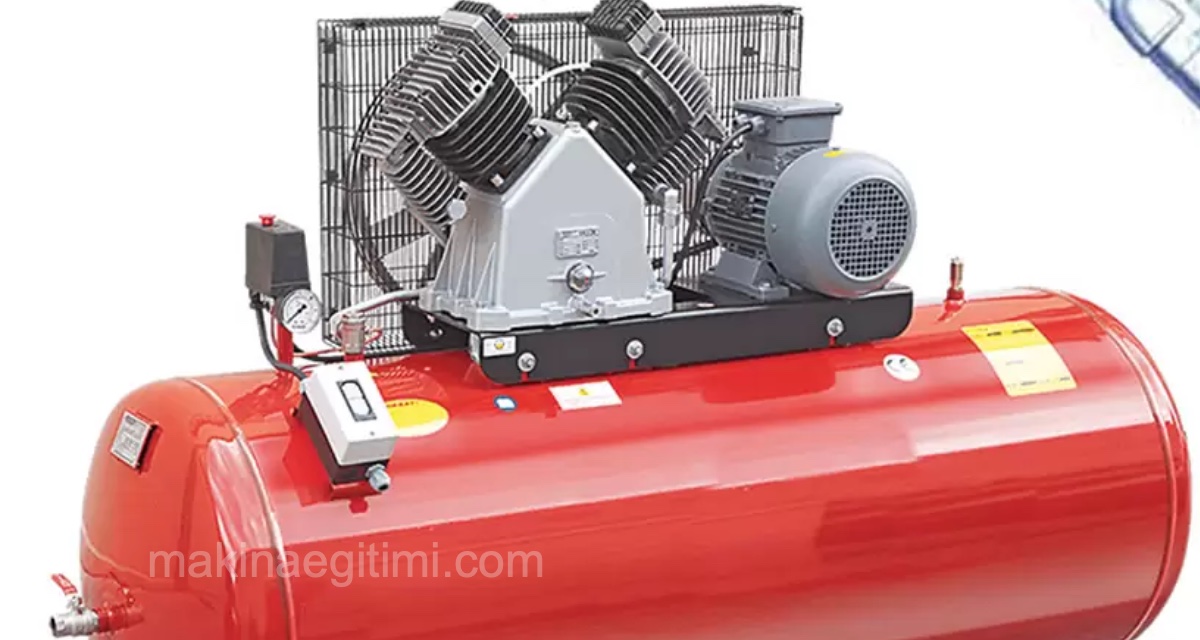
A reciprocating compressor is a positive displacement air compressor in which air is drawn into a chamber and compressed by a piston. A reciprocating air compressor is a positive displacement compressor because air is first drawn into a chamber and compressed as the chamber’s volume is reduced, with the volume being reduced by a piston.

Working Principle of a Reciprocating Compressor

In a reciprocating air compressor, the piston moves to BDC and air is drawn from the atmosphere into a cylinder, carrying it toward TDC. Compression of the air begins and increases, and pressure rises accordingly. Once the pressure limit is reached, the discharge valve opens and compressed air flows into the storage tank.

parts and working principle of a reciprocating compressor

Piston: Moves back and forth inside the cylinder and compresses the air.
Cylinder: Air is compressed inside the cylinder.
Crankshaft: Connected to the electric motor’s shaft and transmits rotary motion to the piston.
Intake valve: When the piston moves to BDC, air is drawn in through an intake valve.
Discharge valve: Compressed air is discharged into the storage tank through the discharge valve.

The highest position the piston reaches inside the cylinder is called Top Dead Center (TDC).
The lowest position is called Bottom Dead Center (BDC).

Intake and Compression Stroke


In a reciprocating compressor, air is drawn in as the piston moves down, and compressed under pressure as it moves up.

Single-Stage and Two-Stage


Two-stage reciprocating compressors can reach higher pressure values by compressing air in two stages.

Choosing Oil-Lubricated / Oil-Free


Oil-free reciprocating compressors are preferred in applications requiring clean air (such as paint shops).

How Does a Reciprocating Compressor Work

how a reciprocating compressor works

When power is applied, the electric motor starts to rotate and turns the crankshaft connected to it, and the piston begins to move back and forth inside a cylinder. As the piston moves downward, air from the atmosphere enters the cylinder chamber.

After reaching BDC, the piston starts moving upward, and the air begins to compress, tending to increase in pressure. Once the set pressure is reached, the discharge valve opens, and compressed air is transferred through it into a storage tank where it can be used.

Types of Reciprocating Compressors

1- Single-acting air compressor
2- Double-acting air compressor
3- Single-stage air compressor
4- Two-stage air compressor

Single-Acting Air Compressor

A single-acting reciprocating air compressor uses only one side of the piston to compress air, while the other side connects to the crankcase and isn’t used for compression.

Double-Acting Air Compressor

In a double-acting type reciprocating compressor, both sides of the piston are used to compress air. There’s intake on one side and compression on the other. Both intake and compression occur on every stroke of the piston.

Single-Stage Air Compressor

operation of a single-stage compressor

In a single-stage reciprocating air compressor, air compression takes place in a single cylinder. Air drawn in from the atmosphere on the first stroke is compressed and delivered to the storage tank on the second stroke.

Two-Stage Air Compressor

working system of a two-stage compressor

In a two-stage air compressor, compression takes place in two stages. In the first stage, air is compressed in one cylinder, and after this it’s transferred to a second cylinder for further compression. And finally, the compressed air is stored in a tank.

Related Questions

While the piston moves from bottom dead center to top dead center inside the cylinder, the intake and discharge valves remain closed. During this time, the volume inside the cylinder shrinks and the trapped air gradually compresses, increasing in pressure.

If the valve opens too early, air escapes before it has been sufficiently compressed, and the desired pressure can’t be reached. Having it open only once the set pressure threshold is reached ensures that only sufficiently compressed air is sent to the storage tank.

Related Posts

Hidrolik Filtre Seçimi Hydraulic Filter Selection pneumatic applications, robot Introduction to Pneumatics and Definitions Pressure Gauges and Types of Pressure Gauges Pressure Gauges and Types of Pressure Gauges piston compressor and its internal structure Types of Pneumatic Compressors 4 yollu 2 konumlu yön kontrol valfleri 4-Way 2-Position Directional Control Valves Hydraulic Oils and Their Properties Hydraulic Oils and Their Properties Elements of a Hydraulic Cylinder Elements of a Hydraulic Cylinder Pnömatik Şartlandırıcılar Pneumatic Conditioners (FRL Units)
Pneumatic Circuit Components Pneumatic Compressors
Share. Facebook Twitter WhatsApp Tumblr Email Telegram Copy Link

Leave A Reply Cancel Reply

What Is Classical Music? Periods, Great Composers and History
How to Save Fuel in Vehicles
  • Contact
  • Terms of Service
  • Privacy & Cookie Policy

Type above and press Enter to search. Press Esc to cancel.