What material are reamers made of? What are reamer materials and the parts of a reamer? We’ll cover these topics in this article.
Reamer Materials
Reamers are made from high-speed steel and carbon steel. Reamers made from high-speed steel can cut 4-5 times faster than those made from carbon steel, and using these reamers is also more economical. An advantage can be gained with an adjustable machine reamer whose body is hardened steel but whose blades are made from high-speed steel. Reamers that need to withstand large forces are made with carbide tips.

The fact that carbide tips retain their sharpness at high temperature and are resistant to wear makes them well suited for use in reamers as well. Since their dimensions can be maintained without deterioration for a long time, they are very useful for mass-production work.
In sandy or hard-skinned castings, carbide-tipped reamers last several times longer than high-speed steel
reamers. There is also no special rule for speed and feed with carbide-tipped reamers; however, the speed and feed values used for high-speed steel reamers are used when starting the job.
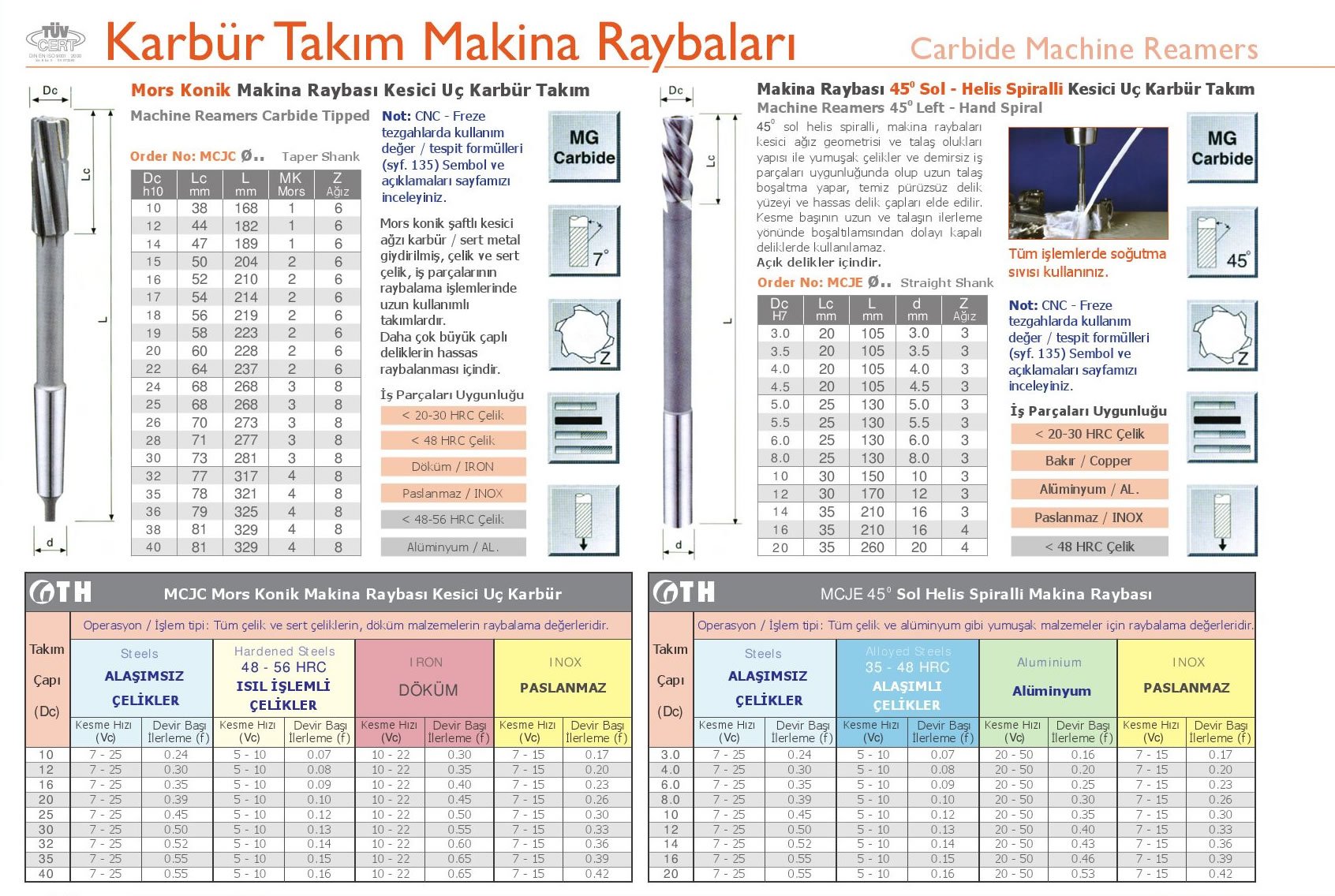
A cutting speed and feed table for carbide-tipped machine reamers, based on the selected material and reamer diameter, for reaming steel and cast steel, gray cast iron, malleable cast iron, aluminum, and stainless steel materials.
Parts of a Reamer
Reamers generally consist of 3 parts. These are: the chamfered tip, the body, and the shank.
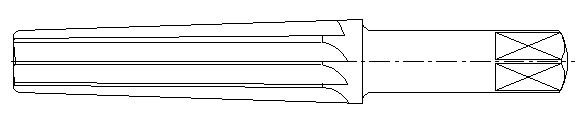
Chamfered Tip:
This is the part of the reamer that does the cutting work. Each chamfered tooth is ground so that the cutting edges have an equal clearance angle. These properties hold true
for taper reamers. In straight-fluted reamers, most of the cutting is done by the cutting edges on the body.
Body:
Made up of several flutes and lands. The land is the portion between two flutes. Along the top of each land, there is a margin that starts at the chamfered tip and extends to the end of the flute. Behind the margin is a clearance angle.
On most reamers, the cutting edge surfaces form an angle with a plane passing through the center. This is called the reamer rake angle. If there is no such angle, the cutting edge face lies on the plane passing through the center.
Shank:
Made either cylindrical or tapered. Tapers are designated by Morse taper
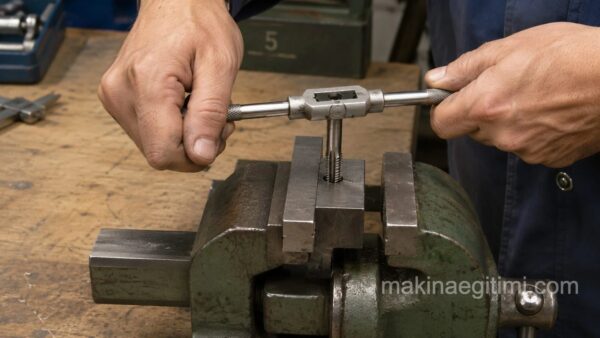
numbers according to the size of the reamer. They are fitted into a chuck or into the spindle socket of the machine to be used. On reamers with a cylindrical shank, there is a square section at the end of the shank. A tap wrench is attached to this section to turn the reamer.
In this article, we tried to answer the question: what material are reamers made of? We covered reamer materials and the parts of a reamer. See you in our next articles.
Related Posts