

When you notice black smoke coming out of your car’s exhaust, there is no single, simple explanation for it. The physical principle behind that smoke, however, is quite clear: either more fuel is entering the engine’s combustion chamber than it can burn, or the engine is not getting enough air to burn the fuel completely. In engine terms this is called a “rich mixture”. In this article we go step by step through the real causes of a rich mixture, how to tell those causes apart, and which check points to which fault.
The Principle Behind Black Smoke: A Rich Mixture
For an engine to run properly, air and fuel have to be mixed in a certain ratio. When that ratio is upset and there is too much fuel for the amount of air, part of the fuel cannot burn completely. Those unburnt fuel particles are thrown out of the exhaust as soot, that is, as black smoke.
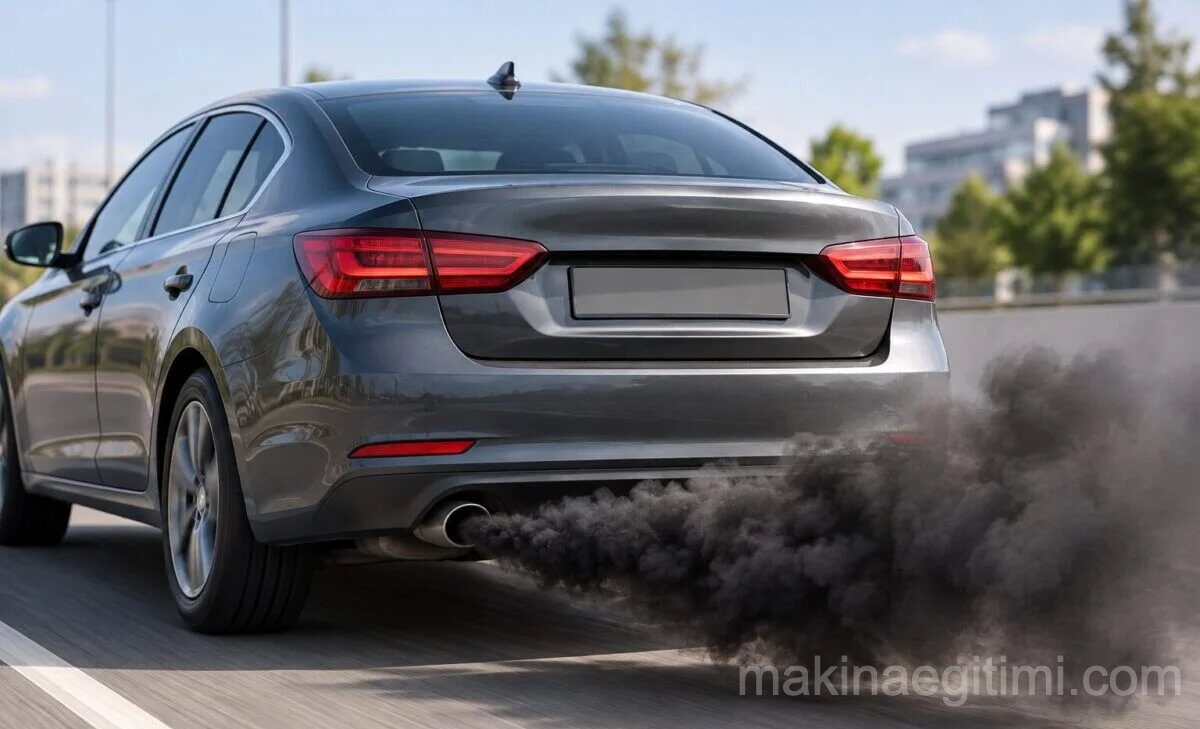
Why Does Black Smoke Come from the Exhaust?
With black smoke there are really only two places to look:
- either more fuel than normal is being sent to the engine,
- or the engine is not getting enough air.
Almost every one of the causes below traces back to one of these two roots.
There can be a number of reasons for black smoke coming from a car’s exhaust. The most common ones are these:
Fuel Injector Fault
The injectors are responsible for spraying fuel into the combustion chamber as a fine mist. If an injector leaks, drips or does not close fully, more fuel than necessary enters that cylinder, and the unburnt fuel from it turns into black smoke. An injector fault is the most frequently met item on this list, and the one whose most obvious symptom is usually black smoke.
How to check: Reading the car’s fault codes with an OBD-II scanner is the first step; injector circuit faults usually show up as codes between P0201 and P0208. For a further check you can run the engine at idle and disable the injectors one by one — whichever injector reduces the smoke when it is cut out is the cylinder with the problem.
Clogged Air Filter
A dirty or blocked air filter reduces the amount of air reaching the engine. When the air drops while the fuel stays the same, the mixture becomes relatively rich and black smoke appears. This is the cheapest and easiest cause on the list to check, so it should always be looked at before moving on to the others.

How to check: Take the air filter out of its housing and hold it up to the light. If it barely lets the light through, or is visibly dirty, it needs replacing. This check needs no tools and takes a few minutes.
Mass Air Flow (MAF) Sensor Fault
If the mass air flow sensor that measures the air entering the engine sends incorrect data, the engine’s electronic control unit calculates the fuel quantity wrongly. If the sensor reads less air than there actually is, the system thinks it is sending too little fuel and in fact pumps too much, which leads to black smoke.
How to check: An OBD-II scanner usually shows MAF faults as codes between P0100 and P0104. The sensor itself can also be inspected visually; if there is oil or dirt built up on it, it may need cleaning.
Fuel Pressure Regulator Fault
When the regulator responsible for keeping the fuel pressure steady fails, fuel can be delivered to the system at a higher pressure than it should be. That makes the injectors spray more fuel than normal, and the result is black smoke.
How to check: Measure the pressure in the fuel line with a fuel pressure gauge and compare it against the reference value in the vehicle’s manual. If the pressure is clearly above the reference value, the regulator is the suspect.
Turbo Boost Problems
On turbocharged vehicles, a turbo producing more boost than it should, or a cracked or split turbo hose, can upset the air-fuel balance going into the engine. On cars with a turbo fault, black smoke is usually accompanied by a drop in pull and a loss of power.
How to check: Inspect the turbo hoses visually for cracks, splits or loose connections. With the engine running you can also press lightly on the hoses by hand to feel whether air is escaping.
Carbon Build-Up in the Combustion Chamber
Carbon that builds up over time in the combustion chamber and on the valves can stop the fuel from burning properly. This build-up is usually the result of neglected servicing or the use of poor-quality fuel, and it leads to a slower, more gradual increase in black smoke than the other causes.
How to check: Diagnosing this with certainty usually calls for a garage to view the combustion chamber with an endoscope. But if the car has high mileage and the fuel system has not been serviced regularly, this possibility moves up the list.
Confirming any of these causes requires the vehicle to be examined by a garage. Heavy black smoke in particular indicates a serious fault in the engine’s combustion system, and the vehicle should be looked at straight away.
The Real Role of Exhaust System Faults
A fault in the exhaust pipe, the catalytic converter or an exhaust valve does not produce black smoke directly, because black smoke forms in the combustion chamber and the exhaust system only carries that gas away. A badly blocked catalytic converter can, however, make the exhaust gas back up, and indirectly reduce engine performance and upset combustion. For that reason exhaust system faults do not belong at the top of the black-smoke list; they are a possibility to consider once the other options have been ruled out.
How to check: If there really is a fault in the exhaust system, its main symptoms are not black smoke but abnormal noise from the exhaust, loss of power, a warning light coming on, or a sudden rise in fuel consumption. If those symptoms appear together with black smoke, then checking the catalytic converter becomes relevant.
What Should Not Be Confused with Engine Oil Level
A low engine oil level can damage the engine by increasing friction, but the typical thing you see at the exhaust in that case is not black smoke but blue or grey smoke, because what is burning there is engine oil, not fuel. If you are seeing black smoke from your exhaust, checking the oil level is still a good habit, but it should not be treated as the prime suspect for black smoke.
How to check: Check the dipstick. If the level is low, top it up, but if the smoke is still black, the place to look is the fuel and air system.
In What Order Should You Check?
With so many possible causes, it matters to know where to start. The order that works in practice is this:
- Note when the smoke appears. If it only appears under acceleration, a turbo or injector problem is more likely. If it is there constantly, a clogged air filter or a permanent injector fault comes to the fore.
- Read the fault codes with an OBD-II scanner. This is the cheapest and fastest step, and it points directly to most injector, MAF and fuel pressure problems.
- Inspect the air filter visually. It needs no tools and takes a few minutes.
- Examine the turbo hoses. If you are in a turbocharged vehicle, this check should also be done early on.
- Test the fuel pressure and the injectors. These steps need tools, so their turn comes if the first four produce no result.
Related Videos
Causes of Black Smoke From Exhaust | How To Fix It

Black Smoke from Exhaust: Common Causes & Fix
Is Your Car Blowing Black Smoke? Causes & Fixes!

Diesel Exhaust Black Smoke: Meaning & 5 Common Causes
Black smoke from the exhaust is a sign that the engine is running on a rich mixture in one way or another, but there is no single cause for it. An injector fault, a clogged air filter, a mass air flow sensor problem, a fuel pressure issue and turbo faults are the real leading actors in this picture. Exhaust system faults and a low engine oil level usually announce themselves with different symptoms and should not be treated as the primary cause of black smoke. Simple checks carried out in the right order will, more often than not, let you narrow the problem down considerably before you go anywhere near a garage.
Related Questions
It means more fuel is entering the combustion chamber than is needed, while not enough air is getting in. Because the excess fuel cannot burn completely, sooty black smoke comes out of the exhaust.
The problem can come from two different places: the injectors may be spraying more fuel than they should, or the engine may not be getting enough air because of a clogged air filter. Since both situations produce the same result (too much fuel, too little air), both need to be checked.
Brief, light smoke does not usually pose an immediate danger, but constant, heavy black smoke both increases fuel consumption and can damage expensive parts such as the catalytic converter. It is therefore cheaper to have the problem looked at without putting it off.
Black smoke comes from unburnt fuel, while blue or grey smoke comes from engine oil leaking into the combustion chamber and burning there. The two colours point to different systems and should not be confused.
No code appearing means the problem may have a mechanical cause (a clogged air filter or a cracked turbo hose, for example), because faults of that kind do not always trigger an electronic fault code. In that case the emphasis should be on visual checks.
The basic principle is the same, but on diesel vehicles a blocked EGR valve and DPF (particulate filter) can also contribute to black smoke. When a black smoke problem comes up on a diesel, these two components should be added to the checklist.
Light black smoke seen once or twice after a sudden press of the accelerator is usually nothing to worry about. But if it becomes a constant thing, you should work through the order of checks above.
Related Posts
 How Is Engine Oil Checked? Engine Oil Check
  If the Engine Won’t Start, the Reason. Reasons the Engine Won’t Start
  Blue Smoke from the Exhaust and Its Causes
  The Cause of Bad Smells From a Cars AC and How to Fix It
  What Is AdBlue, What Does It Do?
  How Is Engine Oil and Oil Filter Change Done?
  If You Just Bought a New Vehicle, Read This. What Is the Break-In Period?
  How Is Spark Plug Cleaning Done. Ways to Clean Spark Plugs