
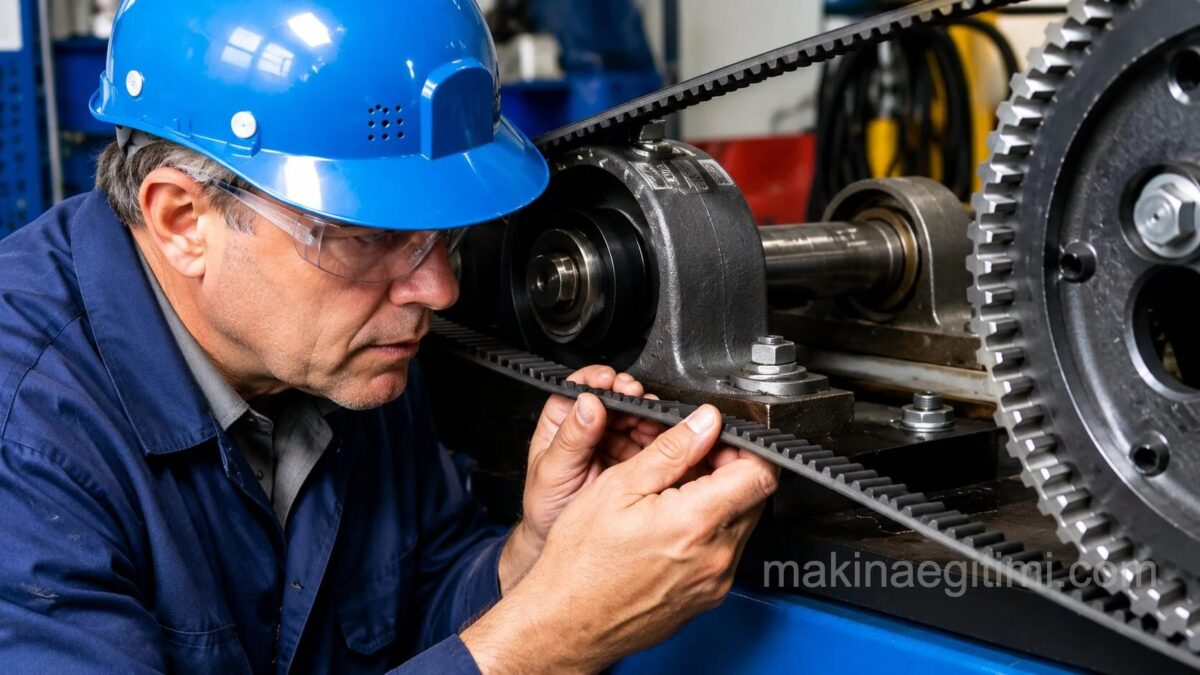
We’re back with a topic for machine maintenance workers. In this article we’ll cover how belt-pulley maintenance is done.
Maintenance of Pulleys
For all pulleys, new and old, attention should be paid to the fact that the groove surfaces are:
– Not worn
– Free of burrs and tool marks, to grinding-level precision
– All pulley grooves cut equally.
– The pulleys should be checked to make sure they’re on the same axis.
On this topic, it should be known that running pulleys wear and expand over time, burrs and tool marks on the pulley will tear the belt, and on unequally cut pulleys, the entire load will be carried by the shortest belt, causing it to break prematurely.
Tension Check
Keeping belts at the correct tension both increases efficiency and prevents premature wear.
Pulley Alignment
Misaligned pulleys can cause the belt to wear excessively on one edge and fail prematurely.
Crack Inspection
Cracks forming on the belt surface signal an increased risk of breakage and should be replaced in time.
Maintenance of Belts
One of the most important topics in belt inspection is belt tension. Full efficiency cannot be obtained from an overly tight or overly loose belt, and its service life is shortened.
If the belt is under-tensioned:
– Instead of rotating together with the pulley, the belts will slip, which both shortens their life and causes excessive heating, and they will fail to transmit the required load.
– The belts will crack and break under the sudden loading at startup.
– The belts will fly off the pulleys.
If overtightened, however:
– It causes unnecessary load on the drive shafts.
– It causes the belts to be overstretched, shortening their service life.
Correct belt tension:
There are two methods used in practice to find the correct tension.
1-Traditional method: When pressed with a fingertip on the belt mounted on the pulley, the belt should move 1 to 2 cm in either direction.
2-With Tension-Measuring Devices: Tension can be determined by measurements taken using the distance between the pulleys as the main reference.
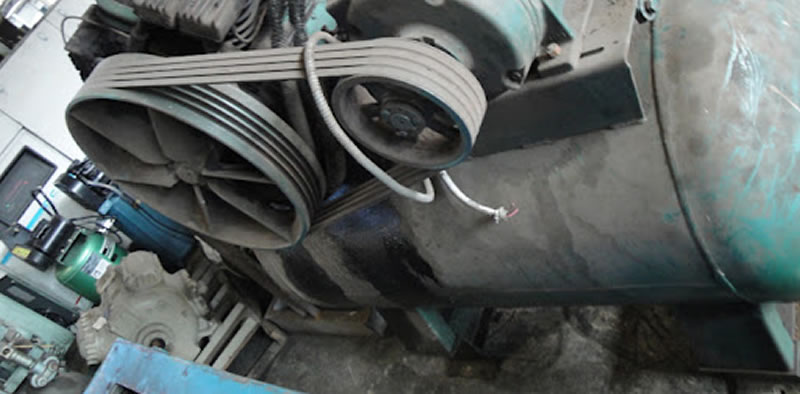
Preventive Maintenance:
a) Check the tension periodically as described earlier.
b) Do not use belts from different brands, or old and new belts, together.
c) Check whether the pulley grooves are worn, and check for run-out or imbalance. Replace any pulleys that are deformed, worn, or broken.
d) Ensure the belts don’t come into contact with foreign matter such as dust, oil, or debris. Remember that dust and debris have a sanding effect, while oil causes the belt’s chemical structure to break down.
e) Prevent the belts from coming into contact with machine paint after assembly.
Related Questions
A burr or tool mark on the groove surface continuously rubs against and wears the belt’s surface as it rotates. This seemingly small imperfection can cause damage severe enough to tear the belt over time.
A loose belt may slip instead of rotating fully with the pulley, leading to power loss and wear. An overly tight belt, on the other hand, puts extra load on the pulley bearings and the belt itself, causing it to fatigue prematurely.
Related Posts
 Pulleys and Parts of Pulleys
  What Is a Pulley? Where Are Pulleys Used?
  Compression Spring. Compression Spring Calculation and Drawing
  Formulas for Gear Drawing and Manufacturing
  Where the Worm and Worm Wheel Are Used
  Five Ways to Cool Roller Bearings
  Helical Gear Geometry and Strength Calculation
  Metric-Whitworth Thread Tables