

Definition of component forces: each of the forces that contribute to producing a resultant force is called a COMPONENT FORCE. In this article, we’ll cover the topic of finding component forces with example problems.
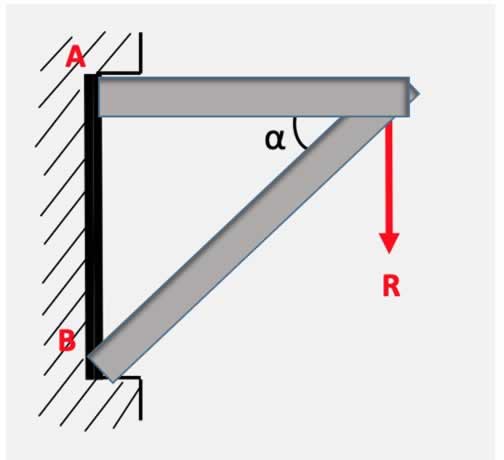
For example, the resultant force acting on the beam above is known. However, when we want to find the forces acting on points A and B of the beam, we’ll need to resolve force R into its components.

Methods Used to Find Component Forces
Lami’s Theorem (Sine Theorem)
To apply this theorem, the number of forces must be 3, and they must intersect at a single point. Additionally, the vector sum of the forces must equal zero.

In other words, when the forces are added tip-to-tail, the triangle must close.
When a force forms an arbitrary triangle with the forces it will be resolved into, and the angles opposite the forces are known, the calculation is performed according to Lami’s theorem.
According to Lami’s theorem, in the triangle of the resultant and component forces, the ratio of the sines of the angles opposite the forces is constant.


Projection Method (Graphical Method)
In the projection method, the sums of the components along each coordinate axis are taken and converted into a single force.
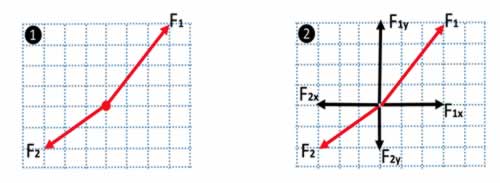
As a result, a force is produced on each of the x and y axes. By finding the resultant of these again, the force acting on the system and the angle it makes with the axis are found.
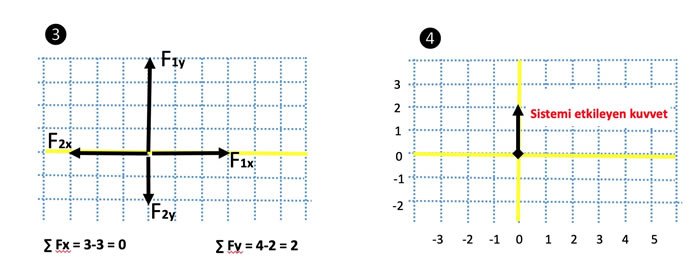
Example Problem:
Find the x and y projections of the force F shown in the figure, using both the graphical and analytical methods.

Solution (Graphical Method)
By connecting point O with the points where perpendicular rays sent from the tip of force F meet the coordinate axes, we find the projections Fx and Fy. These are the component forces.

Solution (ANALYTICAL METHOD)
Since there are only two forces, Lami’s (sine) theorem cannot be applied. The solution is reached using trigonometric functions.


Example problem 2
How much force is the object on the inclined plane shown in the figure pulled with, as a result of the weight force?

Solution:

Example Problem 3
The system shown is in equilibrium. If α = 30° and the pulley is loaded with 50 N, what is the equilibrium force in the pulley’s rod?

Solution
In the pulley system, load = lifting force F = FG = 50 N
Here, forces FG and F are balanced by force Fp in the pulley’s rod. The solution can be found according to Lami’s theorem:

Related Posts
 What Is Moment? How Is It Calculated? Moment Lesson
  What Is the SI System of Units? Base and Derived Units
  Base and Derived Quantities
  Finding the Resultant Force in a System of Forces
  Simple Machines
  How to Calculate the Resultant Force
  What Is a Body and a System?
  What Is Pascal’s Principle? Where It Is Used