

Developed in the 1930s, this process is widely used in the metal manufacturing industry. Almost all metals and alloys can be welded with this method. Because of the nature of the process, generators are easy to use. Since it offers roughly twice the welding efficiency of standard metal arc welding, it is an economical and more efficient method.
Known as Gas Metal Arc Welding (MIG/MAG), in this method the arc forms between a consumable wire electrode and the workpiece. The arc occurs under a shielding gas atmosphere such as argon, helium, CO2, or various gas mixtures. The consumable electrode is fed automatically into the weld zone through a nozzle. Because this automatically fed electrode also melts, it simultaneously acts as the filler material.
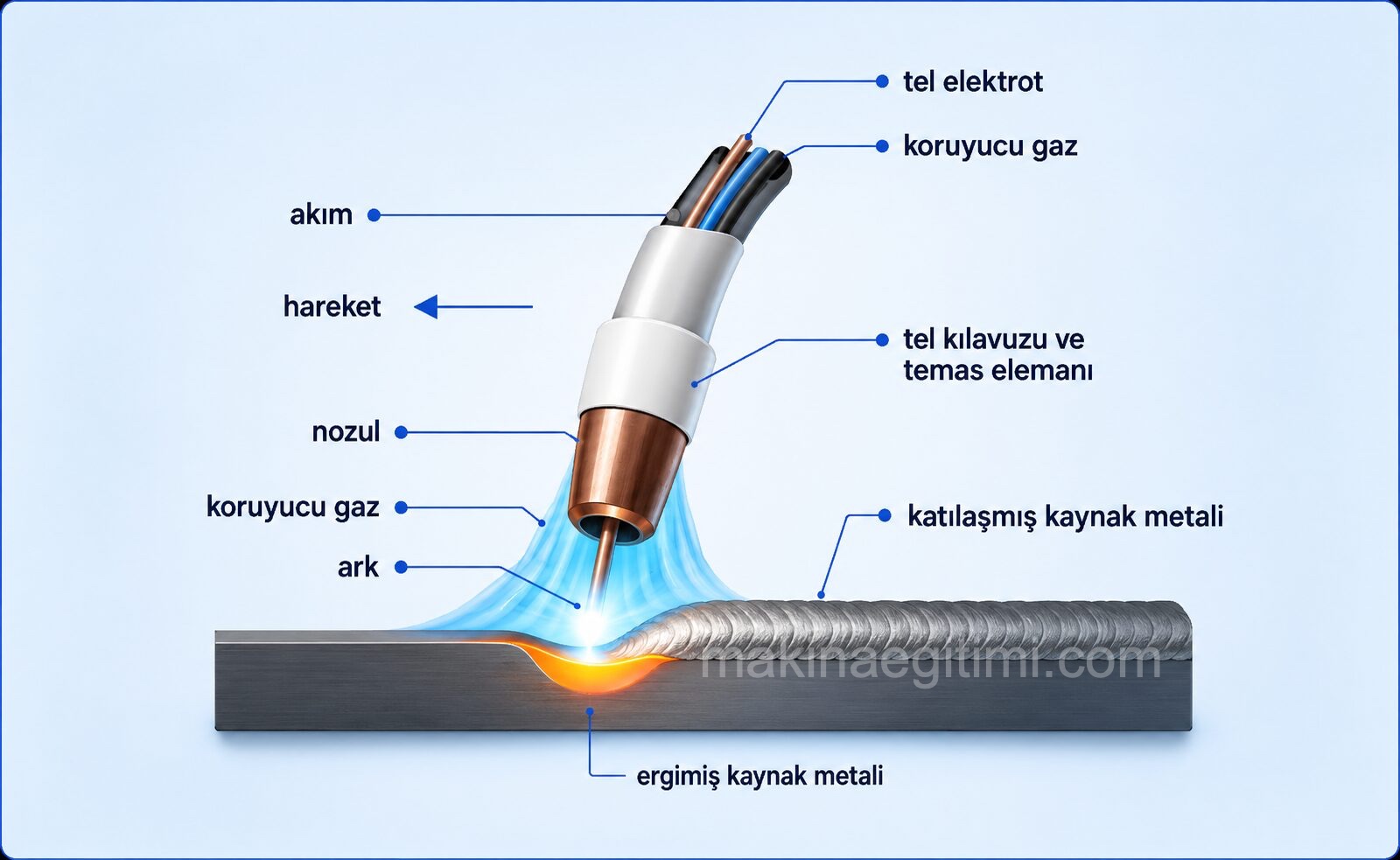
The figure above shows the principle of gas metal arc welding. In addition to the use of inert gases, deoxidizers are usually present and help prevent oxidation.
Because there is no need for frequent electrode changes as in standard arc welding, this process is fast and economical. In addition, no slag forms on the weld bead, making it possible to deposit a larger amount of metal in the weld zone.
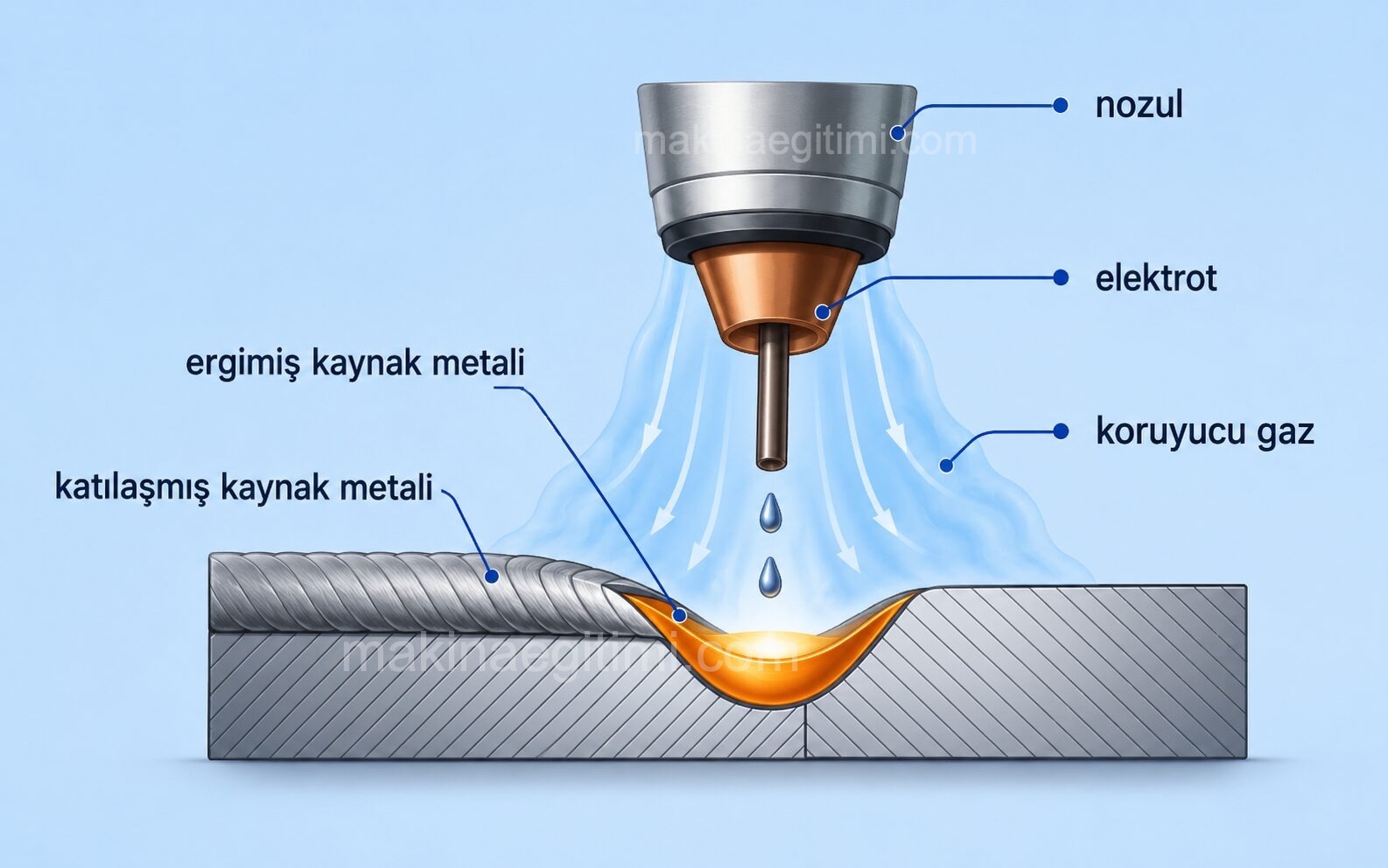
Since it offers roughly twice the welding efficiency of standard metal arc welding, it is an economical and more efficient method. Low current, low voltage, and small-diameter electrodes are used with the short-circuit technique. In this case metal transfers from the electrode to the workpiece in droplets, and a short circuit occurs each time the electrode tip touches the molten pool.
With high current and larger-diameter electrodes, the metal transfer mode changes and the amount of transferred metal increases rapidly. This way, thick-section and simple parts can be joined. However, since temperatures in gas metal arc welding are relatively low, the process is better suited to plates and sheets thinner than 6 mm.
It can easily be used in manufacturing in place of standard metal arc welding. This process can also be adapted to flexible manufacturing methods with robots. Numerous advanced robots have been developed to carry out this process. However, the computer electronics of these robots must be protected from the high-frequency effects emitted by the welding process.
What Is TIG Welding
TIG stands for Tungsten Inert Gas, a type of gas-shielded welding named after its initials. The TIG welding process uses the high heat of an arc formed by a non-consumable tungsten electrode. When wolfram is used in place of the tungsten electrode, the process is called WIG.
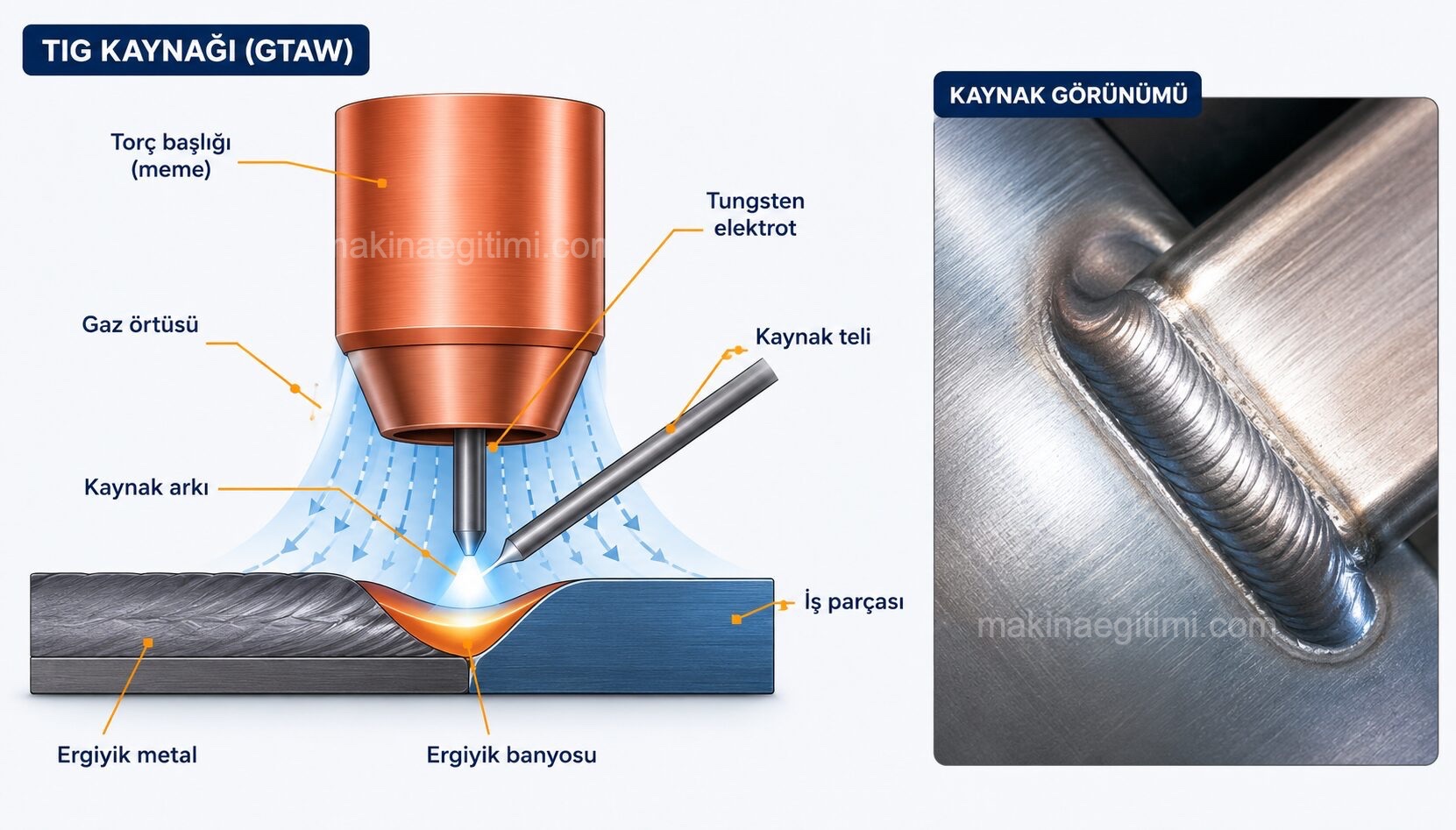
Arc formation in TIG welding (left) and the appearance of a TIG weld (right)
How TIG Welding Is Performed
TIG welding is performed either semi-automatically or fully automatically. In semi-automatic welding, welding current and shielding gas are supplied automatically to the weld zone. This happens when the welder pulls the trigger on the torch or presses a button. At the same time, filler wire is fed to form the weld bead. In fully automatic welding, the arc’s movement, arc length, shielding gas flow, and feeding of the filler wire into the weld zone are all handled by a mechanical system.

How TIG welding is performed

The appearance of TIG welding, an example of a part joined with TIG welding
Components of TIG Welding
TIG welding equipment consists of a welding machine, a shielding gas cylinder, a torch (electrode holder), a non-consumable tungsten electrode, and filler wire.
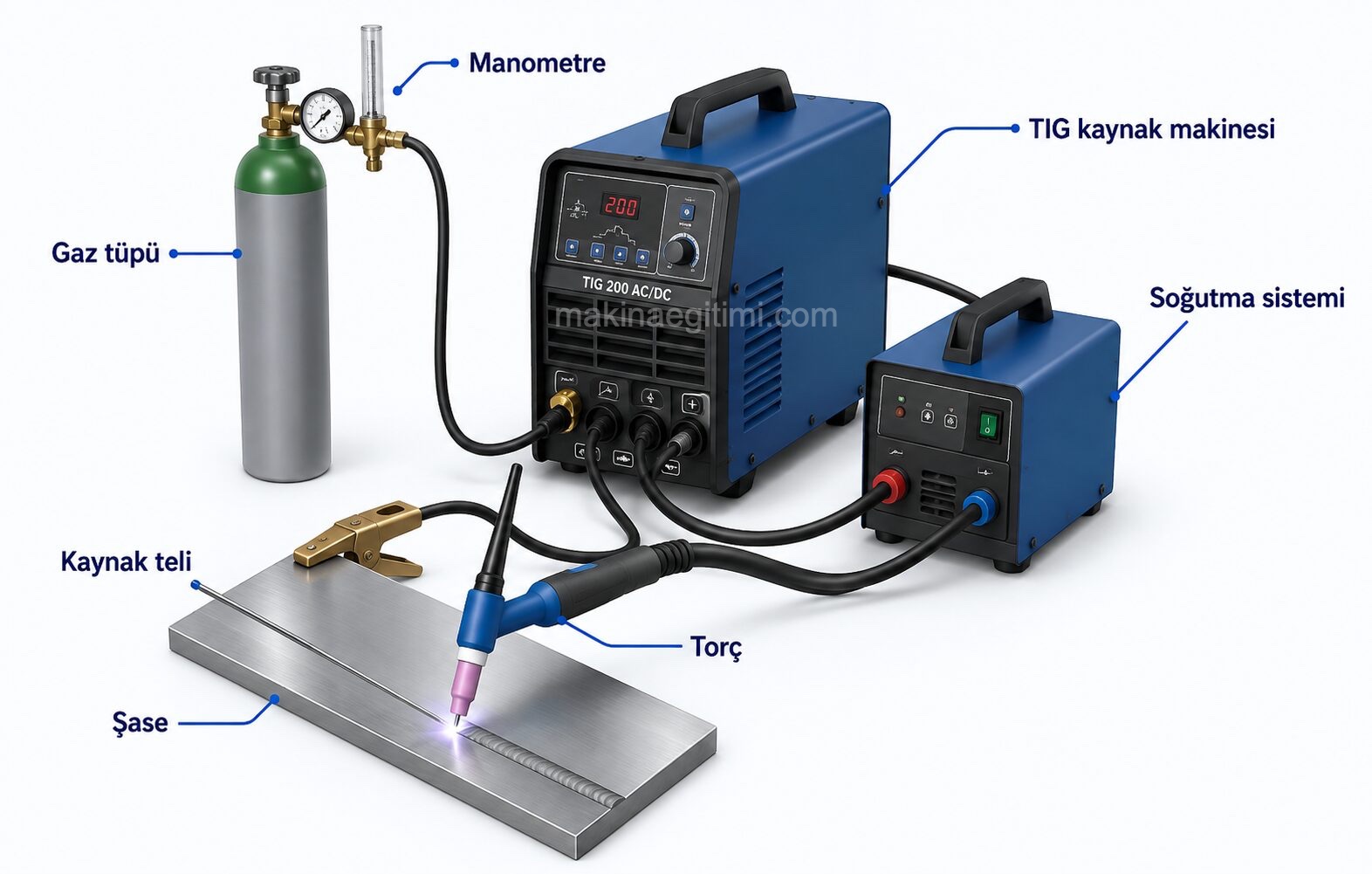
TIG Welding Machines
The machines used in TIG welding come in two types, direct current and alternating current, chosen based on the properties of the parts to be joined. Direct current machines give good results when welding certain metals (stainless steel, brass, silver, high-carbon steel, copper, and cast metal), while alternating current machines give good results for other metals (magnesium, aluminum, stainless steel up to 1.25 mm, silver plating, and welding hard surfaces).
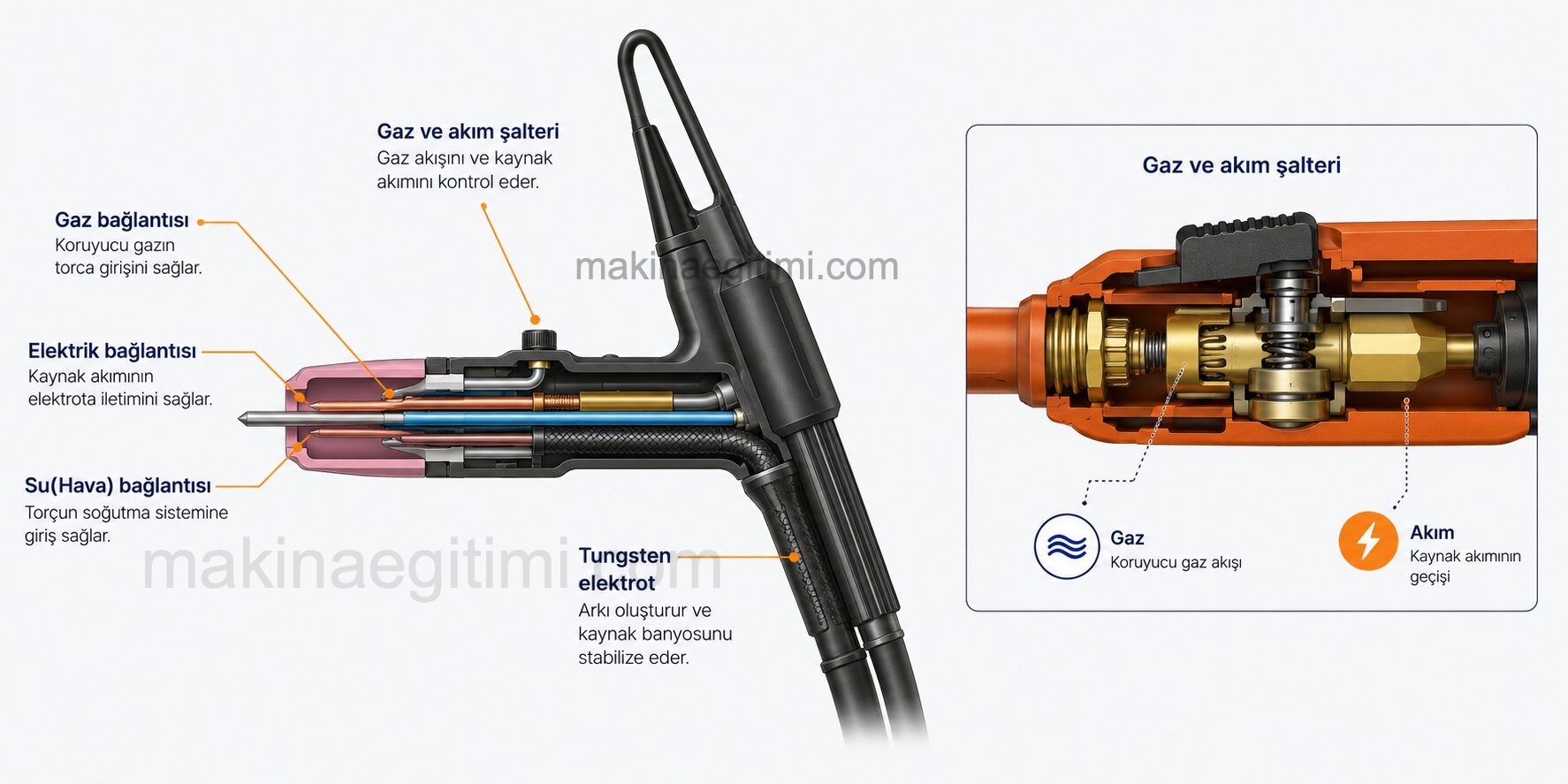
On manually operated torches, welding current and gas are supplied to the weld area by means of a button. On some welding equipment, this is instead done with the help of a foot pedal. Using a foot pedal allows better control of the welding current as the weld approaches its end.
Related Posts
 Welding Electrode Types
 What Is Submerged Arc Welding, How Is It Done
 Electrodes Used for Welding Stainless Steels
 Advantages and Disadvantages of Laser Welding
 What Is Soldering? Soft Soldering and Brazing Methods
 Occupational Health and Safety in Welding Work
 Roles and Benefits of the Electrode Coating
 How Is Underwater Welding Done? Underwater Welding