
Close Menu
  • MAKİNELER ve İMALAT
    • Tools & Equipment
    • Computer-Aided Drawing
    • CAD/CAM Education
    • CNC Machine Programming
    • Casting Technologies
    • Electrical & Electronics Technologies
    • Hydraulics & Pneumatics
    • Manufacturing Processes
    • Manufacturing Technologies
    • Occupational Safety
    • Mold & Die Design
    • Solid Modeling
    • Welding Technology
    • Machine Elements
    • Mechanical Trade Drawing
    • Materials Science
    • Automotive & Vehicle Technologies
    • Robotics Technologies
    • Health Technologies
    • Defense & Aerospace Technologies
    • Descriptive Geometry
    • Technical Drawing
    • Software & Hardware Technologies
    • Innovative Manufacturing Methods
  • TEKNOLOJİ ve YAŞAM
    • OTOMOBİLLER ve TAŞIT
      • Vehicle & Engine Knowledge
      • Safe Driving
      • Sürüş Destek Sistemleri
    • Genel Kültür
      • Movies & TV Shows
      • Görsel ve Grafik Sanat
      • Books & Literature
      • Music
      • Sports
      • History
      • History of Technology
    • GÜNDELİK YAŞAM TEKNOLOJİLERİ
    • Hobbies & Entertainment
    • Internet Technologies
    • Health
    • Mobile Technologies
Makine Eğitimi
  • Machines & Manufacturing
    Machine Elements
    Hydraulics & Pneumatics
    Technical Drawing
    Computer-Aided Design & Manufacturing
    Basic Manufacturing Processes
    Manufacturing Processes
    Industry Technologies
    Other Technical Courses
    Motion & Power Transmission
    Simple Machines
    Chains & Sprockets
    Shafts & Journals
    Gears
    Cams
    Couplings
    Belts & Pulleys
    Springs
    Bearings
    Keys
    Fastening Joining
    Retaining Rings
    Screws, Bolts & Nuts
    Cotter Pins
    Flanges
    Welding
    Rivets
    Pins & Bolts
    Washers
    Calculators
    Gear Ratio Calculator
    Spring Constant Calculator
    Belt Pulley Ratio Calculator
    Other Machine Elements
    Slides & Linear Guides
    Brakes
    Flywheels
    Clamps
    Shock Absorbers
    Gaskets & O-Rings
    Seals & Sealing Elements
    Hydraulics
    Introduction to Hydraulics & Principles
    Hydraulic Systems & Applications
    Accumulators
    Filters
    Motors
    Pumps
    Valves
    Pneumatics
    Introduction to Pneumatics & Principles
    Pneumatic Systems & Applications
    Pneumatic Circuit Components
    Valves
    Cylinders
    Silencers
    Motors
    Compressors
    Dryers
    Conditioning Units
    Common Topics & Maintenance
    Hydraulic & Pneumatic Maintenance
    Study Notes, Exams & Tests
    Technical Drawing
    Introduction to Technical Drawing
    Geometric Drawings
    Perspective & Projection
    Orthographic Views
    Dimensioning
    Sectioning
    Assembly & Detail Drawings
    Tolerances
    Surface Finish Symbols
    Mechanical Engineering Drawing
    Screws, Bolts & Nuts
    Pulley Drawings
    Gear Drawings
    Shafts & Journals
    Bearing Drawings
    Pins & Bolts
    Spring Drawings
    Welds in Technical Drawing
    Washers
    Cotter Pins
    Technical Drawing Exercises
    Mechanical Drawing Exercises
    Gear Exercises
    View Extraction Exercises
    Pulley Exercises
    Pin & Bolt Exercises
    Threaded Fastening Exercises
    Descriptive Geometry
    Computer-Aided Drawing
    AutoCAD Drawing Lessons
    Solid Modeling & Animation
    Solid Model Drawing Files
    Solid Model Assembly Examples
    Solid Model Drawing Lessons
    3D CAD Software Reviews
    Solid Modeling Exercises
    CNC Programming
    CAM
    Measurement & Inspection
    Dial Indicators
    Calipers
    Gauges
    Micrometers
    Materials Science
    Steels
    Cast Iron
    Aluminum
    Plastics
    Material Testing & Hardness Measurement
    Occupational Safety
    Workshop Safety
    Safety When Working With Electricity
    Machine Safety Rules
    Hand Operations
    Filing
    Marking
    Cutting Operations
    Reaming
    Tapping
    Threading With a Die
    Drill Bit Sharpening
    Working With Machines
    Basic Turning Operations
    Basic Milling Operations
    Shaper Machine
    Machining
    Turning
    Milling
    Grinding
    Innovative Manufacturing Methods
    EDM (Electrical Discharge Machining)
    Laser Machining
    Waterjet Machining
    3D Printing
    3D Scanners
    Welding
    Rolling
    Casting
    Mold & Die Design
    Mechanical & Hydraulic Presses
    Blanking & Piercing Dies
    Bending Dies
    Drawing Dies
    Plastic Injection Molds
    Extrusion Dies
    Compound Dies
    Progressive Dies
    Blow Molds
    Spinning Dies
    Spray Molds
    Manufacturing of Machine Parts
    Automotive & Vehicle Technologies
    Motor Vehicle Manufacturing
    Raw Material Production
    History of Technology
    Health & Medical Technologies
    Defense & Aerospace
    Robotics Technologies
    Software & Hardware Technologies
    Mechanics - Strength of Materials
    Physics Topics
  • Technology & Life
    Hobbies & Entertainment
    Sports
    Music
    Vehicle & Engine Knowledge
    Vehicle Maintenance & Repair
    Safe Driving
    Driver Assistance Systems
    History
    Movies & TV Shows
    Books & Literature
    Computers & Internet
    Computer Tips
    Software Reviews
    Hardware & Peripherals
    Practical & Safe Internet Use
    Visual & Graphic Art
    Mobile Technologies
    Travel
    Science
    Health
    First Aid Knowledge
    Everyday Technologies
Makine Eğitimi
Home»Occupational Safety»What Is Personal Protective Equipment (PPE)? What Are Its Types?
30 August 2026

What Is Personal Protective Equipment (PPE)? What Are Its Types?

Set of personal protective equipment including helmet, gloves, and safety shoes

One of the most fundamental elements of workplace safety is selecting and using the right equipment to protect workers from hazards on the job. The general name for this equipment is Personal Protective Equipment (PPE). In this article, we cover what PPE is, what types of it exist, and why proper use is so important.

  • What Is Personal Protective Equipment (PPE)?
  • Why Is Personal Protective Equipment Mandatory?
  • Types of Personal Protective Equipment
    • Head Protection
    • Eye and Face Protection
    • Hearing Protection
    • Respiratory Protection
    • Hand and Arm Protection
    • Foot Protection
    • Body Protection
    • Fall Protection Equipment
  • How to Choose the Right PPE?

What Is Personal Protective Equipment (PPE)?

Personal Protective Equipment (PPE) is the general name for any tool, device, or gear worn, attached, or carried by a worker to protect against one or more health and safety hazards. PPE does not eliminate a hazard; it only reduces or prevents the hazard’s effect on the worker. For this reason, in workplace safety, PPE is considered the last step in the hierarchy of controls: first the source of the hazard is eliminated, then engineering and administrative controls are attempted, and PPE is used as a final shield against whatever risk remains.

Why Is Personal Protective Equipment Mandatory?

Under Turkey’s Occupational Health and Safety Law No. 6331 and the associated “Regulation on the Use of Personal Protective Equipment in Workplaces,” an employer is required to provide appropriate PPE to workers when workplace risks cannot be fully eliminated through engineering or administrative controls, and to supervise the workers’ use of this equipment. PPE must bear the CE mark, be appropriate for the work being performed, and be inspected regularly.

Types of Personal Protective Equipment

Head Protection

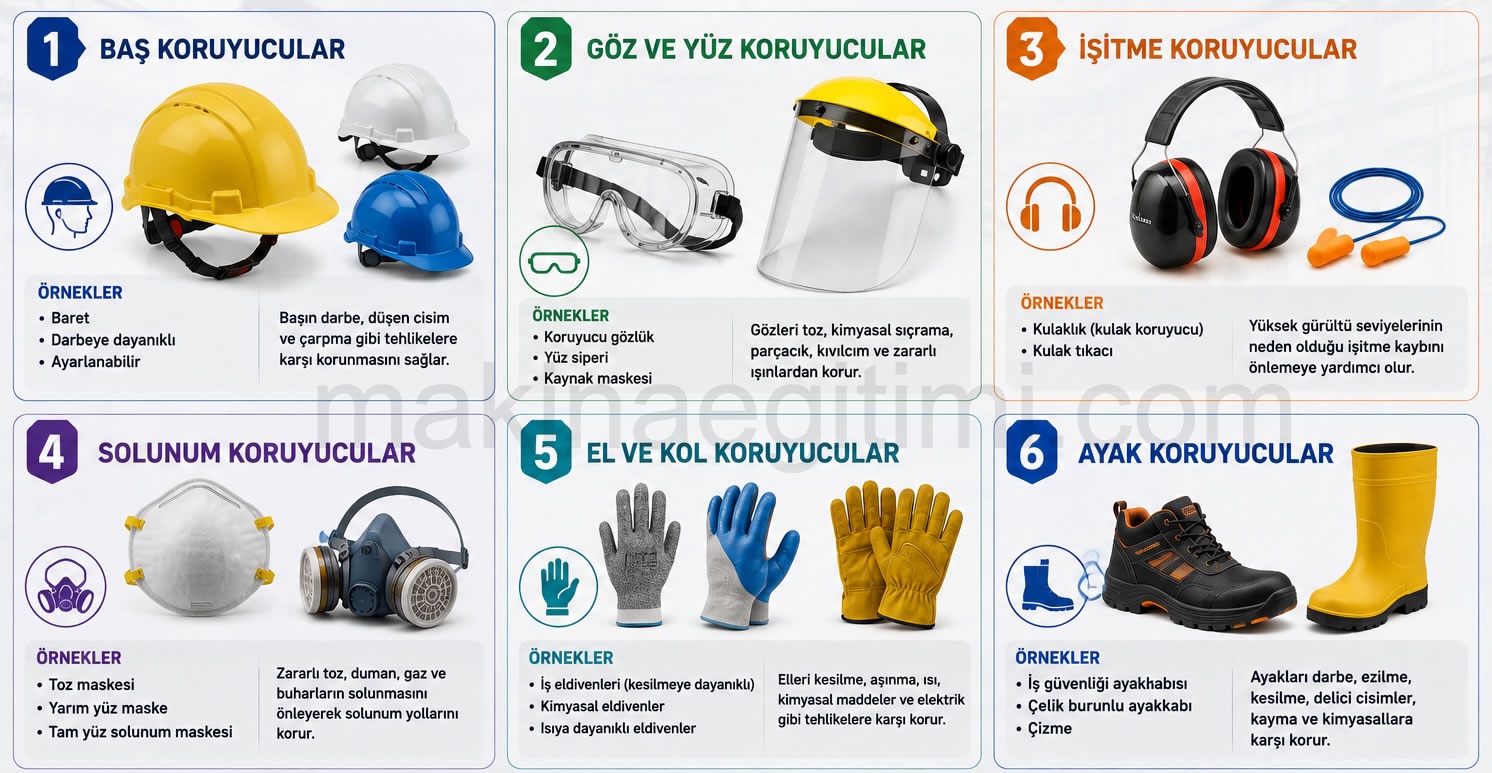
Hard hats (safety helmets) protect the head against falling objects, impacts, and electric shock. They are mandatory in construction, mining, and heavy industry facilities.

Eye and Face Protection

Safety glasses and face shields protect the eyes and face against hazards such as flying chips, welding light, chemical splashes, and dust. Welding masks, used in welding work, also have special filters against harmful UV and infrared radiation.

Hearing Protection

Ear plugs and earmuffs are used to prevent hearing loss in high-noise environments (above 85 dB). They are mandatory in workshops with noisy equipment such as CNC machines, presses, and compressors.
personal protective equipment

Respiratory Protection

Dust masks, gas masks, and respirators protect the lungs against welding fumes, paint solvents, metal dust, and harmful gases. The filter class of the mask used (FFP1, FFP2, FFP3) should be selected according to the type of hazard present in the environment.

Hand and Arm Protection

Work gloves protect hands against cuts, punctures, burns, chemical contact, and electric shock. Depending on the task, cut-resistant, heat-resistant, or electrically insulated gloves should be chosen. Choosing the wrong gloves (for example, wearing loose gloves near a rotating machine) can increase the risk of an accident rather than prevent it.

Foot Protection

Steel-toe work shoes protect the feet against falling objects, sharp punctures, and slippery floors. Insulated-sole models are used for electrical work, while acid/chemical-resistant models are used in chemical environments.
personal protective equipment body protectors

Body Protection

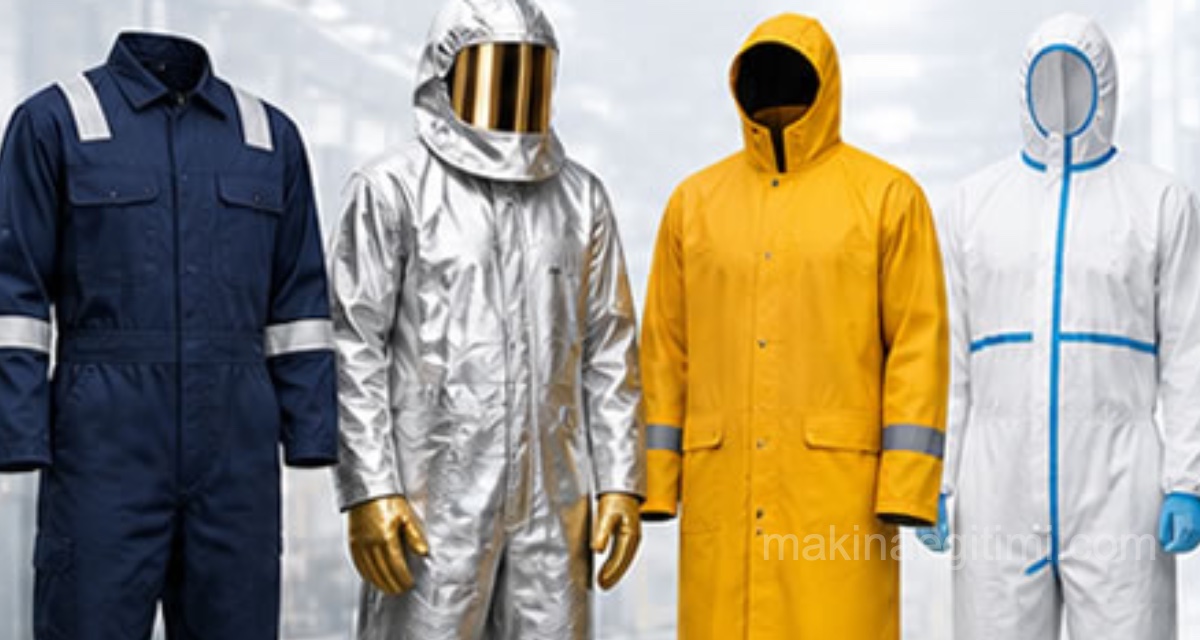
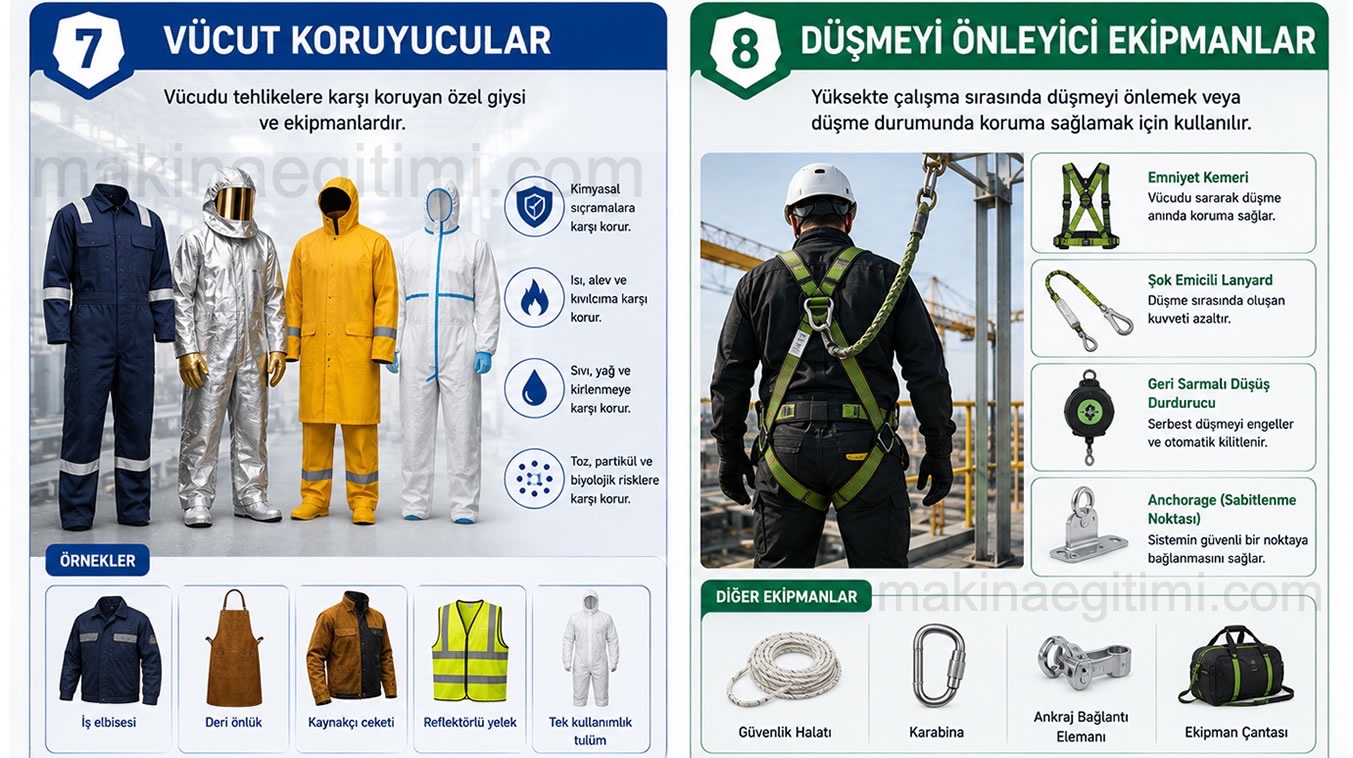
Reflective vests increase visibility, while aprons, coveralls, and welder’s jackets protect the body against sparks, hot metal particles, and chemical splashes.

Fall Protection Equipment

Safety harnesses, ropes, and carabiners are used against the risk of falling in work performed at height (roofs, scaffolding, poles).

How to Choose the Right PPE?

  • First, a risk assessment should be carried out in the workplace to identify which hazards are present.
  • The chosen PPE must be certified (CE marked) against the relevant hazard.
  • PPE must be the right size/type for the user’s body and the task being performed; equipment that is too large or too small provides no protection.
  • It should be inspected regularly, and any PPE that is damaged or has reached the end of its service life should be replaced immediately.
  • Workers should be trained on the proper use of PPE; improperly used PPE can provide less protection than not using it at all.

Personal protective equipment is the last and most visible line of defense in preventing workplace accidents and occupational diseases. However, it must be remembered that PPE alone is not enough; the real goal is to eliminate or reduce the hazard at its source. PPE should be considered part of a holistic workplace safety culture, together with the other measures taken.

Related Posts

occupational safety for people working with electricity Occupational Safety When Working With Electricity 5S Management in Workshops and Factories 5S Management in Workshops and Factories Elektrik İç Tesislerinde Güvenlik Safety in Electrical Interior Installations hydraulic pneumatic machine safety rules Safety Rules for Workers on Hydraulic and Pneumatic Machines Safety Rules for Working on a Lathe Safety Rules for Working on a Lathe Workplace Safety in Welding Work Occupational Health and Safety in Welding Work Safe Forklift Use Safe Forklift Use. Forklift Safety Rules Workplace Safety with Hand Tools Workplace Safety and Misuse of Hand Tools


Occupational Safety Specialist Training
Share. Facebook Twitter WhatsApp Tumblr Email Telegram Copy Link

Leave A Reply Cancel Reply

Music Terms: Tempo, Harmony, Chord, Syncopation and More
The Jaw-Dropping Dribbles That Send Football Crowds Wild
  • Contact
  • Terms of Service
  • Privacy & Cookie Policy

Type above and press Enter to search. Press Esc to cancel.