

Laser cutting and waterjet cutting both have their advantages and disadvantages. Before asking “which is better?”, let’s go over the characteristics of both methods:
Characteristics of Laser Cutting
It uses laser radiation heating to cut the workpiece. This technology is unmatched in terms of speed and accuracy. Cutting precision is high, and it produces very little waste while being able to process workpieces with complex shapes.
It’s suitable for cutting thinner materials, such as plastic, ceramic, or metal, less than 25 mm thick. Cutting can be done quickly in any direction.

There are currently two types of laser cutting machines: one is CO2 cutting (carbon dioxide cutting), and the other is fiber laser cutting.
Differences Between CO2 Cutting and Fiber Laser Cutting
Cutting Power: Fiber laser cutting machines adopt a diode Aurora system that can effectively transmit very high power without any attenuation. In CO2 laser cutting machines, it’s difficult to increase power, and the mirror it uses can burn out when power is high. For this reason, a fiber laser cutting machine’s available power is much higher than that of a CO2 laser cutting machine.
Cutting Thickness: Currently, in many cases, the thickness a fiber laser can cut is nearly the same as CO2, but it’s more efficient than CO2, with 70% less power consumption and less wear.
Simplicity: Many fiber laser manufacturers call fiber laser cutting machine setup “plug and play”. For users who need this technology, fiber laser offers high efficiency and quick cost recovery.
Laser cutting has become a low-cost form of production due to its fast cutting speed, short cycle time, and high accuracy.
Laser Cutting Speed
On thin metal sheets, laser cutting can generally work 3-5 times faster than waterjet.
Heat-Affected Zone
Since laser cutting melts material to cut, it leaves a thin heat-affected zone (HAZ); waterjet is entirely exempt from this.
Cutting Thick Material
Waterjet can cut materials up to 150 mm thick, while laser is generally more efficient on thinner materials.
Characteristics of Waterjet Cutting
Waterjet cutting is more economical than laser cutting.
Because it’s a cold cutting process and can be applied to many types of materials, it has a wider range of application than laser cutting. It’s a suitable, sustainable, and environmentally friendly cutting method for heat-sensitive materials.
It doesn’t cause thermal damage to the workpiece and can be used in industries with high requirements, such as aerospace, marine, automobile manufacturing, textiles and shoemaking, ceramics, machining, and other industries.

It can’t be used to cut absorbent materials like wood, or materials that could rust when exposed to moisture.
Another advantage of waterjet cutting is that, since it can cut from any direction, it can use 3D nesting software.
Pure water alone can be used when cutting softer materials. For harder materials, garnet sand is generally used, mixed with water suitable for cutting sheet metal.
The nozzle size varies depending on the workpiece’s thickness.
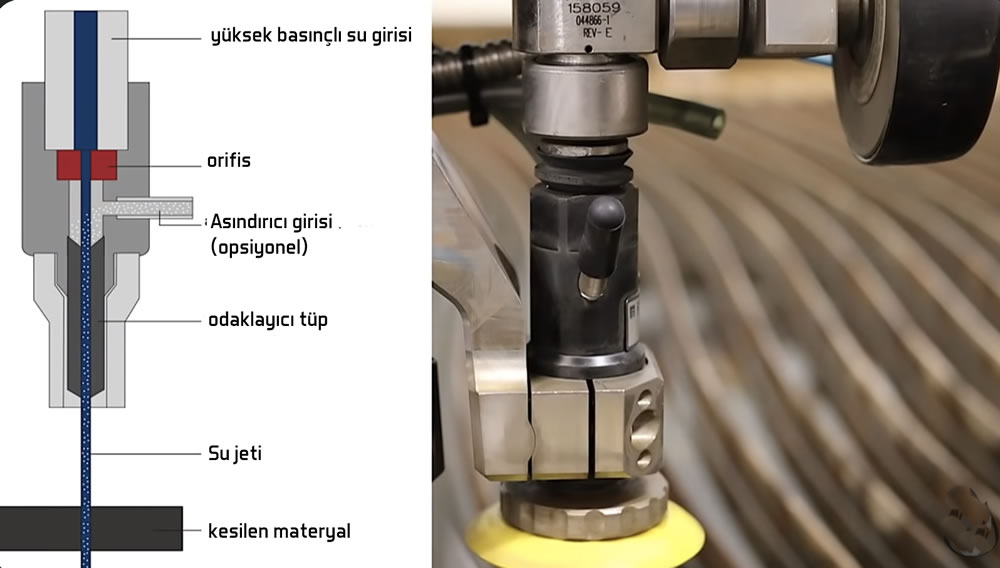
The smaller the nozzle, the thinner the material that can be cut, and vice versa. However, cutting very thick and hard materials takes more time, which increases cost.
Although waterjet cutting is more economical, its maintenance cost is high, since parts like high-pressure pumps and cutting heads wear out.
Conclusion: Which Is Better?
Laser cutting and waterjet cutting share one common advantage: compared to other methods (plasma and oxy-fuel cutting), their kerf widths are very small, so they can be used for workpieces too small to be cut by other machines.
To summarize, laser and waterjet cutting methods are completely different, but neither is better than the other — they complement each other. Businesses can use laser cutting or waterjet depending on their needs. When your factory has both of these cutting machines, your competitive advantage will undoubtedly increase significantly.
Because you can have more flexible options regarding the type of cutting materials, the thickness of the workpieces, or the factory’s subsequent order management system.
Related Questions
Since the laser cuts using heat, the thicker the material, the harder it has to work, and cutting quality can suffer. On thin materials under 25 mm, it has the advantage in both speed and precision.
Increasing power in a CO2 laser is difficult due to the risk of the system’s mirrors being damaged at high power. Fiber lasers, using a different light delivery system, can reach higher power without hitting this limitation.
Related Posts
 Electrical Discharge Machining (EDM) Machines
  The Best 3D Scanning Apps
  What Is 3D Printing – How Do 3D Printers Work?
  The Best 3D Scanners of 2022 – Buying Guide
  The Best Free CAD Software for 3D Print Design
  The Relationship Between Laser Cutting Quality and Material Composition
  3D-Print-Ready Cat & Mouse Automaton Toy
  Advantages and Disadvantages of Laser Welding