
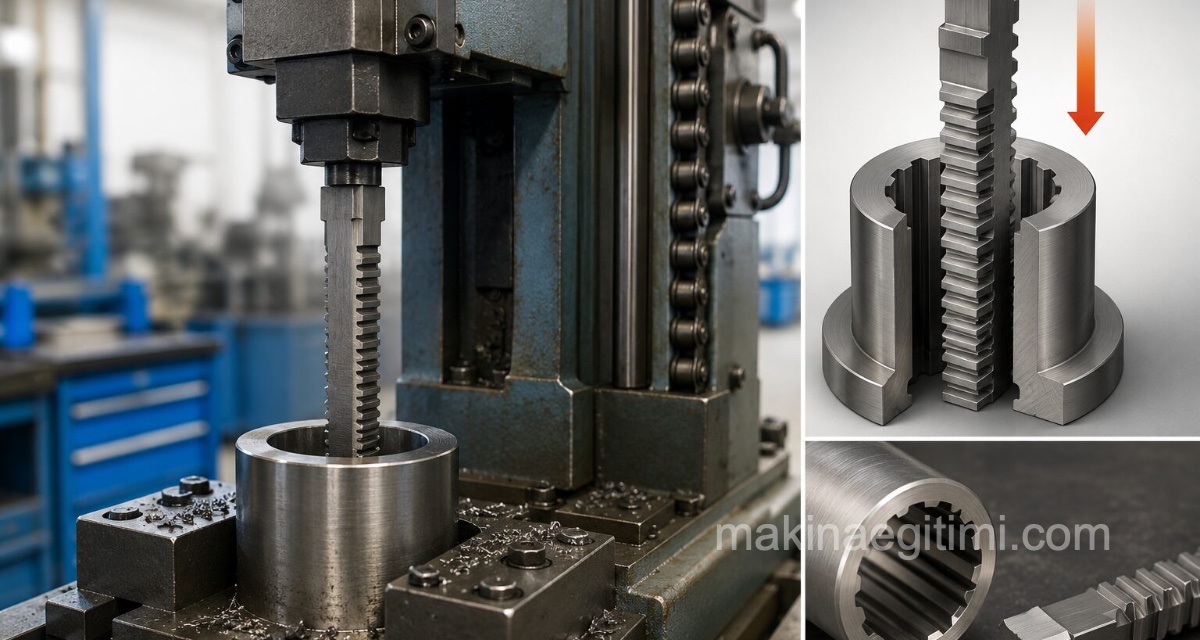
Broaching machines are simple in construction, since they only need to provide the linear cutting and return stroke of the broach tool. Drive and control are provided hydraulically. They operate semi-automatically or fully automatically. Cutting speeds are selected in a range between 10 m/min and 40 m/min.

On broaching machines, the motions of the cutting tool or the workpiece must be precise. The machine must be sturdy enough to withstand high forces.
Horizontal Broaching Machines
Broaching of long parts is done on horizontal machines. Pull broaches are generally used on horizontal broaching machines. They take up a lot of floor space. These are used for parts to be produced in small quantities.

Broach Tool Structure
A broach tool is a special cutting tool with a series of teeth arranged one after another, each larger than the one before it.
Finishing in a Single Pass
Broaching can machine complex internal or external profiles to their final dimensions, typically in a single pass.
High Production Efficiency
Broaching machines offer high precision and fast cycle times in mass production.
Vertical Broaching Machines
While horizontal broaching machines take up a lot of floor space, vertical broaching machines occupy less space. Push broaches, surface broaches, and form broaches are used on vertical broaching machines.

Chain-Type Broaching Machines are horizontal external broaching machines in which the workpieces, fastened to a chain belt, are pulled along the securely mounted broach tool to provide the cutting motion.
Related Questions
The broach tool has a series of teeth arranged one after another, each larger than the one before it. As the tool passes through the part once, these teeth engage in sequence and progressively cut the material, achieving the desired final dimension in a single pass.
Since these machines take up a lot of floor space and setup takes time, the cost remains high until many identical parts are produced, at which point it becomes more efficient. For small-quantity production of long parts, this disadvantage is acceptable.
Related Posts
 Lathe Tool Angles and Their Effect on Surface Quality
 What Do Cooling / Cutting Fluids Do? Their Functions
 How to Mount a Milling Cutter: Collet, Adapter and Arbor Methods
 Balancing a Grinding Wheel. Grinding Wheel Balancing
 Drilling Errors. Causes and Solutions
 Types of Drill Bits, Lesson
 Cutting with a Hacksaw
 What Is a Tool Holder. What Does It Do. How Is It Used?