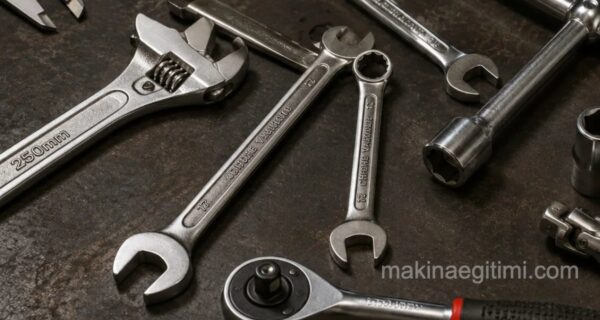
A tool holder is a term used in turning, in the manufacture of machine parts. It’s used to hold the lathe tool bit (cutting tool) and mount it to the machine. Various types of tool holders are made depending on their shape and purpose.
Types of Tool Holders
- Straight-shank tool holders: One of the most commonly used tool holder types. A straight-shank tool holder is used to mount high-speed steel bits for facing and longitudinal turning operations.
- Carbide-tip tool holders: Used to carry a carbide tip. Carbide cutting tips are attached to their carrying holders either by brazing or with screws.
- Boring tool holders: Used for mounting boring bars. Since they’ll be working inside a hole, they have a slim profile.
- Parting/grooving tool holder: Allows a parting-off bit to be mounted in a way that matches its flat cross-section.

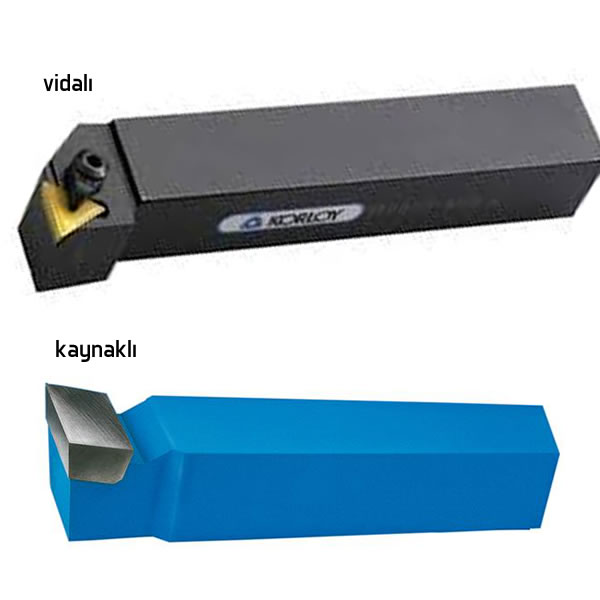


Hard Metal Tips
Tool holder bodies are generally manufactured from carbon steel or stainless steel and designed to be easy to sharpen.
Replaceable Tip Design
Many modern tool holders use a segmented insert design so a dulled tip can be easily snapped off and replaced.
Ergonomic Grip
Tool holder bodies are ergonomically designed to reduce hand fatigue during extended use.
What Material Are Tool Holders Made From?
Tool holders need to hold bits securely at the point they’re mounted. Because of frequent mounting and dismounting, tool holders need to be resistant to wear and crushing. Because of these requirements, tool holders are made from materials such as unalloyed tool steel (C60T, C10T, C80T, C105T…), forged steel, cast steel, and similar materials.
How Is a Tool Holder Used?
Mounting Bits into the Tool Holder
So that the bit doesn’t flex while cutting, it should be mounted into the tool holder as short as possible and without gaps.
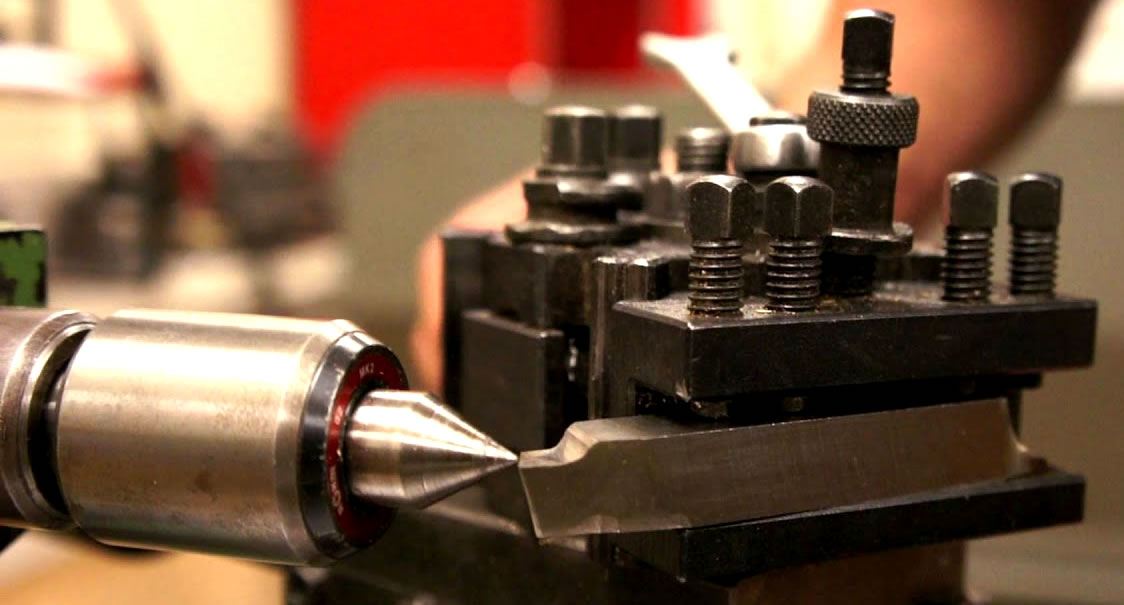
The cutting tip of the bit mounted in the tool holder must be at center height. For this purpose, shims are used to adjust so that the bit’s tip is at center height, that is, on the turning axis (the spindle axis). The tailstock’s tapered tip is used as a reference for this.
What Happens If the Lathe Tool Bit Isn’t Mounted at Spindle Axis Height?
When the bit is at center height, its angles are normal and it performs a proper turning operation relative to the spindle axis.
If the bit is above center height (above the spindle axis): the clearance angle decreases and friction increases.
If the bit is below the spindle axis: both the rake angle decreases and the tool digs into the workpiece.
Safely Mounting a Lathe Tool Bit
For occupational safety, it’s important to mount bits according to technological rules. For this reason:
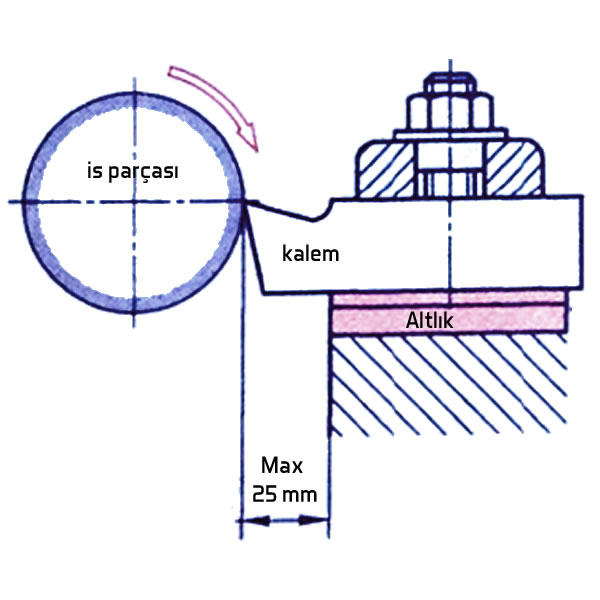
The bit should normally be able to be set up with one or two shims, and shouldn’t be mounted with its tip extending more than 25 mm.
If the bit is mounted with too long an overhang, it can flex and break.
Shims should be aligned with each other. One should not be set back further than the other.
The bit must be perpendicular to the workpiece axis. Otherwise, it will flex under the effect of the feed force and dig into the work.
Related Questions
Each type of bit (straight-shank, carbide-tipped, boring bar) has a different shape and mounting requirement. Holding these different geometries securely requires a specially designed tool holder suited to each bit type.
Instead of replacing an entire bit once its tip goes dull, snapping off just the small dulled tip and fitting a new one is both more economical and faster. This design lets the tool holder body be reused over and over.
Related Posts