

Dies that produce parts requiring more than one forming operation, worked in sequence at separate stations, are called progressive dies (progressive mold / progressive die stamping).
In progressive dies, each processing stage of the part being produced is completed at a separate station. In some cases, empty (idle) stations can be included within the die. This prevents the female die from being weakened and makes assembling the punches easier. However, this increases the length of the die set.
Progressive dies are generally used when mass production volume is very high and the cost of the part to be produced is low. Otherwise, designing and building a progressive die for stamping parts with low production quantities will increase the cost of the die as well as the cost of the stamped part.

The figure above shows the stamping positions on the strip material for a part produced in a simple pierce, blank, and part-off progressive die.
Design of Progressive Dies
The person designing a progressive die must demonstrate their knowledge and skill, and should also draw on previously built progressive die designs along with their own experience.
The following process steps should be kept in mind when designing progressive dies.
1- The sheet material thickness should not be too small.
2- Die set dimensions suited to the available press machine should be chosen.
3- The total forming force must not exceed the tonnage of the available press machine.
4- Pilot holes and notches used for guiding purposes should be placed at the first station, and other piercing, blanking, bending, drawing, and similar operations should be done at subsequent stations.
5 — The strip material used for drawing or forming operations should be prepared to the appropriate dimensions.
6 — If a part requires a large number of piercing operations, these operations should be distributed across several stations.
7 — In simple pierce-and-part-off progressive dies, to increase the female die area, piercing should be designed at the first station, an idle second station, and the part-off operation at the third station (Figure 10.11-b).
8 — An idle station should be included to ease the movement of the strip material and increase the strength of the female die, stripper, and punch plates.
9 — The rolling direction of the strip material should be indicated.
10- Whether the drawing or forming operation will be in the downward or upward direction should be designed in advance.
11- Depending on the shape of the part being produced, any other operations preceding the cutting operation must be clearly specified.
12 — The strip-material feed mechanism should be selected to suit the die design.
13 — To minimize material waste, the strip layout plan should be prepared in several different configurations.
14 — The cutting or forming area suited to the press force must be specified.
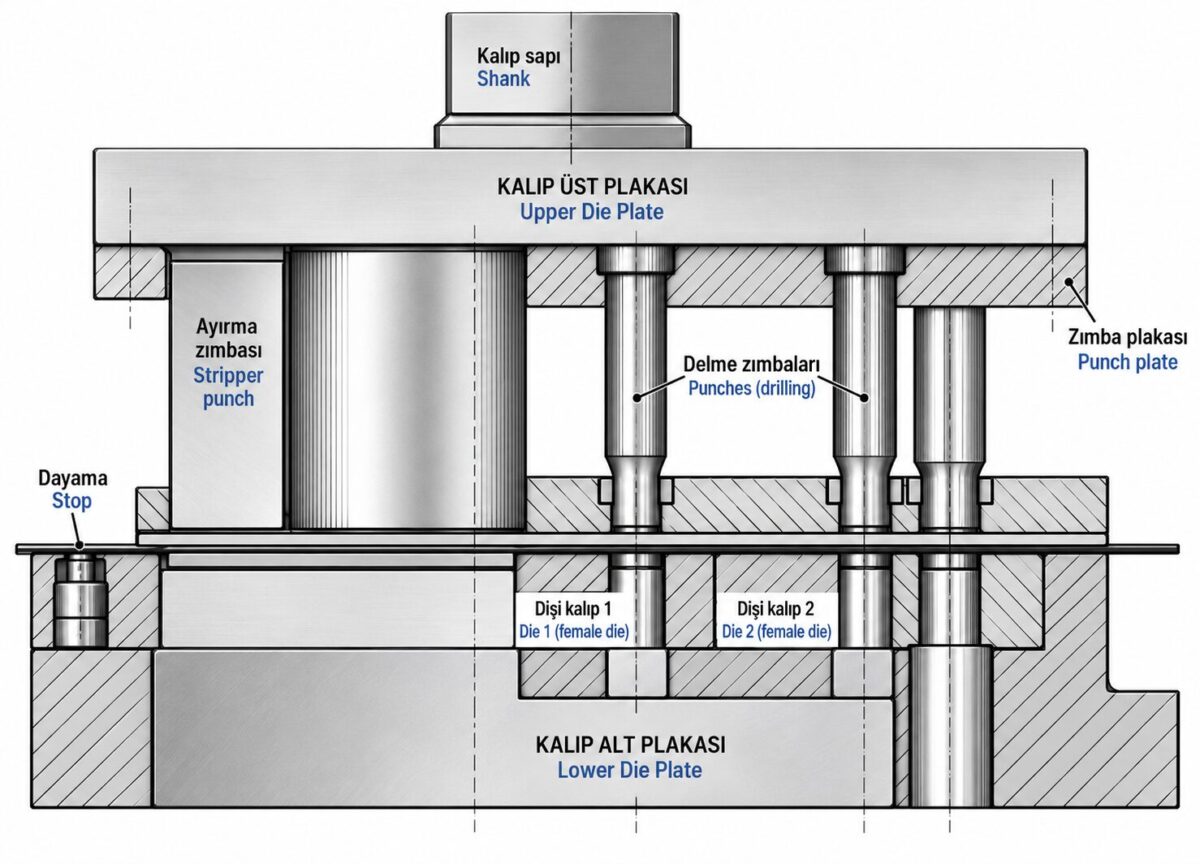
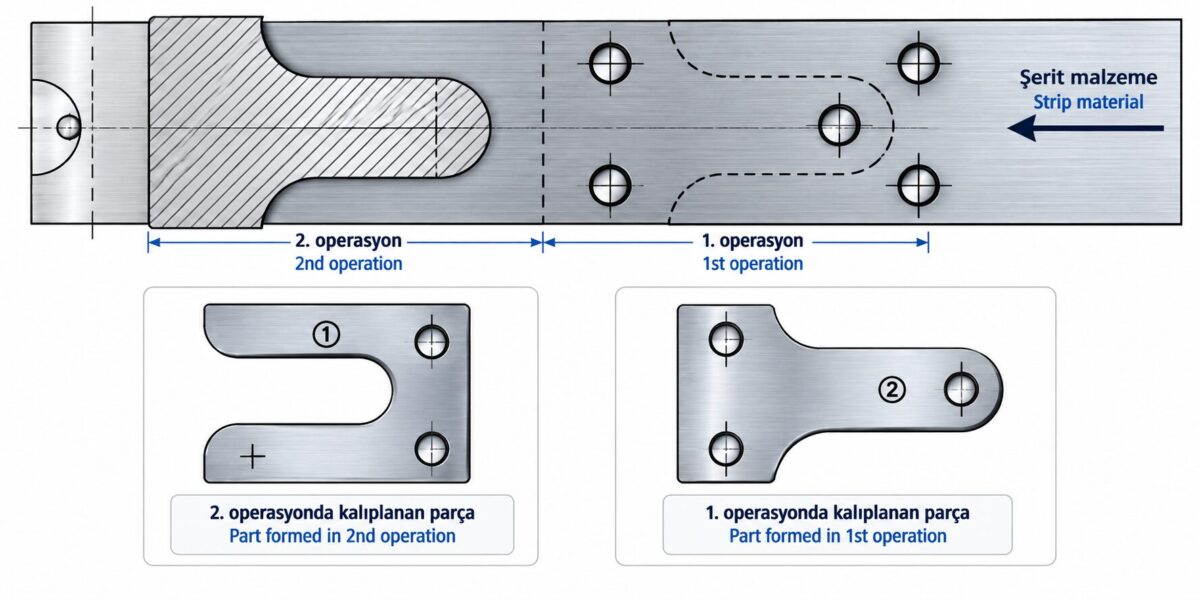
The strip material layout for the part to undergo progressive stamping operations is prepared in advance and applied directly to the female die. The figure above shows a cross-sectional view of the die illustrating the progressive stamping operation, with the strip material layout along with the produced parts shown below it.


The figure above also shows the layout plan for the strip material for a seven-step progressive stamping operation.
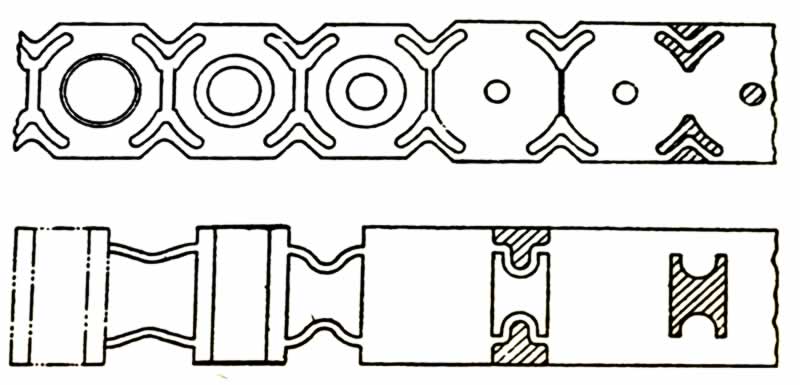
The figure above shows the strip material layout plans to be used in stamping two differently shaped parts.
Related Videos

Progressive stamping die

Deep drawing progressive die

Progressive stamping mold

Stamping tools

Progressive stamping die

Electrical box stamped in progressive tool
Staged Process Sequence
Progressive dies advance the sheet strip station by station, completing a different operation at each station.
High Production Speed
By processing different stages of multiple parts in a single press stroke, progressive dies achieve very high production speeds.
Strip Feed Precision
Precisely advancing the strip to the correct station in progressive dies is critical to part quality.
Related Questions
Consecutive operations can weaken the female die; adding an idle station between them prevents this weakening and makes mounting the punches to the die easier. The tradeoff is that the die set becomes longer.
The design and construction cost of these dies is high, and this cost only comes down per part as the number of parts produced increases. For low-volume production, this high upfront cost doesn’t pay off, so a progressive die isn’t preferred.
Related Posts
 Professional 3D Scanners and Their Applications
  How Is a Crankshaft Made
  Gear Manufacturing Methods
  What Is Wire EDM, How Does It Work?
  What Is Electrical Discharge Machining (EDM). Machining with EDM
  How Is a Splined Shaft Made? Splined Shaft Manufacturing
  How Are Washers Made
  Laser Cleaning: Removing Rust, Dirt, and Grease