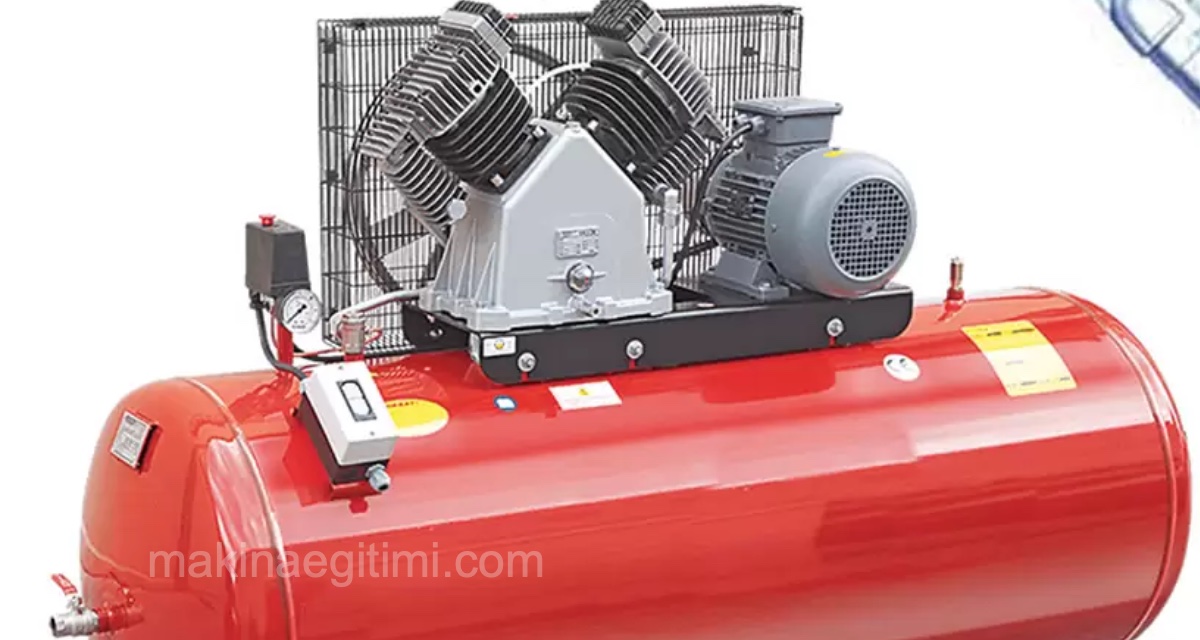
In our Hydraulics and Pneumatics lessons, we’ve devoted this article to reciprocating (piston) compressors. We’ll examine the working principle, main parts, and types of the compressor.
What Is a Reciprocating Compressor?
A reciprocating compressor is a positive displacement air compressor in which air is drawn into a chamber and compressed by a piston. A reciprocating air compressor is a positive displacement compressor because air is first drawn into a chamber and compressed as the chamber’s volume is reduced, with the volume being reduced by a piston.
Working Principle of a Reciprocating Compressor
In a reciprocating air compressor, the piston moves to BDC and air is drawn from the atmosphere into a cylinder, carrying it toward TDC. Compression of the air begins and increases, and pressure rises accordingly. Once the pressure limit is reached, the discharge valve opens and compressed air flows into the storage tank.

Piston: Moves back and forth inside the cylinder and compresses the air.
Cylinder: Air is compressed inside the cylinder.
Crankshaft: Connected to the electric motor’s shaft and transmits rotary motion to the piston.
Intake valve: When the piston moves to BDC, air is drawn in through an intake valve.
Discharge valve: Compressed air is discharged into the storage tank through the discharge valve.
The highest position the piston reaches inside the cylinder is called Top Dead Center (TDC).
The lowest position is called Bottom Dead Center (BDC).
Intake and Compression Stroke
In a reciprocating compressor, air is drawn in as the piston moves down, and compressed under pressure as it moves up.
Single-Stage and Two-Stage
Two-stage reciprocating compressors can reach higher pressure values by compressing air in two stages.
Choosing Oil-Lubricated / Oil-Free
Oil-free reciprocating compressors are preferred in applications requiring clean air (such as paint shops).
How Does a Reciprocating Compressor Work

When power is applied, the electric motor starts to rotate and turns the crankshaft connected to it, and the piston begins to move back and forth inside a cylinder. As the piston moves downward, air from the atmosphere enters the cylinder chamber.
After reaching BDC, the piston starts moving upward, and the air begins to compress, tending to increase in pressure. Once the set pressure is reached, the discharge valve opens, and compressed air is transferred through it into a storage tank where it can be used.
Types of Reciprocating Compressors
1- Single-acting air compressor
2- Double-acting air compressor
3- Single-stage air compressor
4- Two-stage air compressor
Single-Acting Air Compressor
A single-acting reciprocating air compressor uses only one side of the piston to compress air, while the other side connects to the crankcase and isn’t used for compression.
Double-Acting Air Compressor
In a double-acting type reciprocating compressor, both sides of the piston are used to compress air. There’s intake on one side and compression on the other. Both intake and compression occur on every stroke of the piston.
Single-Stage Air Compressor

In a single-stage reciprocating air compressor, air compression takes place in a single cylinder. Air drawn in from the atmosphere on the first stroke is compressed and delivered to the storage tank on the second stroke.
Two-Stage Air Compressor

In a two-stage air compressor, compression takes place in two stages. In the first stage, air is compressed in one cylinder, and after this it’s transferred to a second cylinder for further compression. And finally, the compressed air is stored in a tank.
Related Questions
While the piston moves from bottom dead center to top dead center inside the cylinder, the intake and discharge valves remain closed. During this time, the volume inside the cylinder shrinks and the trapped air gradually compresses, increasing in pressure.
If the valve opens too early, air escapes before it has been sufficiently compressed, and the desired pressure can’t be reached. Having it open only once the set pressure threshold is reached ensures that only sufficiently compressed air is sent to the storage tank.
Related Posts