In this article in the milling section, we’ll examine what milling machine accessories are. We’ll go one by one over what accessories such as the rotary table, clamping shoe, T-nut, vise, linear indexing attachment, dedicated fixtures, milling heads, and magnetic table are used for, and how they’re used.
Rotary Tables
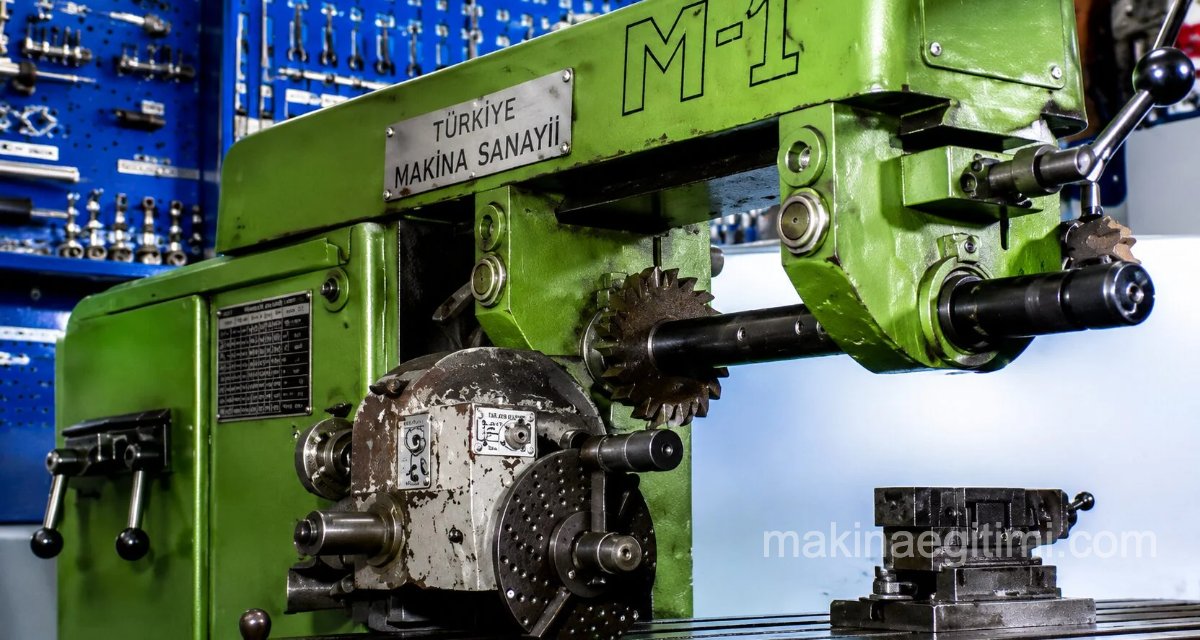
What is a rotary table used for? Rotary tables are generally used for the peripheral milling of internal and external surfaces, machining cams by marking out their periphery or surfaces, and cutting large-diameter internal and external spur gears. Rotary tables come in horizontal and vertical types depending on the job at hand.

Horizontal rotary table

Vertical rotary table

Machining on a milling machine with a chuck mounted on the rotary table
Bolts and Clamping Shoes
These are parts frequently used among milling machine accessories. Workpieces too large or oddly shaped to be held with a vise are clamped using bolts and clamping shoes. Manufactured in various sizes and shapes, these fixtures allow parts to be clamped safely and easily.
Bolts
This consists of a bolt sized to fit the T-slots on the milling table, and a nut. The head of the bolt that goes into the T-slot is made to a size and shape that keeps it from turning within the slot. It’s also called a “T-nut.”

Using a T-nut and stud bolt together
Clamping Shoes and Their Supports
These are parts used for clamping down, with a bolt and nut, workpieces too large for a vise or that are not geometric in shape. They are manufactured in various shapes and sizes. They are either drilled through the middle to let the bolt pass, or relieved in the shape of a slot for practicality during clamping and unclamping.

Clamping shoes are among the most commonly used milling machine accessories.
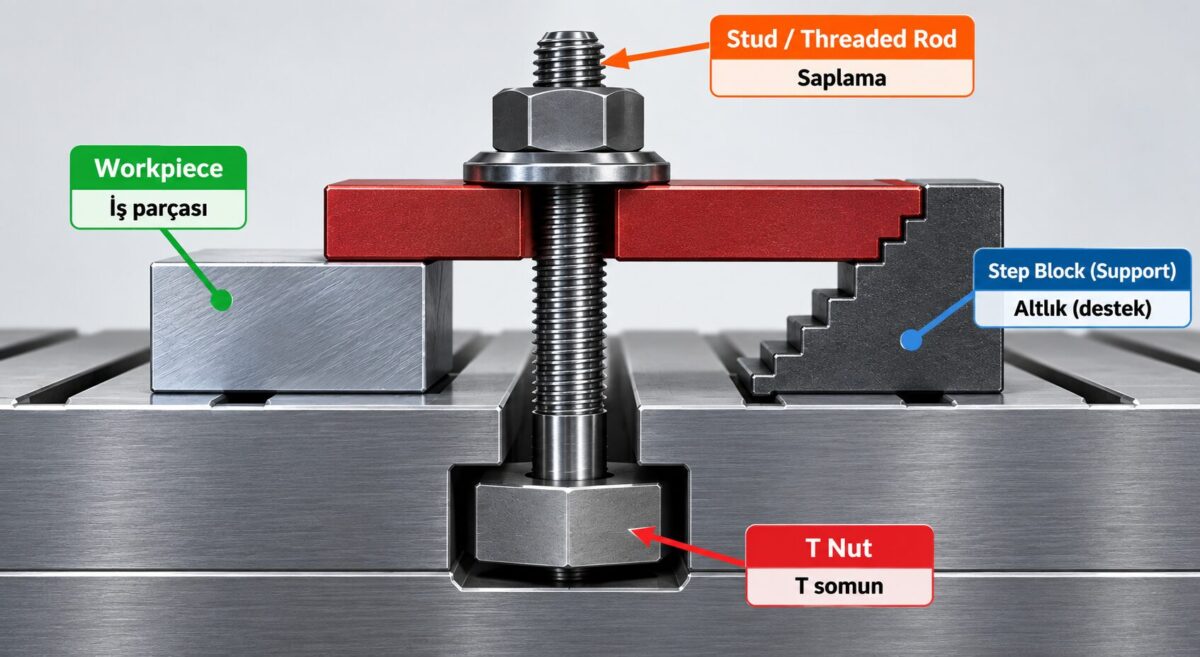
Clamping a workpiece with a T-nut, stud support, and clamping shoe

Examples of clamping with a clamping shoe

Clamping with side-clamping shoes
Vises
Vises used to clamp workpieces on a milling machine have parallel jaws, one of which is fixed to the body while the other is positioned on the body via a bed and slide system, allowing it to move.

Machine vise and angle table for the vise
Vises are attached to the machine table using bolts or clamping shoes. When clamping, it’s very important that the vise jaws be set parallel to the machine body. For this, parallelism is achieved using a dial indicator. Also, since the keys under the vise are made to fit exactly into the table’s T-slots, parallel mounting is made easier.
Clamping Parts in the Vise
When clamping with a vise, it is very important that the part be clamped without any gap. For this, parallel-ground supports must be used during clamping.
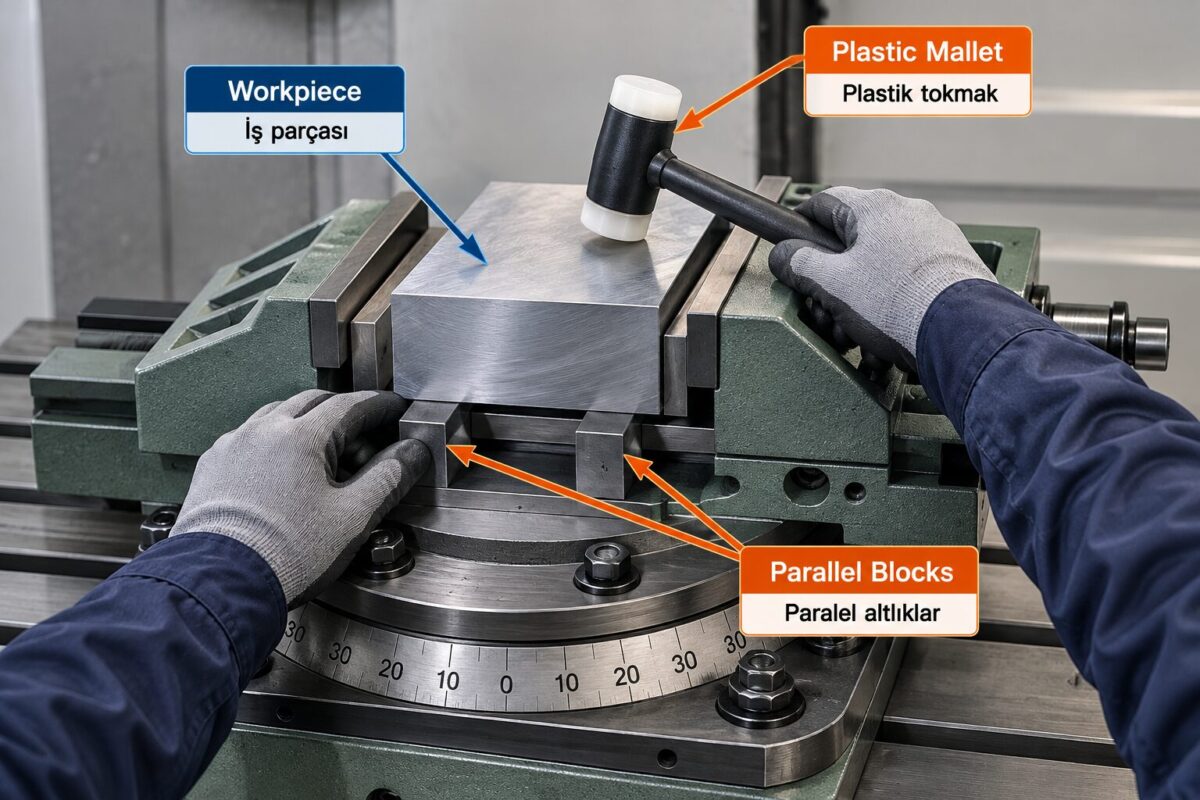
After the parallel supports are placed in the vise, the workpiece is set on top of them, and while the vise is being tightened, the part is tapped with a brass hammer or plastic mallet to ensure it seats fully.
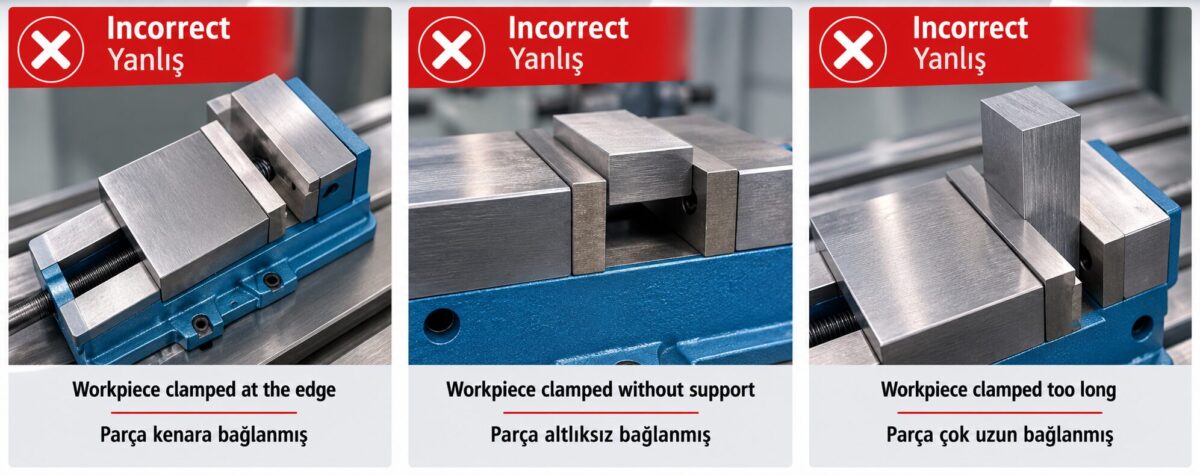
Incorrect ways of clamping in a vise
Dedicated Clamping Fixtures
Specially made clamping fixtures are used for producing identical workpieces in series. In serial milling, removing and clamping each part individually and constantly repeating these operations wastes time. It also causes strain and fatigue for the worker. The workflow slows down, and production decreases due to the time lost.
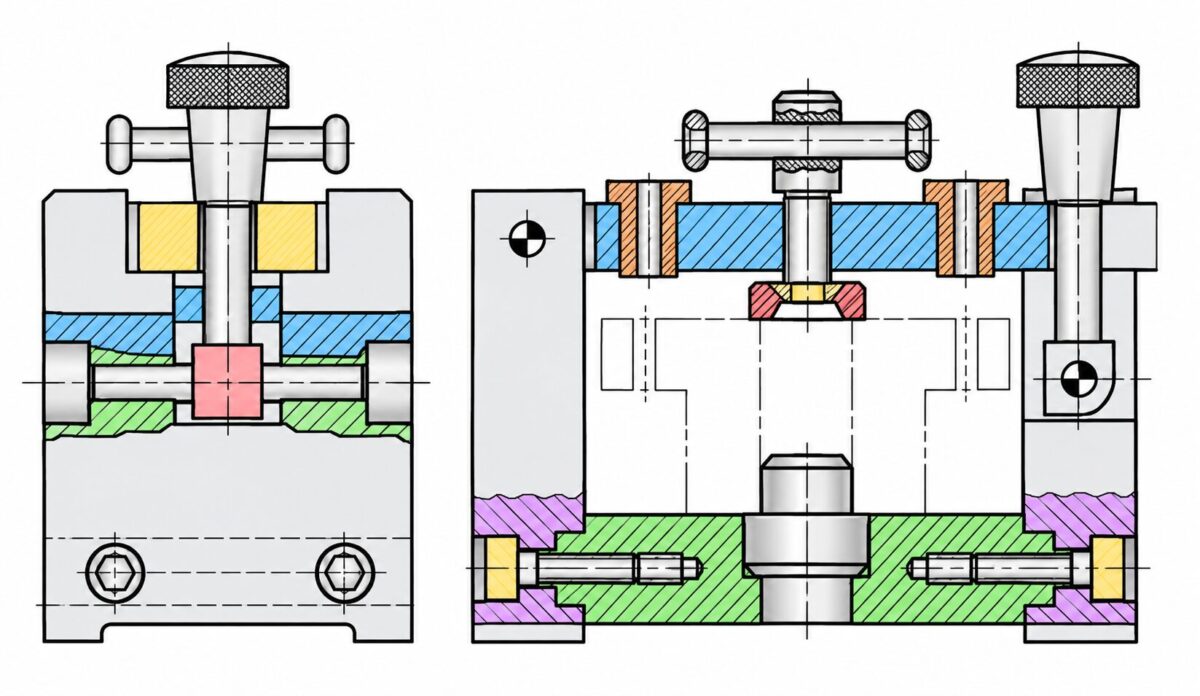
When designing clamping fixtures, attention is paid to whether it’s a multiple or single clamping situation, and to performing the removal and clamping operations in the shortest possible time. It’s also important for the fixture’s cost to be low. An expensive fixture will do more harm than good.
In clamping fixtures, it’s also very important that removing or clamping operations be practical. That is, the removal or clamping operation should be achieved with a single motion. Also, taking parts out of the fixture or placing them in should be easy and practical. A fixture being very complex does not mean it’s very good.
Magnetic Tables
Workpieces that cannot be clamped with a vise or clamping shoes, or where a clean surface is desired at high speed, are machined with the help of a magnetic table mounted on the machine table.

The most important thing to pay attention to when milling with magnetic tables is not to take too heavy a chip. Otherwise, the workpiece may break free from the magnetic table, which can cause accidents.
Milling Heads
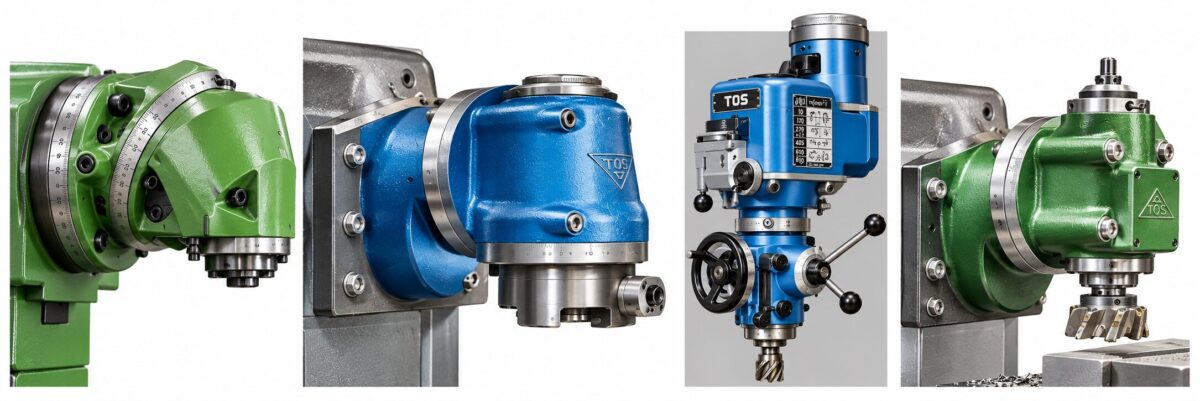
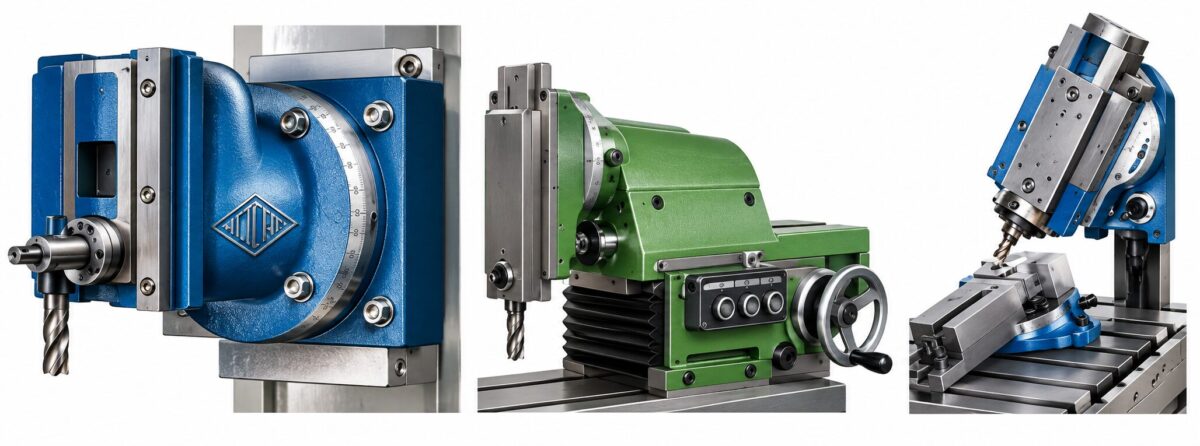
Universal vertical head and vertical head
These are the elements used on milling machines to attach and position the cutters, together with auxiliary tooling, needed to machine workpieces. Although similar to one another, milling heads are classified as follows based on the operations they can perform:
Vertical head
Horizontal head
Universal vertical head
Eccentric head
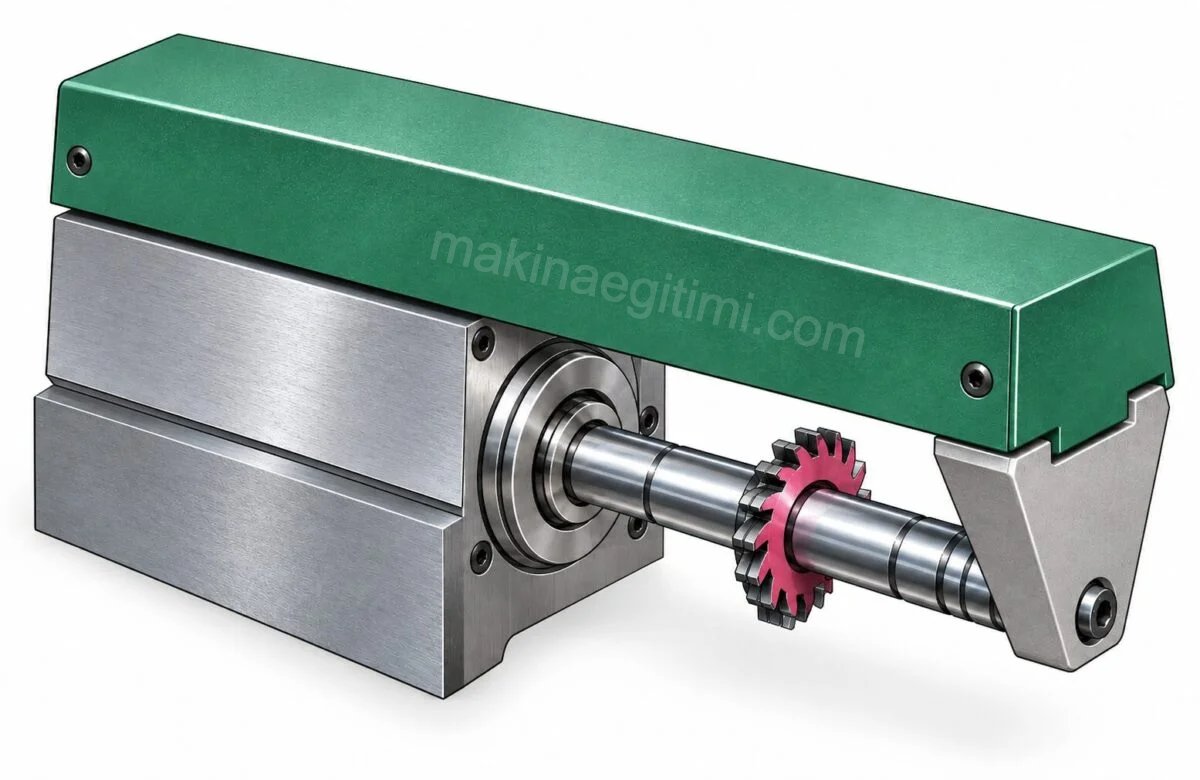

horizontal head
Video (above) of mounting a cutting tool onto the horizontal head with the help of an arbor
Eccentric head
Linear Indexing Attachment
The linear indexing attachment is one of the auxiliary parts of a universal milling machine, and is used only on the machine it belongs to.
The attachment consists of a perforated disc mounted on the table lead screw shaft, two gears fitted on the perforated disc’s shaft, and mounting parts. The attachment is mounted at the front of the machine table, and generally on the left side.

In this article, we covered universal milling machine accessories. We briefly touched on the areas of use for accessories such as the rotary table, vise, clamping shoe, milling heads, and clamping fixtures. Looking forward to seeing you in new publications.

Related Questions
Operations such as cutting large-diameter internal or external gears, or milling a circular surface, require the part to be rotated in a controlled way. The rotary table makes these kinds of operations possible by providing that rotation at precise angles.
These parts are attached directly to the table using special bolts and clamping shoes that fit into the T-slots on the table. This method offers a secure clamping alternative for parts too large or irregularly shaped for a vise to grip.
Related Posts