
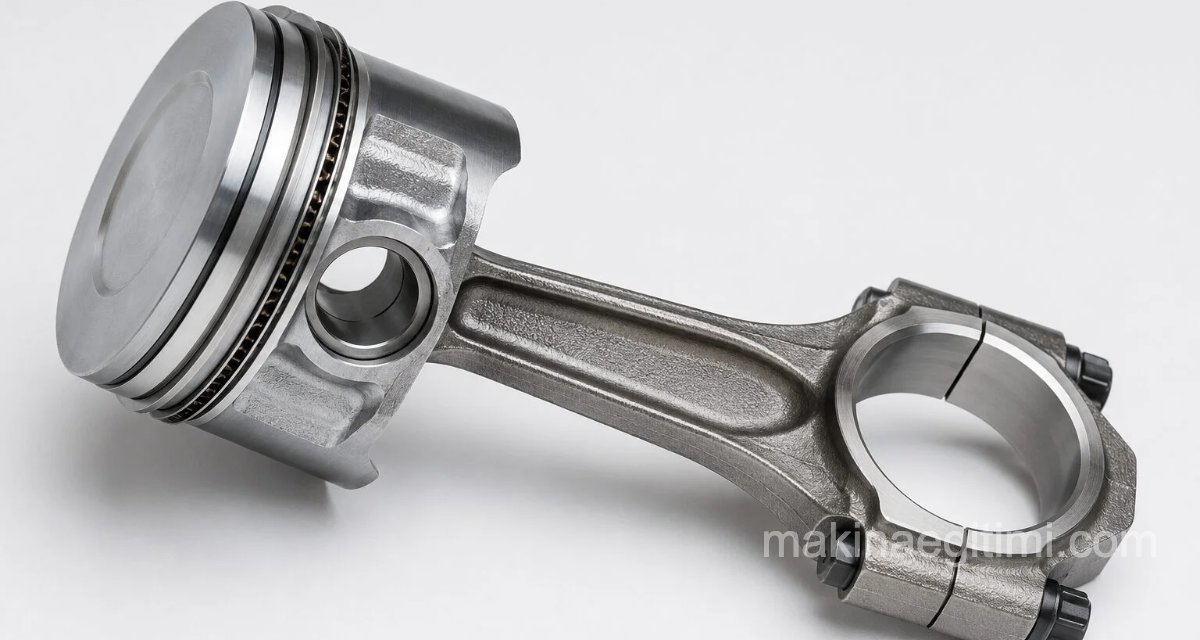
In this article, we’ll examine the forces acting on a piston, and how the piston material must be chosen as a result of the forces acting on it. We’ll go into detail about what material the engine piston, connecting rod, and piston pin are made of.
Forces Acting on the Piston
The piston’s functions are: to withstand the gas pressure released during combustion and transmit it to the connecting rod through the piston pin. To transfer combustion heat to the cylinder surface through the piston rings. To seal against gas leakage while moving between the combustion chamber and the crankcase side.
Pressure Force Acting on the Piston
The piston crown is subjected to severe stress from a high combustion pressure of 40…60 bar. The forces acting on the piston cause it to deform

Temperature
Temperatures in the combustion chamber can reach up to 2500°C. In a gasoline engine’s piston, under load, temperatures reach 120°C at the piston skirt, 240°C in the ring belt area, and 280°C in the middle of the piston crown.
The thermal expansion of the piston crown is greater than that of the piston skirt, due to the higher temperature and greater mass concentration at the crown.
Inertial Forces Acting on the Piston
On every stroke, the piston accelerates from rest to maximum speed and is decelerated again.
The inertial forces released during the acceleration and deceleration of the piston cause the engine to vibrate in the vertical direction, and inertial moments also try to rotate it around its center of mass.
If inertial forces are not balanced, they cause vibration and noise.
The larger the mass of the piston, the greater the inertial forces and inertial moments become.

The piston skirt and ring grooves are subjected to friction. On the piston skirt, the side force FN caused by the connecting rod’s angled position causes wear.
Under poor lubrication conditions (cold starts or excessive load), there is a risk of metal-to-metal contact and scuffing.
Piston Material
What should the piston be like? Due to the operating conditions, the following properties are required of the piston material and construction:
- Lightness
- high strength
- good thermal conductivity
- low thermal expansion
- high wear resistance
- good sliding properties
What the Piston Material Should Be Like
Because of their complex shapes, pistons are manufactured by casting. For this reason, the piston material must have the following technological properties:
* Good castability
• Good machinability

Piston Pin Material
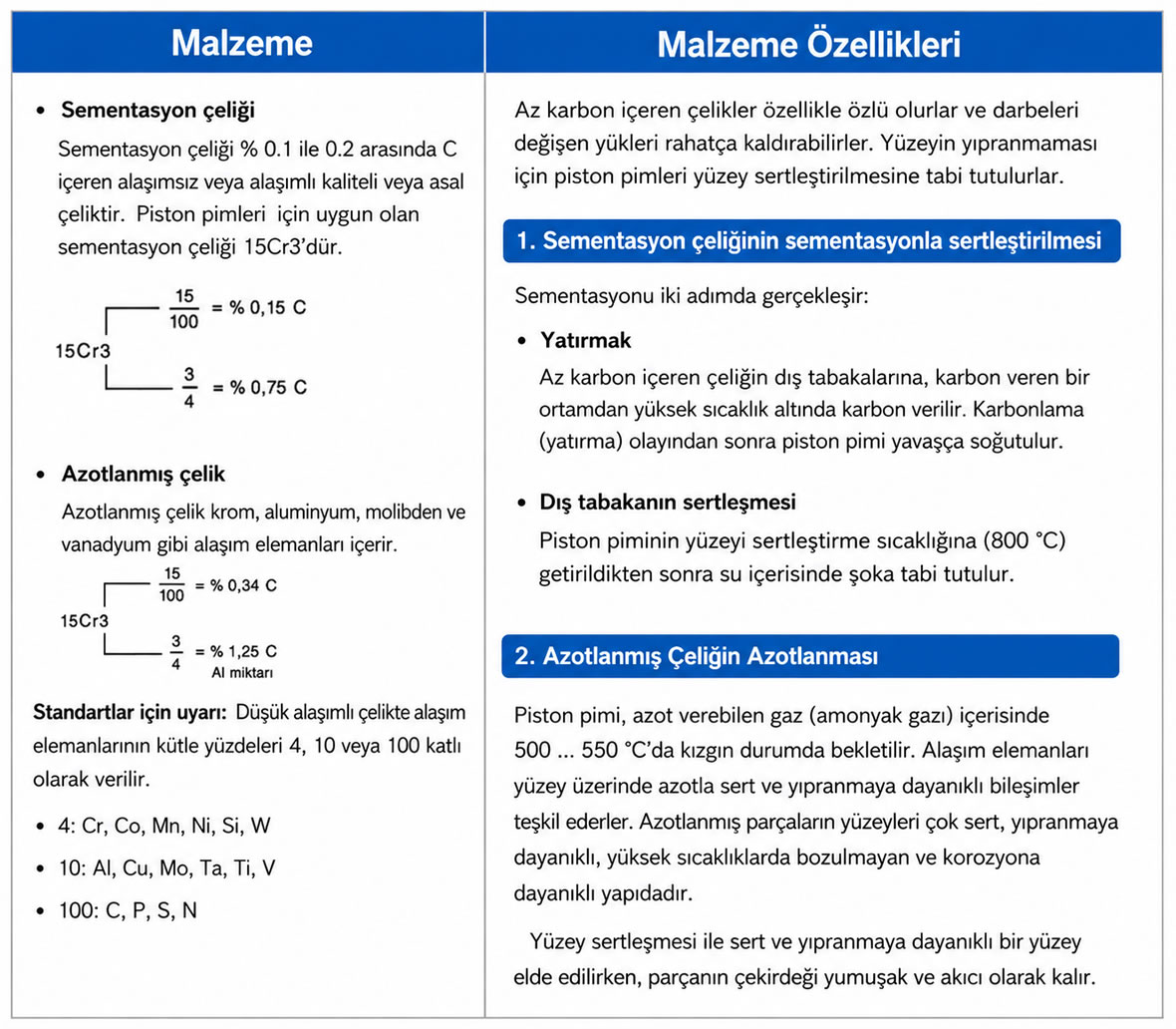
What does the piston pin do: It connects the piston to the connecting rod. It transmits the piston force to the connecting rod.
It serves as the connection between the piston pin bushings on the connecting rod and the pin bores on the piston.
Why does the piston pin bend: The piston pin can bend due to gas force, inertial force, and impact loading from different directions.
Wear occurs under high surface pressure, small and slow sliding motions, and poor lubrication conditions in leakage gaps.
What the Piston Pin Material Should Be Like
In addition to a high bending strength, the material must also have good yield properties. The upper surface of the piston pin must not wear.
A good piston pin must have
• a hard, wear-resistant surface
• a tough core structure.
Forces Acting on the Connecting Rod
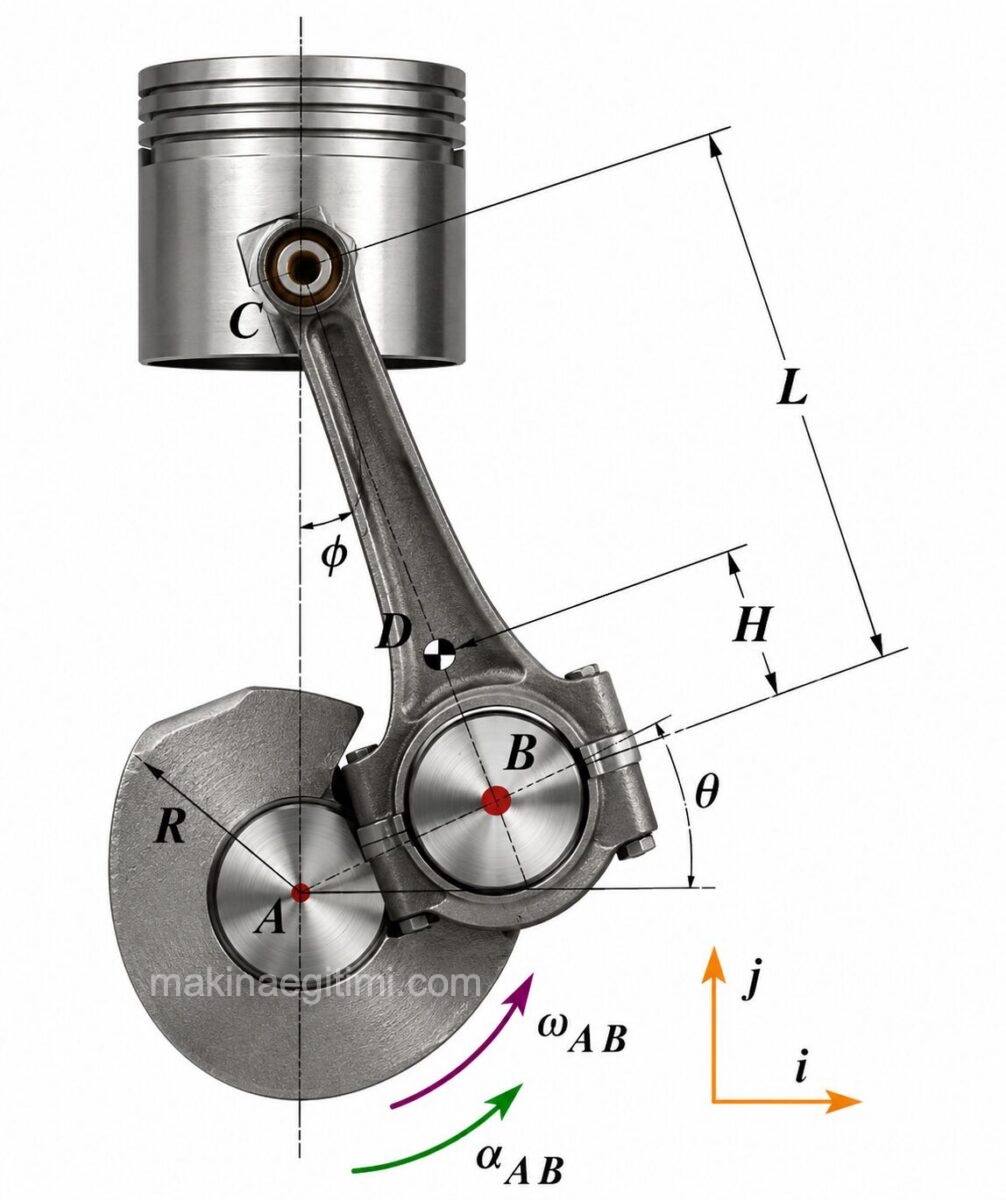
What does the connecting rod do: The connecting rod connects the piston to the crankshaft. It transmits the piston force to the crankshaft. It applies a turning moment to the crankshaft. It converts the piston’s linear motion into the crankshaft’s rotary motion.
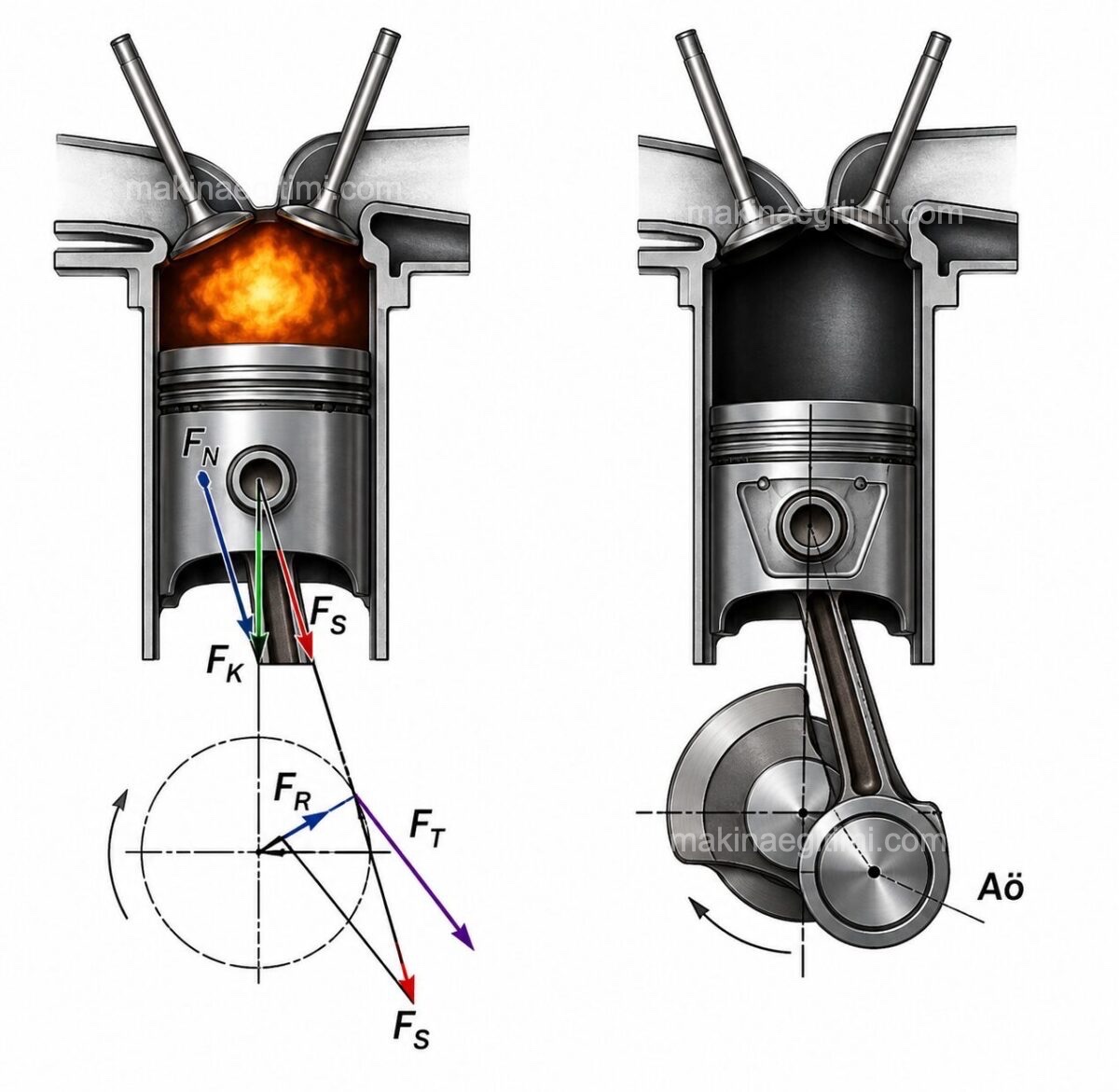
Compression and tension: A high piston force Fk creates large compressive forces along the direction of the connecting rod. A high piston inertial force Fm leads to a tensile force.
Buckling: The length of the connecting rod introduces a risk of buckling.
Bending: The centrifugal forces caused by the connecting rod’s pendulum motion create a bending effect on the shaft.
Connecting Rod Material

In addition to tensile strength, the connecting rod must also have high overall strength. To increase buckling and bending strength, the connecting rod has an I-beam (double-T) cross-section.
Connecting rods are made of quenched and tempered steel.
What is quenched and tempered steel: It is a quality base steel containing 0.35–0.6% carbon. Ck 35 is a suitable material for the connecting rod.
The connecting rod’s high strength and toughness are achieved through quenching and tempering. This process takes place in two steps.
1- Hardening
The connecting rod is heated up to 800°C and then quenched in oil. This produces a needle-shaped structure called martensite. Hardened parts with a martensite structure have high hardness and strength, but low elongation and yield capability. They are brittle.
2- Tempering
By reheating the connecting rod up to 500°C, the material loses some of its hardness and brittleness, and its toughness increases.
Related Posts
 Engine Knocking Noise
 The Relationship Between Cutting Tools and Surface Roughness
 Heat Transfer Course – Handwritten Lecture Notes
 Chip Control and Chip Breakers in Metal Machining
 The Software Mechanical Engineers Use the Most
 Cutting Tool Wear Types and Causes of Wear
 Chip Types and Forms in Machining
 Forces Acting on the Crankshaft. Crankshaft Material