
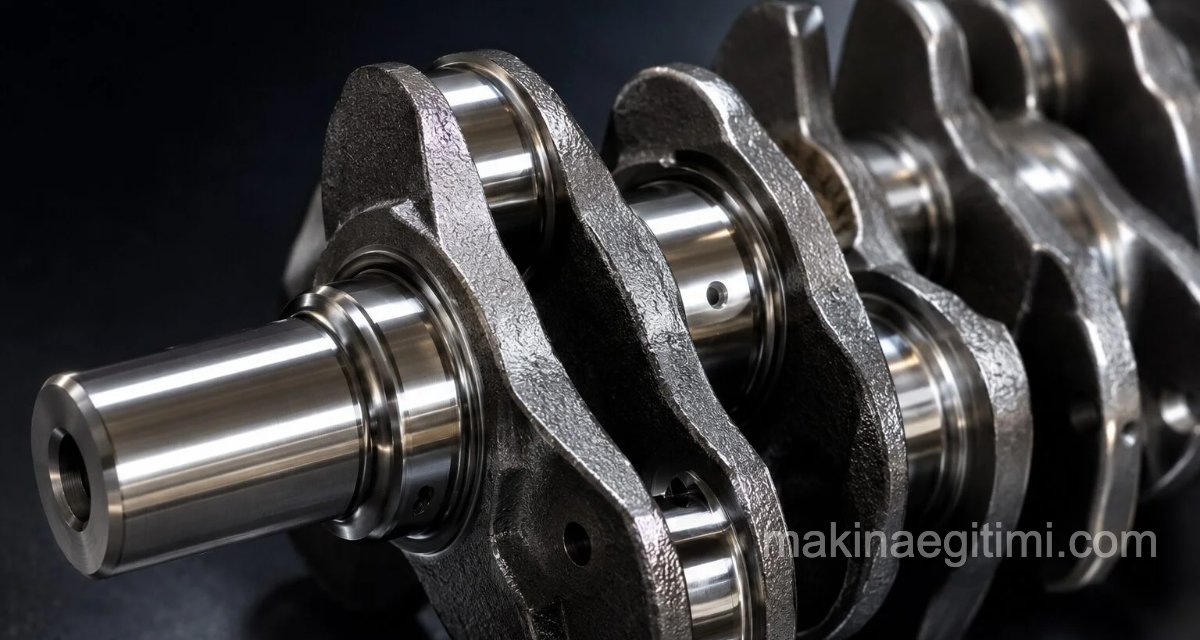
Forces Acting on the Crankshaft
The crankshaft converts the linear motion of the piston into rotary motion, and the turning force at the connecting rod into rotational torque.
When the gas and mass forces acting on the piston are summed, a variable force diagram emerges during operation. This causes an irregular rotational speed in the crankshaft, which must be reduced to a technically acceptable level through energy storage (a flywheel).
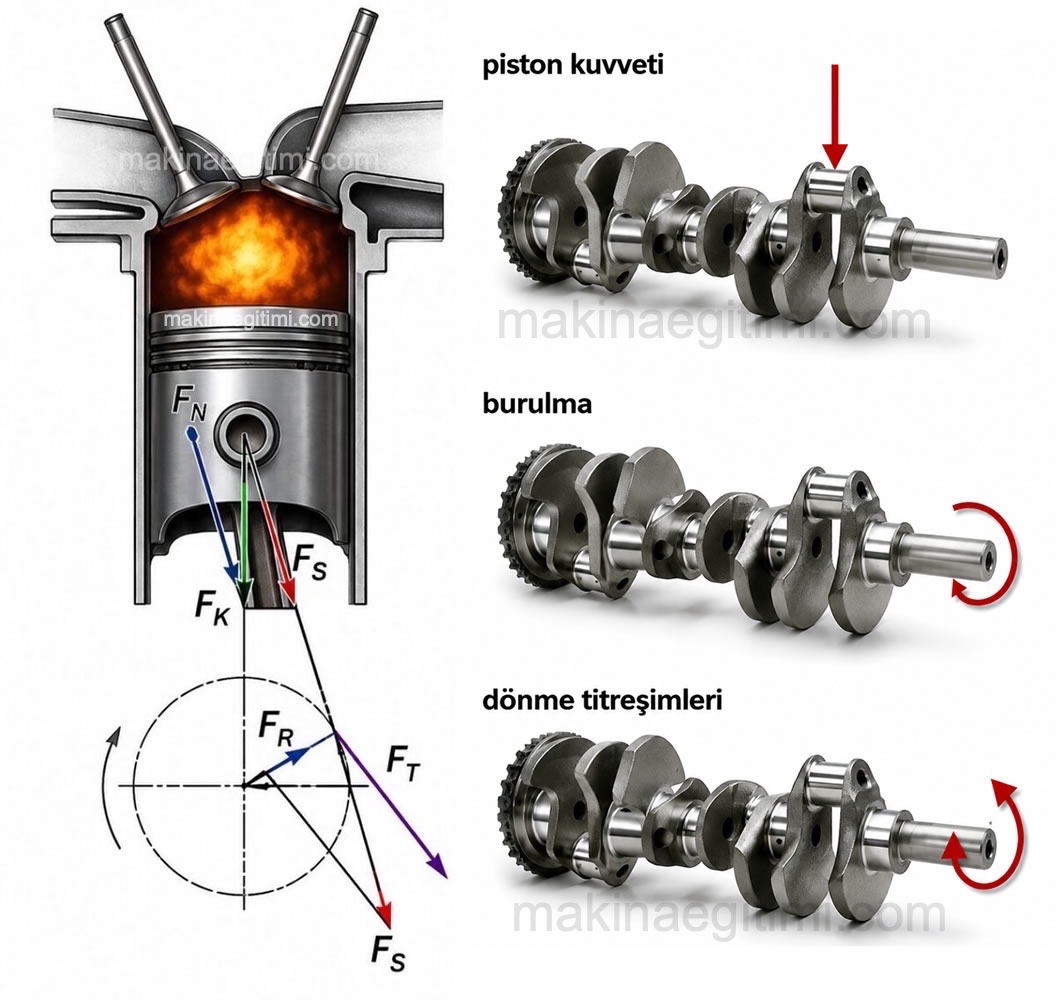
Bending: The piston and mass forces act on the connecting rod journal of the crankshaft, bending it.
Torsion: Due to the elasticity of the crankshaft material, it is twisted by the piston force.
Wear: Wear occurs at all the bearings of the crankshaft.
Torsional vibrations: The piston force, acting on the crankshaft in an impulsive manner, twists the crankshaft. When the force is removed while the gear is in neutral, the crankshaft returns to its original position. This produces torsional vibrations. At a given speed, the vibrations caused by the piston force superimpose on one another. This causes the engine to run very irregularly. The vibrations can even break the crankshaft.
Crankshaft Material
Crankshafts must have high bending and torsional strength. The bearings must also be resistant to wear. The crankshaft material must have high strength, high toughness,
and good wear resistance. So what material is a crankshaft made of?
Crankshafts are produced either by hot forging in a die or by casting. The shapes of cast crankshafts are more suited to stresses than forged crankshafts, and are more durable.
Forged crankshafts are made, for example, from the low-alloy quenched-and-tempered steel 42CrMo4.
Cast crankshafts are made, for example, from nodular (spheroidal graphite) cast iron GGG-60. (Here the number 60 means a minimum tensile strength of 600 N/mm².)
In nodular cast iron, the carbon is separated out in the form of spherical graphite nodules. To obtain nodular cast iron, a small amount of magnesium must be added to the melt.
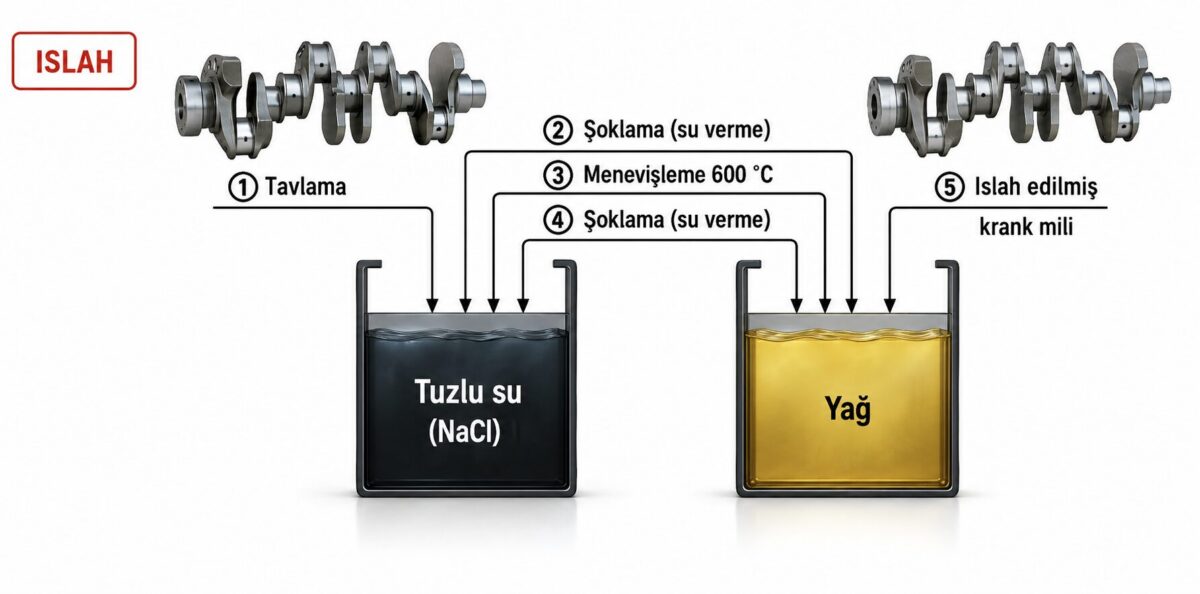
The desired material properties can only be achieved through heat treatment. So what is done to increase the strength of the crankshaft?
Quenching and tempering: This is tempering carried out at high temperatures after hardening.
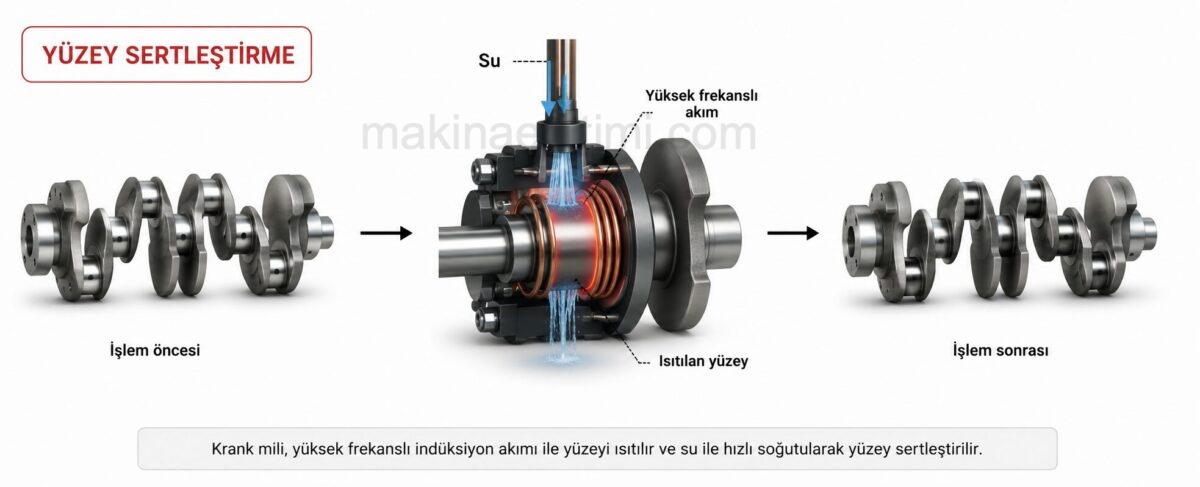
Surface hardening: To increase the durability of the crankshaft material, the outer surfaces of the crank journals (journal: the part of a shaft that sits inside a bearing) are heated using electric current (induction hardening) and then quenched. No carbon enrichment of the surface is needed, since the steel already contains 0.42% C.
The spherical separations in the base structure do not create a notch effect. The properties of nodular cast iron resemble those of steel. It can elongate and is resistant to impact, shock, and corrosion. Surface hardening can be used to increase the wear resistance of the bearing areas.
Related Posts
 Cutting Tool Wear Types and Causes of Wear
 Causes of Cutting Tool Wear in Milling
 The Relationship Between Cutting Tools and Surface Roughness
 Chip Types and Forms in Machining
 Heat Transfer Course – Handwritten Lecture Notes
 Forces Acting on the Piston and Piston Material
 Helical Gear Geometry and Strength Calculation
 Chip Control and Chip Breakers in Metal Machining