We’re covering a topic from the Machining Processes lessons in Machine Education. We’ll cover linear indexing on a milling machine, an example application of creating scale graduations on a milling machine, and cutting a rack gear on a milling machine. We’ll look at the calculations for selecting the gears needed to make a rack gear on a universal milling machine.
Linear Indexing on a Milling Machine
By making use of universal dividing heads, it’s possible to create linear graduations (scales and rack gears) on parts. It’s necessary to advance the workpiece, mounted directly to the machine table or in a vise, by a set amount for each interval.
The feed can be given with a micrometer collar, but for easy and error-free division, it can also be done using the dividing head and gears. It’s also possible to cut a perfect rack with a special attachment.
To create scale graduations, a suitably prepared lathe tool bit or a special scribing point is mounted on the milling machine. The tool bit or point is attached using a special tool holder or flanges prepared for the milling machine, or with the help of arbor collars.

The dividing head is used to make linear divisions. When the crank arm with the indexing plate is turned, the dividing head’s worm shaft also rotates. A gear with a tooth count of Z, found through calculation, is fitted to the worm shaft, and a gear with a tooth count of Z1 is fitted to the table lead screw. When the crank arm is turned a set amount, the table advances by the desired value.

Making a Scale with Linear Indexing on a Milling Machine
EXAMPLE:
Calculate the gears needed to make a millimeter scale. The milling machine’s table lead screw pitch is 6 mm, and the crank arm will be given 2 revolutions.
SOLUTION:
H1 = 6
t= 1 mm (each division on the scale is 1 mm)
T=2 with these values;

An 80-tooth gear is fitted to the dividing head’s worm shaft,
a 48-tooth gear to the idler shaft,
a 60-tooth gear to the idler shaft,
and a 30-tooth gear to the milling machine’s table lead screw.

Related Videos

Cutting a Rack Gear on a Milling Machine
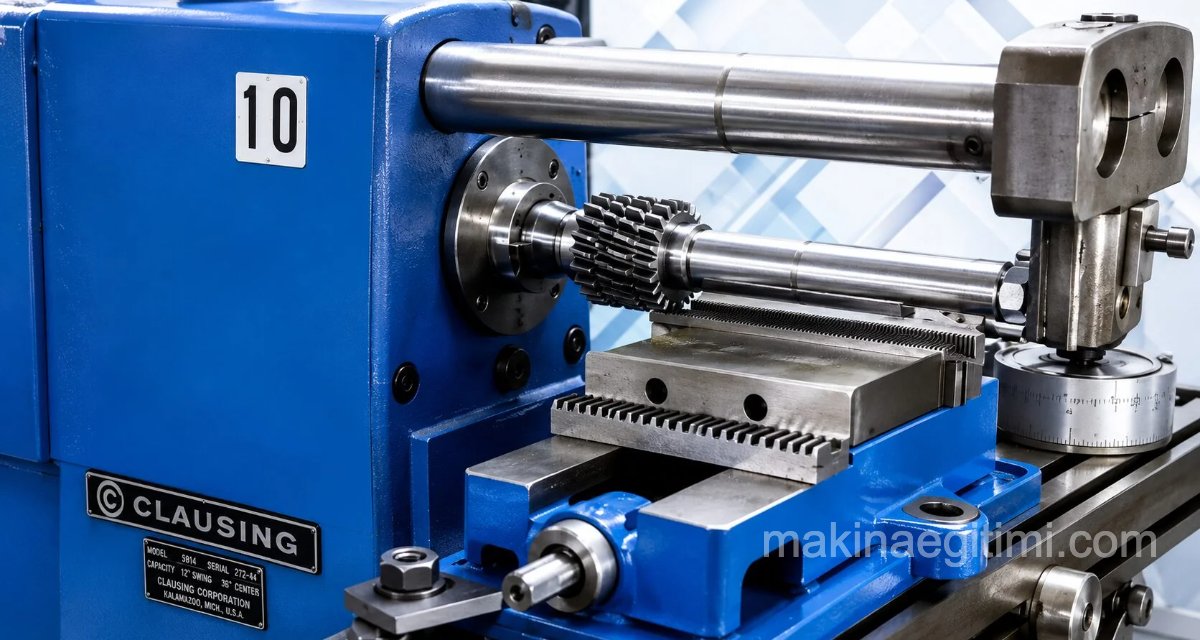
Rack gears are also a form of linear indexing. The only difference is that we need a module milling cutter to cut a rack gear on a milling machine.

Module milling cutter

Rack gear
A rack gear can be cut on a milling machine using either a horizontal or vertical head. Let’s see how a rack is cut using a horizontal head.
Cutting a Rack Using a Horizontal Head

module cutter mounted on the arbor
After selecting the appropriate module cutter, it’s mounted on the milling machine’s arbor with the help of spacer bushings and a nut. The highest-numbered module cutter in the set is used for cutting rack gears.
For detailed information, SEE: Selecting Module Milling Cutters

The arbor is mounted to the machine’s head via a draw bolt, through the socket at the back of the housing. Then, the part to be cut with the rack gear teeth is mounted in the machine’s vise. Once the appropriate cutting speed and spindle speed are selected for the workpiece, the machine is started.

The workpiece is brought close to the cutter using the handles on the milling machine. A piece of paper is placed on the part to sense when the module cutter makes contact with it.

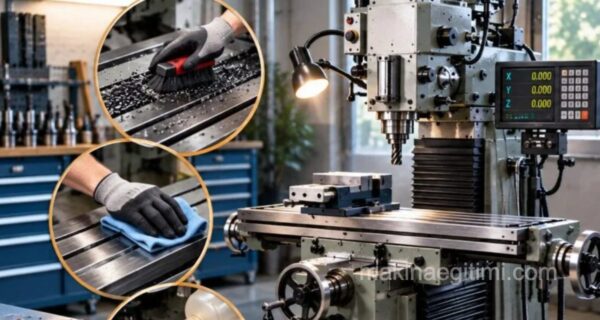
On a classic toolroom milling machine, you have the ability to move in 3 axes without needing any external attachment. You can carry out these movements with the handwheels shown in the picture.

Thanks to the micrometer collars on the handwheels, you can precisely set the feed movements you want on the milling machine.
Example rack gear cutting application:
On a milling machine with a table lead screw pitch of 6mm, find the gears needed to cut a rack with a module of 2. The crank arm will be given 4 revolutions.
SOLUTION:
m= 2
H1= 6 (table lead screw pitch)
T= 4 revolutions


An 88-tooth gear is fitted to the dividing head’s worm shaft,
a 28-tooth gear to the idler shaft,
an 80-tooth gear to the idler shaft,
and a 24-tooth gear to the milling machine’s table lead screw
NOTE: Since the value of Π (pi) is 3.1416, this value is generally taken as 22/7 to simplify gear calculations.
Some Videos About Cutting a Rack Gear on a Milling Machine


Related Posts