This article looks at why maintenance matters on a milling machine, how periodic maintenance is classified, how the lubrication system works, and how the arbor and other accessories should be protected.

Whether a milling machine can work for many years without losing its accuracy depends largely on regular maintenance. Neglected maintenance does not only shorten the life of the machine; it also lowers the quality of the parts produced on it.
Why Milling Machine Maintenance Matters
There are several basic reasons for taking the maintenance of a milling machine seriously. First of all, regular maintenance extends the service life of the machine. The quality of the work produced on a well-maintained machine also improves, because the accuracy of the ways and slides is preserved. On top of this, regular maintenance improves occupational safety, because sudden failures caused by worn or unlubricated parts are prevented.
The effect of working on a well-maintained machine is not only technical. The morale and motivation of the person working on a regularly serviced machine are also affected positively. An operator who knows the machine runs reliably can focus on the job with higher efficiency. Over time this is reflected in the general working discipline of the workshop.
Classification of Periodic Maintenance
On milling machines, periodic maintenance is divided into three main groups according to how often it is carried out.
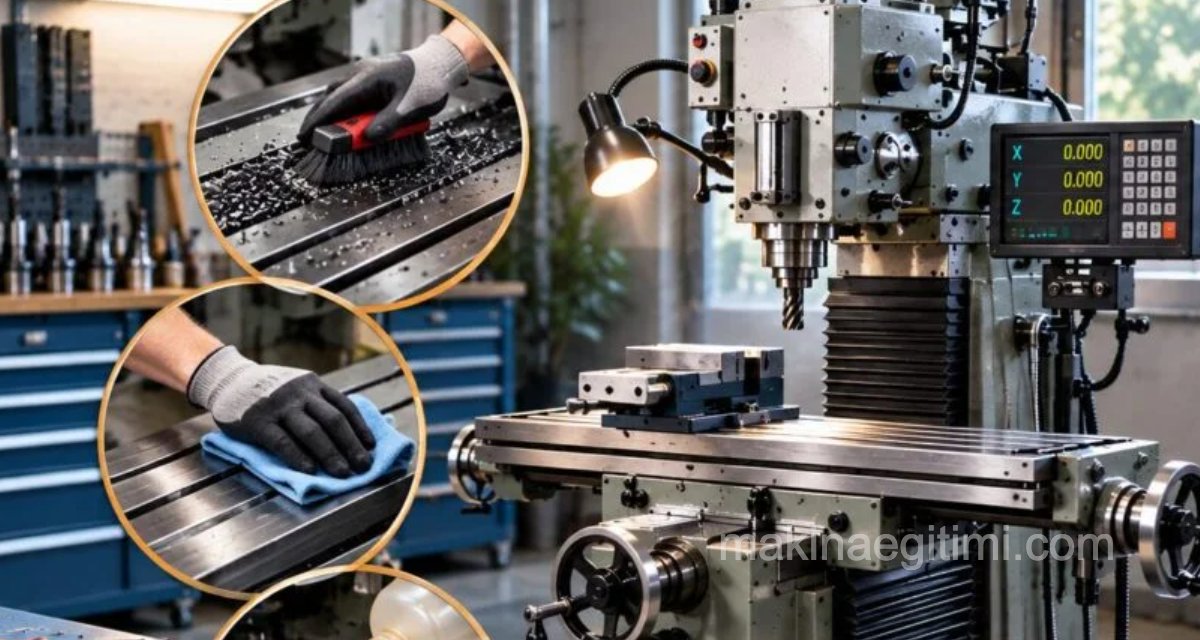
Daily maintenance: At the end of the working period, dust, dirt, chips and coolant residue on the machine are cleaned off. This is the simplest but most frequently neglected maintenance step.
Weekly maintenance: After the daily cleaning, the ways and slides of the machine are lubricated. This step slows down the friction-related wear of the moving surfaces.
Periodic overhaul: The machine is dealt with more comprehensively, and all sections and parts are inspected one by one. Parts that are found to need attention are removed and repaired.
This three-level approach makes it possible to notice a small fault before it turns into a major breakdown. It is a common situation that a workshop which skips the daily cleaning runs into far more problems during the periodic overhaul.
The Importance and Working Principle of Lubrication in Milling
The efficient operation of a milling machine depends largely on the lubrication system working properly. When lubrication fails, friction and the heating that comes with it cause excessive tightness in some areas and clearance in others, disturbing the running order of the machine.
Effective lubrication on a machine tool is usually provided by a pressurised pump system. In this system the pump draws oil through a thick suction pipe and, by means of thin pressure pipes, sends it under pressure to critical points such as bearings, shafts, journals and gears. In this way every moving point of the machine receives enough oil.
Keeping and Protecting the Accessories
The accessories of the milling machine need as much attention as the machine itself. The attachments of the machine should be stored in suitable cabinets in an orderly way. Frequently used hand tools are kept accessible next to the machine, while less frequently used tooling should be protected in an enclosed area. Heavy accessories should be placed on shelves in a balanced way; otherwise there is both a risk of them falling and a risk of damage to the shelving system.
Storing and Protecting the Milling Arbor
Arbors are among the most critical parts of a milling machine and therefore require special attention. Arbors should be stored in a vertical position, because an arbor left horizontally tends to bend over time under its own weight. This bending is difficult to notice by eye but directly affects machining accuracy.


Arbors should be stored neatly together with their spacing collars and sleeves, and they must never be knocked against anything or dropped. Even a small impact can spoil the centring accuracy of an arbor.
Cleaning the Ways and Slides
Another factor that directly affects the accuracy of the machine is the cleanliness of the ways and slides. Chips that build up between the ways and slides must be cleaned off completely, because this residue can cause scratches or wear on the moving surfaces.

The table, saddle and knee should be moved so that foreign matter hidden inside the ways is also brought out. Finally, the ways and slides should be well lubricated and any clearance should be taken up.
Conclusion
Maintenance of a milling machine is not a one-off operation but a continuous habit made up of daily, weekly and periodic steps. A properly working lubrication system, correct storage of the arbor, orderly keeping of the accessories and clean ways and slides both extend the life of the machine and preserve the quality of the work produced. Turning these steps into a routine brings a great benefit in the long run, in terms of both time and cost.
Frequently Asked Questions
Daily maintenance prevents the build-up of chips and dirt, which stops larger problems from developing. Neglected daily cleaning can lead to wear on the ways and slides over time.
An arbor left in a horizontal position can bend slightly over time under its own weight. This bending spoils the centring accuracy of the arbor and has a negative effect on the quality of the machined parts.
A pressurised system delivers oil regularly and in sufficient quantity, through thin pipes, to hard-to-reach points such as bearings and gears. With manual oiling there is a higher risk of these points being overlooked or insufficiently lubricated.
During a periodic overhaul, parts that show signs of wear by eye or during operation are removed and inspected first. The final decision is made according to how heavily the machine is used and the symptoms observed.
Clearance in the ways and slides causes small deviations in the movement of the table or saddle, which spoils the dimensional accuracy of the machined part. Checking and taking up this clearance regularly preserves the accuracy of the machine.
Related Posts