
In this article, we’ll look at how a camshaft is checked when wear, scoring, or similar issues occur on the camshaft, the cam lobes, or the journals. We’ll cover details like what amount of wear is acceptable (within tolerance) when checking a camshaft, and what to do when wear exceeds these amounts.
How Is a Camshaft Checked?
If there’s abnormal wear, corrosion, pitting, or deep scoring on the lobes or journals, they should be replaced. So what happens if a camshaft wears too much? Excessive wear on the lobes and journals causes the valves not to open enough. Because the valves don’t open enough, the cylinders can’t draw in enough air-fuel mixture or air. The engine’s volumetric efficiency and power drop. This is also one of the reasons that increases the engine’s fuel consumption.
No load greater than valve spring pressure acts on the camshaft. For this reason, wear or ovality is rarely seen on the journals and their bearings. On a camshaft, ovality and wear values are determined by measuring the journal diameters.

The bearings the camshaft journals run in are made from a softer material than the journals. Because of this, camshaft journals wear less than the bearings. The camshaft is typically replaced once wear on the journals exceeds 0.02 mm.

Lobe height is measured with a micrometer. If more than 10% wear is detected, the camshaft is replaced.

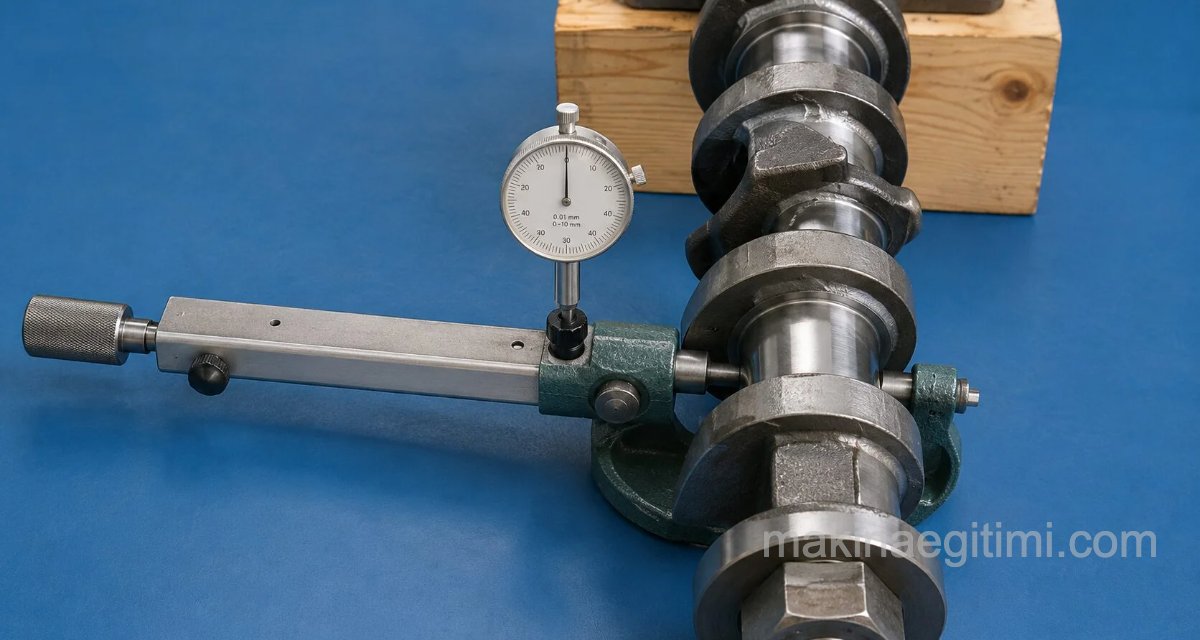
A dial indicator is used to check camshaft runout. The camshaft is placed on V-blocks. The dial indicator’s probe is brought into contact with the center journal. The camshaft is rotated one full turn and the runout is measured. If the runout exceeds 0.05, the camshaft is replaced.

There are also advanced electronic camshaft measurement and analysis devices that can perform many detailed analyses of a camshaft.

The image above shows a screenshot from the measurement, test, and analysis-evaluation software for this kind of electronic analysis device, from software called Cam Analyzer.
In this article, we tried to explain how a camshaft is checked. We covered how the wear that can occur on the camshaft’s journals and lobes — shortened length, runout, and similar issues — can be checked with various measuring and inspection tools. We covered details like what happens if a camshaft wears, whether it damages the engine, and whether it increases fuel consumption. Below you can find some related articles. We hope to see you in our new articles.
Visual Wear Check
Visible pitting or scoring on the camshaft’s lobe surfaces is a clear sign of wear.
Measuring with a Micrometer
Lobe height is measured with a micrometer and compared against the original value specified by the manufacturer.
Checking Axis Deviation
Whether the camshaft is straight can be checked between its two end bearings using a dial indicator.
Related Questions
Bearings are intentionally made from a softer material than the journals. This design choice ensures wear occurs on the bearing side, which is cheaper and easier to replace, protecting the more expensive camshaft.
This kind of damage disrupts the smoothness of the shaft’s surface, causing irregular valve motion. Damage too deep to repair requires replacement, since it prevents the shaft from reliably doing its job.
Related Posts
 Ways to Tell If Your Car Battery Is Dead
 Vehicle Dashboard Warning Lights and Their Meanings, Illustrated
 Brake Fluid: Why It Matters and How to Check It
 What Is an Intake Manifold? Its Job, and Diagnosing a Fault
 Spark Plug Lifespan. How Do You Know When Its Time to Replace It?
 What Happens If a Shock Absorber Fails. Consequences of Shock Absorber Failure
 Spark Plug Oil Fouling: Causes and Symptoms
 What Is AdBlue, What Does It Do?