Article Contents / Topics:
Lubrication of Bearings
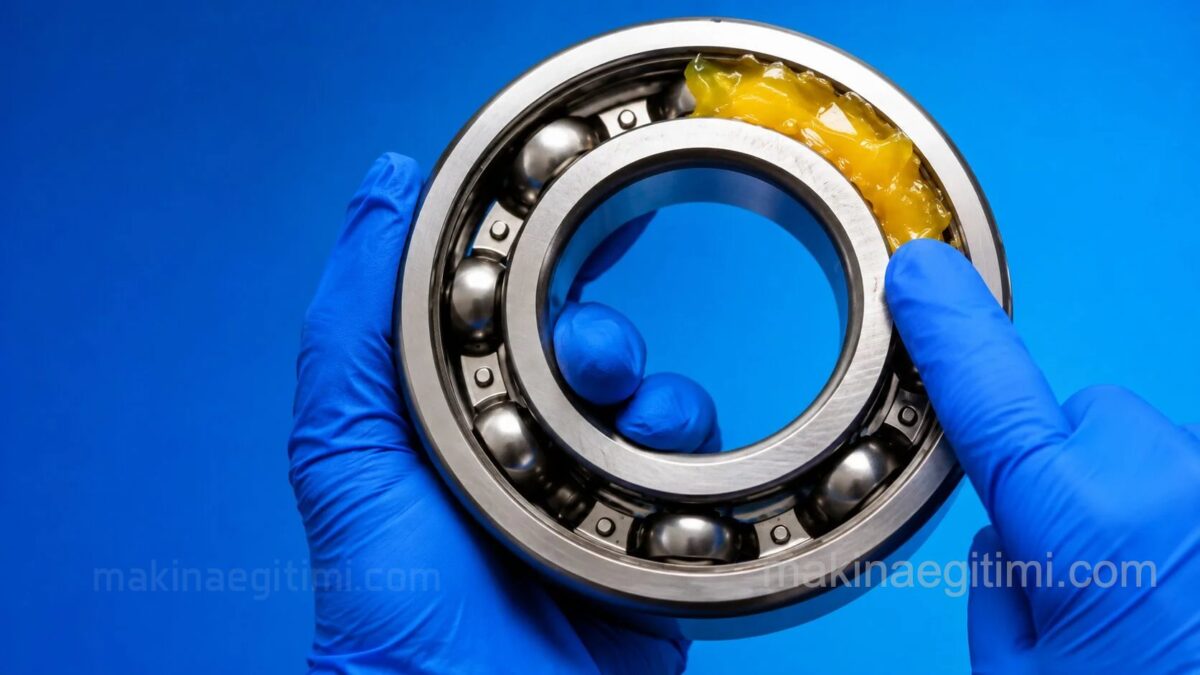
In bearings, these parts must be lubricated to prevent direct metallic contact between the rolling elements, the inner and outer races, and the cage. Lubrication also protects these parts against wear and corrosion. The lubricating ability of oils and greases decreases over time due to mechanical stress, heat, moisture, and other causes. For this reason, contaminated or depleted lubricant must be renewed and replenished in a timely manner. Bearings are lubricated either with grease or with liquid oil.
Self-aligning roller bearings must be lubricated with liquid oil due to their design. Grease is only used for this type of bearing at low rotational speeds. Under normal conditions, grease is used to lubricate bearings, because grease seals the bearing housing against dust, liquid, and dirt, and since it isn’t runny, it’s easy to keep it in place at the bearing area.
Lubrication intervals for bearings are given in their respective catalogs. For small bearings, especially deep-groove ball bearings, the lubrication interval is very long. When this interval is longer than, or at least equal to, the bearing’s service life, sealed bearings — filled with grease and closed with a metal or plastic cover — can be used.

If frequent lubrication with grease will be done, a lubrication hole should be drilled into the bearing housing and a grease fitting fitted onto its end.

Liquid oil is used to lubricate bearings that operate at high speed and high temperature. Bearings operating at low speed are lubricated with liquid oil through an “oil bath.” The bottom of the machine assembly housing the bearings should be at a certain height (slightly below the center of the lowest rolling element). As the bearing rotates, its rolling elements dip into this oil bath in turn and get lubricated. The oil bath used for gears in a machine assembly containing bearings — for example, in a gearbox — can also be used at the same time to lubricate the bearings.

Lubrication of bearings operating at high speed is done with an oil pump. During operation, the oil that heats up due to the high speed is drawn away from the bearing area by a circulating oil pump, cleaned and cooled, and sprayed back onto the bearings.

Importance of Lubrication Interval
Regular lubrication of bearings significantly extends their service life by reducing friction.
Use of Grease
Many bearings are manufactured pre-filled with grease inside sealed covers, lubricated for life.
Role of Felt Seal and Cover
Sealing elements prevent both the oil from leaking out of the bearing and outside contamination from getting in.
Ensuring Bearing Sealing
To prevent oil from escaping from the areas where bearings operate, and also to prevent dust, dirt, water, and foreign liquids from entering the bearing operating area from outside, these areas must be sealed. Bearing sealing is a very important topic for certain machine parts and systems. Aside from pre-sealed bearings, sealing for the areas containing other bearings is generally provided as shown below.
The figures below show non-contact bearing seals used for grease.

Rubber or rubber-elastomer sealing elements are used in bearings to seal in the grease and protect it. Generally, a wool felt seal fitted inside the cover is used for grease, and a rubber lip seal fitted inside the cover is used for sealing liquid oil in bearings. We’ll cover sealing elements such as wool felt seals and rubber lip seals in detail separately, under the “sealing elements” topic.
In this article, we covered the lubrication of bearings and bearing sealing. For other topics you’re looking for regarding bearings, feel free to check out the RELATED TOPICS section below.
Related Questions
Since grease isn’t runny, it’s easier to keep it in place at the bearing area, and it forms a sealing barrier against outside factors like dust and dirt. This practicality makes grease attractive for applications that don’t require frequent maintenance.
The internal geometry of these bearings is such that grease can’t distribute fast enough at high speeds. Liquid oil can penetrate the internals of this type of bearing more easily, providing sufficient lubrication.
Related Posts