
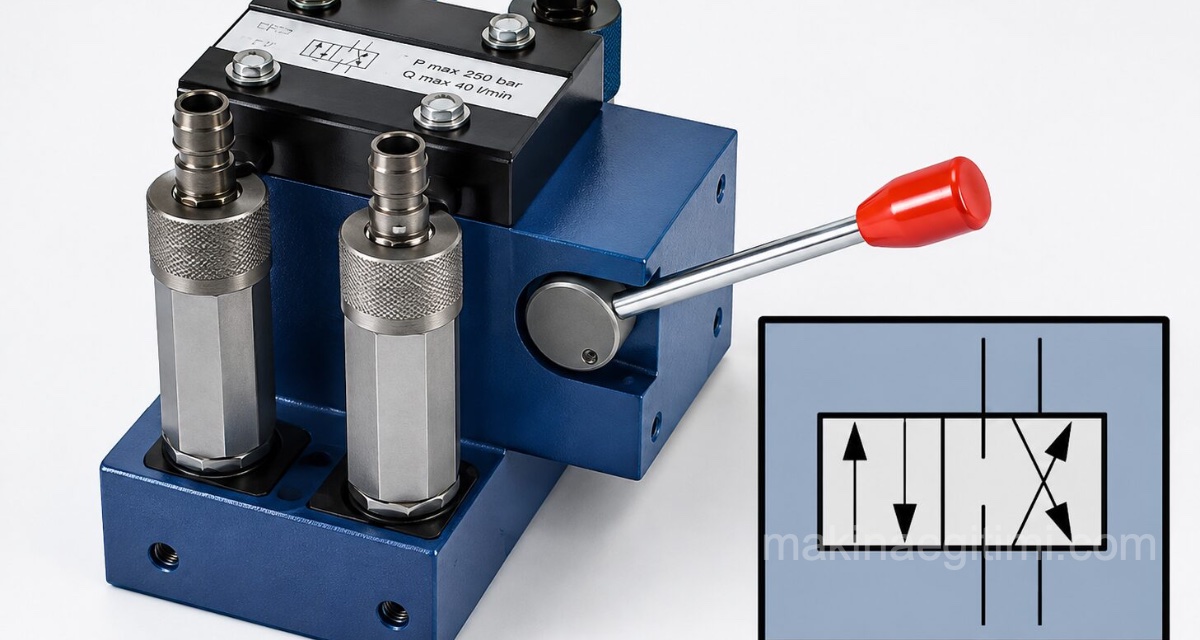
In this section of our Hydraulics/Pneumatics lessons, we’ll cover 4-way 2-position directional control valves. We’ll examine how 4-way 2-position valves work, and where they can be used.
How a 4/2 Directional Control Valve Works
These are four-way, two-position valves with ports P, A, B, T. They’re used to move double-acting cylinders forward and backward. They’re generally used in hydraulic systems. Their use in pneumatics is nearly nonexistent. In pneumatics, 5/2 valves are used instead of 4/2 valves.
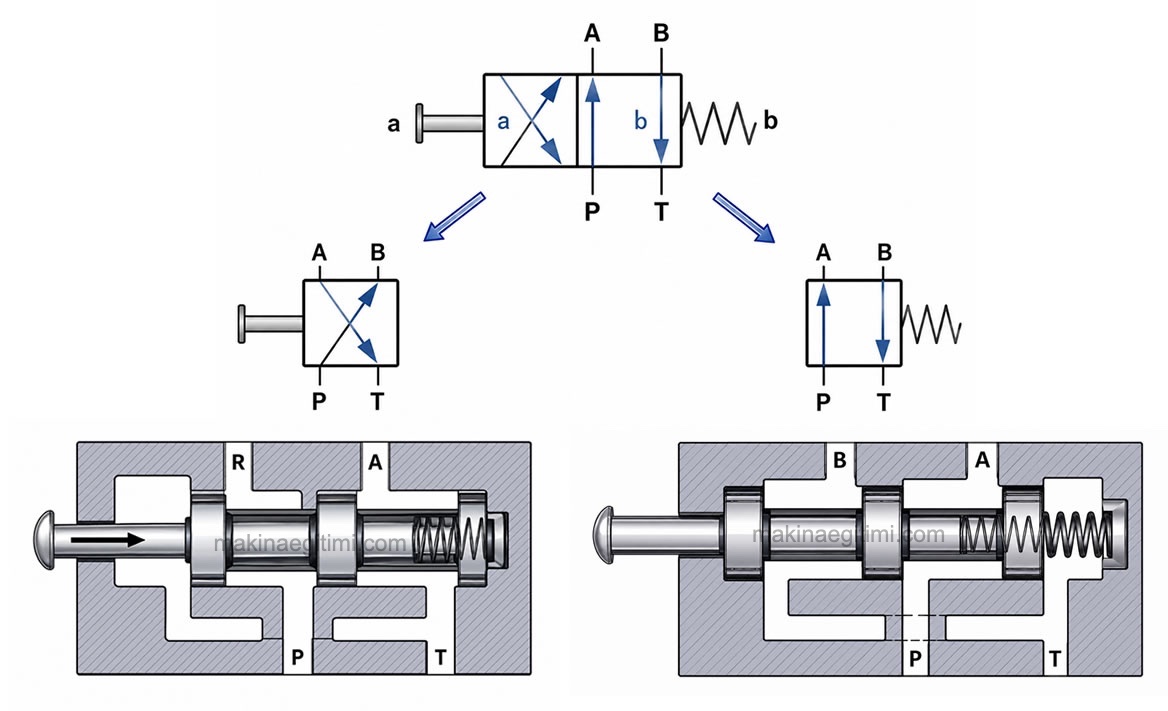
What can be understood from the symbol and cross-section images above is this:
The 4-way 2-position valve normally sends pressure from P to A, but when the button is pressed, it sends it from P to B.
In position 1, meaning when the button isn’t pressed, the piston moves forward. In position 2, meaning when the button is pressed, the piston moves back.

Two-Position Direction Reversal
4/2 directional control valves can simply reverse the actuator’s direction with four ports and two positions.
Single-Acting Cylinder Control
These valves are frequently preferred to control the forward-back motion of single-acting cylinders.
Compact Circuit Design
4/2 valves offer a simpler, more compact circuit design by providing fewer positions than 4/3 valves.
Using 4/2 Valves in a Hydraulic Circuit
Above, we see the control of a double-acting cylinder with a 4-way 2-position directional control valve. The oil flow needed by the system is provided by the hydraulic pump. In the first position, fluid flow (the P pressure line) is toward the right side of the cylinder. The fluid on the left side of the cylinder returns to the reservoir. This keeps the piston on the left.

In the second position (when the pedal is pressed), fluid flow is toward the left side of the cylinder. The fluid on the right side returns to the reservoir. This moves the piston to the right. When the pedal is released, the valve returns to the first position under the effect of spring pressure.

The previous circuit diagram was built as simply as possible so you could focus on the 4/2 valve. nnIn the diagram above, hydraulic circuit elements found in many hydraulic circuits — an electric motor, pressure relief valve, pressure gauge, check valve — have been added. It performs the same job.nnIn the video alongside, you can get an idea of the 4/2 valve’s working system.
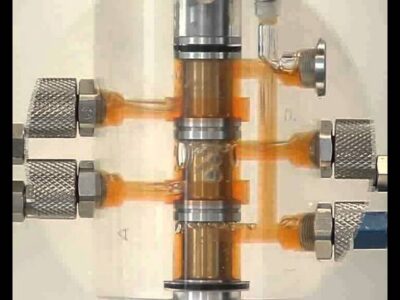 Learn hydraulics – 4/2 Directional control valve
Example Use: Safe Use of a 4/2 Valve in a Hydraulic Press
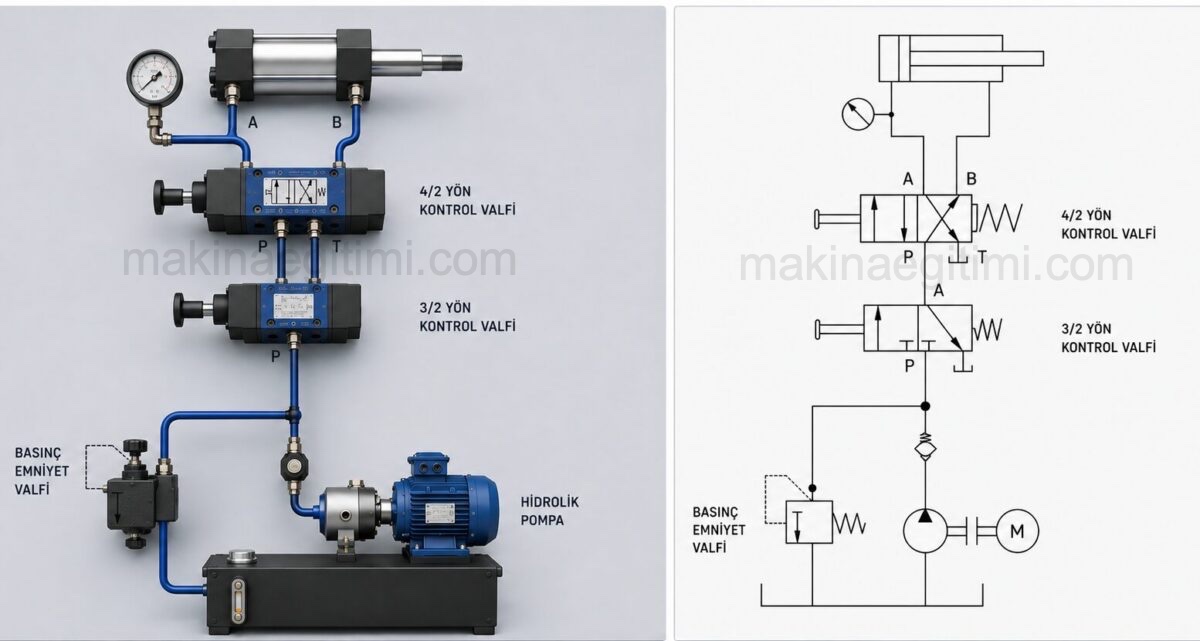
In the application in the circuit above, the 4/2 directional control valve is indirectly controlled by the 3/2 directional control valve. The system is normally idle. The piston doesn’t move. System pressure is zero. Even if the worker presses the button that pushes the piston forward and back, the piston won’t move. Because the pressure line is closed and the oil has returned to the tank. When the 3/2 valve is activated, pressure comes into the system and the piston moves left. If the button connected to the 4/2 valve is pressed, this time the piston moves in the opposite direction.

In this system, when the 3/2 valve and 4/2 valve are placed to the worker’s right and left, for example when we do this on a press machine, the worker will be forced to use both hands to press the buttons. If they release the button connected to the 3/2 valve, all the oil returns to the tank and the pressing stops. In other words, while the piston is coming down, the worker can’t use their hands to, for example, adjust the part. This also benefits them in terms of workplace safety.

Indeed, such precautions are taken on some machines without NC control. In the example above, on a grinding machine, the downward motion of the head is done with two fingers, thus preventing the worker from absentmindedly moving the head down instead of up and getting caught by the grinding wheel.
Where Are 4-Way 2-Position Directional Control Valves Used?
4/2 valves can be used to move a piston that goes one direction when we press the button, and the other direction when we release it. nnFor example, on a hydraulic press machine. When the worker presses the button, the press will apply pressure, and when they release the button, it will release the pressure and rise back up. In addition, the amount of pressure applied can also be adjusted with a pressure control valve.
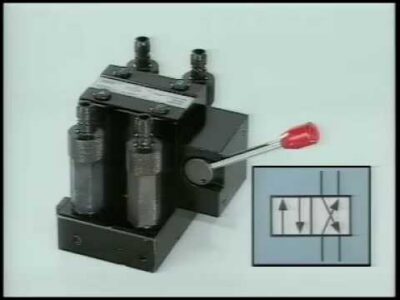 4-way 2-position valve
Related Questions
4/2 directional control valves can simply reverse the actuator’s direction with four ports and two positions.
These valves are frequently preferred to control the forward-back motion of single-acting cylinders.
4/2 valves offer a simpler, more compact circuit design by providing fewer positions than 4/3 valves.
Related Posts
 Time Delay Valve Explanation and Applications
 Hydraulic Oil Selection and Properties Required in Hydraulic Oils
 What Is a Solenoid Valve, How Does It Work?
 Pneumatic Conditioners (FRL Units)
 Spool Overlap in Seat Valves and Spool Valves
 An Overview of How Pneumatic Systems Work
 Pneumatic Directional Control Valves
 Design of Open and Closed Hydraulic Circuits