
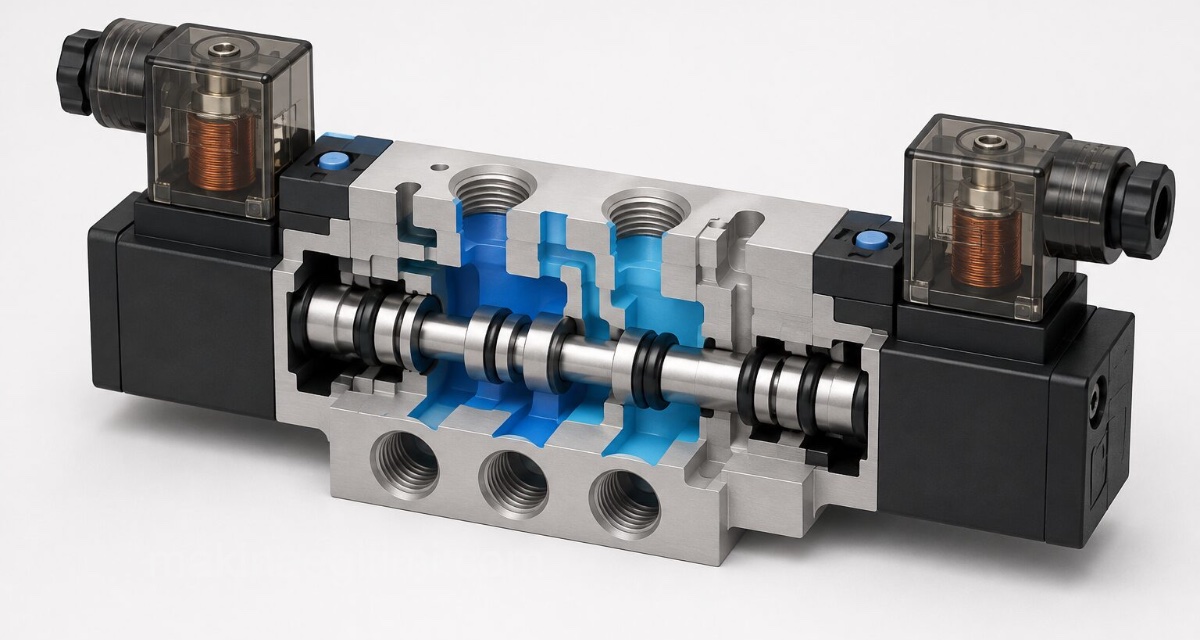
In this article we’ll cover what a solenoid valve is and how it works. We’ll also take a look at a solenoid valve’s parts and internal structure. We’ll touch on what to pay attention to when choosing a solenoid valve.
What Is a Solenoid Valve
It’s a type of valve that controls a fluid by opening and closing in response to an electrical signal. Solenoid valves are used for fluids such as air, gas, water, oil, and steam.

In vehicle engines, two solenoid valves mounted in the control housing are shown in the image below.
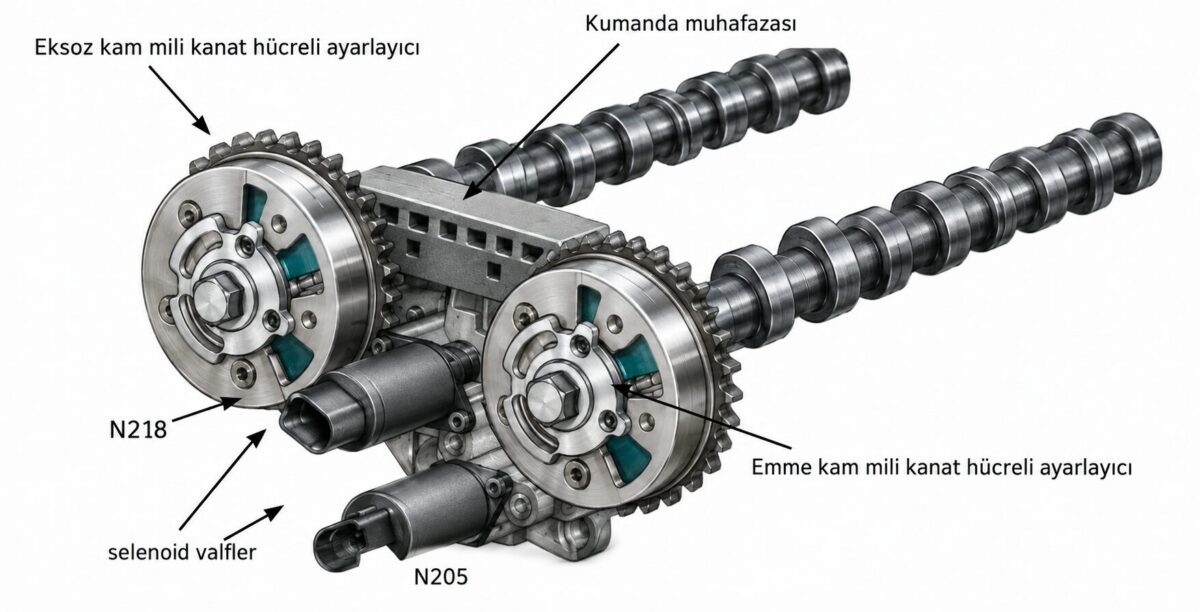
Based on signals from the engine control unit, it distributes engine oil pressure to both vane-cell adjusters. This ensures the correct operation of the hydraulically driven vane-cell adjusters, which help change the camshaft’s position. Intake camshaft timing valve -1 (N205) is responsible for the intake camshaft. Exhaust camshaft timing valve (N318) is responsible for the exhaust camshaft.
Position Change in Solenoid Valves
These valves change position using electrical energy, but this electrical energy alone isn’t enough to change that position.


In all solenoid valves, a DC or AC voltage between 12 and 220 volts is sent to the coil to change position. This voltage creates a magnetic field inside the coil, which pulls the core inside it. This is exactly where pressurized air comes into play: it acts as a supporting force alongside the electrical energy that pulls the core a small distance, allowing the valve to change position.
In other words, the pressurized air we normally use to feed the valve is also used, through a small channel inside the valve body, to change the valve’s position — the coils do nothing more than provide the initial triggering motion.
Electromagnetic Operation
A solenoid valve moves the valve piston using the magnetic field created when electric current is applied.
Fast Response Time
Solenoid valves have a response time fast enough to open and close within milliseconds.
Automation Compatibility
Solenoid valves are easily integrated with control systems like PLCs and are widely used in automated systems.
How Does a Solenoid Valve Work?
Solenoid coils are made in a range of types to operate at different voltages, on either DC or AC current. A solenoid coil is simply a cylindrical winding, and when electric current is applied to this winding, it acts like an electromagnet.

The iron core inside the coil is mechanically linked to the valve’s diaphragm. Since the iron core, and thus the diaphragm, is pressed down by a spring, the solenoid valve is normally closed.
When the solenoid valve’s coil is connected to the power supply, the iron core and the diaphragm are pulled upward. The valve opens, and the fluid passes from the inlet on the left to the outlet on the right.
A video explaining the operating system and parts of solenoid valves
How a Solenoid Valve Works, Video Walkthrough
The videos below explain the parts of solenoid valves and how these valves work
How a Solenoid Valve Works, Video 2
Choosing a Solenoid Valve
When choosing a solenoid valve, you should take into account the valve’s intended use, the pipe connection size, the operating voltage, and properties of the fluid to be used, such as pressure and temperature.

When choosing a solenoid valve, the type of fluid to be used is important. The fluid needs to be free of particles.
You should also pay attention to whether the valve is normally open or normally closed.
The fluid’s pressure, temperature, viscosity, and pipe connection size should be determined according to the valve’s intended use.
You should make sure the pressure of the fluid entering the valve is suitable for that valve. It’s especially recommended to place a filter in the piping upstream of solenoid valves.
Related Questions
A solenoid valve is a type of valve that moves the valve piston using the magnetic field created when electric current is applied.
Solenoid valves have a response time fast enough to open and close within milliseconds.
Yes, solenoid valves are easily integrated with control systems like PLCs and are widely used in automated systems.
Related Posts
 What Is a Check Valve. How Does It Work, What Is Its Function
 Types of Hydraulic Pumps
 4-Way 2-Position Directional Control Valves
 Force Calculations in Pneumatic Cylinders
 Hydraulic Pneumatic Clamping Elements
 Hydraulic Pressure Line Filter Explained
 What Is a Pneumatic Compressor, What Does It Do?
 Hydraulic Cylinder Force Calculator