Close Menu
  • MAKİNELER ve İMALAT
    • Tools & Equipment
    • Computer-Aided Drawing
    • CAD/CAM Education
    • CNC Machine Programming
    • Casting Technologies
    • Electrical & Electronics Technologies
    • Hydraulics & Pneumatics
    • Manufacturing Processes
    • Manufacturing Technologies
    • Occupational Safety
    • Mold & Die Design
    • Solid Modeling
    • Welding Technology
    • Machine Elements
    • Mechanical Trade Drawing
    • Materials Science
    • Automotive & Vehicle Technologies
    • Robotics Technologies
    • Health Technologies
    • Defense & Aerospace Technologies
    • Descriptive Geometry
    • Technical Drawing
    • Software & Hardware Technologies
    • Innovative Manufacturing Methods
  • TEKNOLOJİ ve YAŞAM
    • OTOMOBİLLER ve TAŞIT
      • Vehicle & Engine Knowledge
      • Safe Driving
      • Sürüş Destek Sistemleri
    • Genel Kültür
      • Movies & TV Shows
      • Görsel ve Grafik Sanat
      • Books & Literature
      • Music
      • Sports
      • History
      • History of Technology
    • GÜNDELİK YAŞAM TEKNOLOJİLERİ
    • Hobbies & Entertainment
    • Internet Technologies
    • Health
    • Mobile Technologies
Makine Eğitimi
  • Machines & Manufacturing
    Machine Elements
    Hydraulics & Pneumatics
    Technical Drawing
    Computer-Aided Design & Manufacturing
    Basic Manufacturing Processes
    Manufacturing Processes
    Industry Technologies
    Other Technical Courses
    Motion & Power Transmission
    Simple Machines
    Chains & Sprockets
    Shafts & Journals
    Gears
    Cams
    Couplings
    Belts & Pulleys
    Springs
    Bearings
    Keys
    Fastening Joining
    Retaining Rings
    Screws, Bolts & Nuts
    Cotter Pins
    Flanges
    Welding
    Rivets
    Pins & Bolts
    Washers
    Calculators
    Gear Ratio Calculator
    Spring Constant Calculator
    Belt Pulley Ratio Calculator
    Other Machine Elements
    Slides & Linear Guides
    Brakes
    Flywheels
    Clamps
    Shock Absorbers
    Gaskets & O-Rings
    Seals & Sealing Elements
    Hydraulics
    Introduction to Hydraulics & Principles
    Hydraulic Systems & Applications
    Accumulators
    Filters
    Motors
    Pumps
    Valves
    Pneumatics
    Introduction to Pneumatics & Principles
    Pneumatic Systems & Applications
    Pneumatic Circuit Components
    Valves
    Cylinders
    Silencers
    Motors
    Compressors
    Dryers
    Conditioning Units
    Common Topics & Maintenance
    Hydraulic & Pneumatic Maintenance
    Study Notes, Exams & Tests
    Technical Drawing
    Introduction to Technical Drawing
    Geometric Drawings
    Perspective & Projection
    Orthographic Views
    Dimensioning
    Sectioning
    Assembly & Detail Drawings
    Tolerances
    Surface Finish Symbols
    Mechanical Engineering Drawing
    Screws, Bolts & Nuts
    Pulley Drawings
    Gear Drawings
    Shafts & Journals
    Bearing Drawings
    Pins & Bolts
    Spring Drawings
    Welds in Technical Drawing
    Washers
    Cotter Pins
    Technical Drawing Exercises
    Mechanical Drawing Exercises
    Gear Exercises
    View Extraction Exercises
    Pulley Exercises
    Pin & Bolt Exercises
    Threaded Fastening Exercises
    Descriptive Geometry
    Computer-Aided Drawing
    AutoCAD Drawing Lessons
    Computer-Aided Drawing Exams
    Solid Modeling & Animation
    Solid Model Drawing Files
    Solid Model Assembly Examples
    Solid Model Drawing Lessons
    3D CAD Software Reviews
    Solid Modeling Exercises
    CNC Programming
    CAM
    Measurement & Inspection
    Dial Indicators
    Calipers
    Gauges
    Micrometers
    Materials Science
    Steels
    Cast Iron
    Aluminum
    Plastics
    Material Testing & Hardness Measurement
    Occupational Safety
    Workshop Safety
    Safety When Working With Electricity
    Machine Safety Rules
    Hand Operations
    Filing
    Marking
    Cutting Operations
    Reaming
    Tapping
    Threading With a Die
    Drill Bit Sharpening
    Working With Machines
    Basic Turning Operations
    Basic Milling Operations
    Shaper Machine
    Machining
    Turning
    Milling
    Grinding
    Innovative Manufacturing Methods
    EDM (Electrical Discharge Machining)
    Laser Machining
    Waterjet Machining
    3D Printing
    3D Scanners
    Welding
    Rolling
    Casting
    Mold & Die Design
    Mechanical & Hydraulic Presses
    Blanking & Piercing Dies
    Bending Dies
    Drawing Dies
    Plastic Injection Molds
    Extrusion Dies
    Compound Dies
    Progressive Dies
    Blow Molds
    Spinning Dies
    Spray Molds
    Manufacturing of Machine Parts
    Automotive & Vehicle Technologies
    Motor Vehicle Manufacturing
    Raw Material Production
    History of Technology
    Health & Medical Technologies
    Defense & Aerospace
    Robotics Technologies
    Software & Hardware Technologies
    Mechanics - Strength of Materials
    Physics Topics
  • Technology & Life
    Hobbies & Entertainment
    Sports
    Music
    Vehicle & Engine Knowledge
    Vehicle Maintenance & Repair
    Safe Driving
    Driver Assistance Systems
    History
    Movies & TV Shows
    Books & Literature
    Computers & Internet
    Computer Tips
    Software Reviews
    Hardware & Peripherals
    Practical & Safe Internet Use
    Visual & Graphic Art
    Mobile Technologies
    Travel
    Science
    Health
    First Aid Knowledge
    Everyday Technologies
Makine Eğitimi
Home»Physics Topics»What Is Moment? How Is It Calculated? Moment Lesson
29 August 2026Updated:7 September 2026

What Is Moment? How Is It Calculated? Moment Lesson

What Is Moment? How Is It Calculated? Moment Lesson

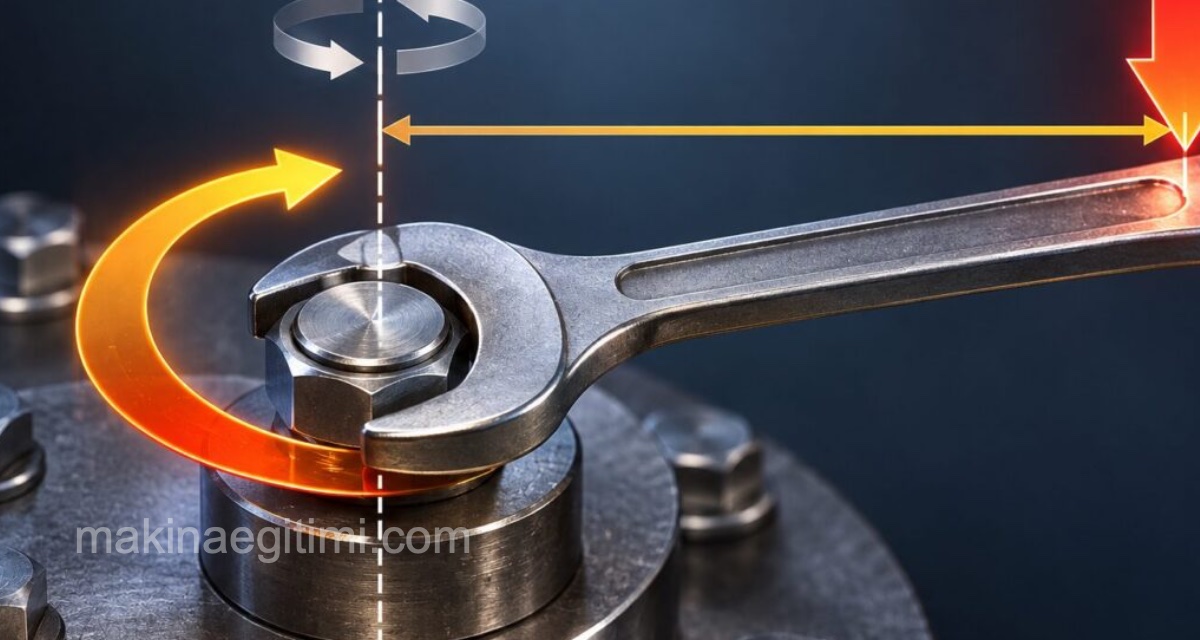
What is moment? The turning effect of forces is called a moment. In this article we’ll cover how a moment is calculated, with worked example problems and an illustrated explanation.
  • How Moment Is Calculated
    • Moment Calculation for Equilibrium Systems
    • Moment and Support Reactions
    • Calculating Moment for Angled Forces
    • Moment Calculation Problems
      • Problem 1 / Moment in Tightening a Bolt
      • Problem 2 / Moment on a Rotating Pulley
      • Problem 3 / Fixed Support
      • Problem 4 / Pinned and Sliding Support
      • Problem 5 / Pinned Support
  • Related Questions
what is a moment

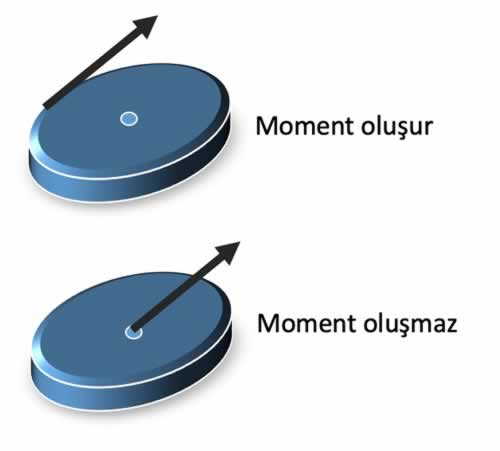
For a moment to occur, the line of action of the force acting on the body must pass outside the pivot point. Otherwise no moment occurs.

How Moment Is Calculated

The value of a moment equals the magnitude of the force multiplied by the length of the moment arm.

Let’s try to close the door shown in the figure by pushing it at various points.

how a moment is formed - explanation

We observe that at point (A) the door closes easily when pushed with force F1, rotating around the hinge. At point B it’s a bit harder, at point C it’s even harder, and at point D (the hinge point itself) we find that no matter how hard we push, we can’t close it at all.

The reason is that the highest moment occurs at point A. Even though the magnitude of the force is the same, the moment arm (distance to the hinge) is at its maximum at point A.

Moment Calculation for Equilibrium Systems

Moment lesson - couple of forces

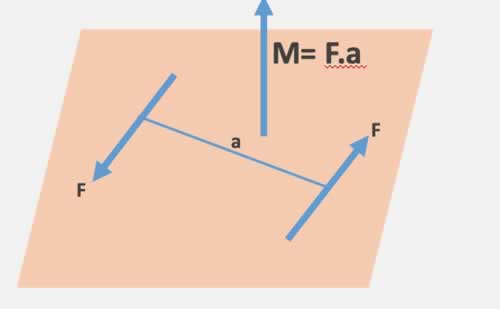
A system formed by two forces that are opposite in direction, parallel to each other, and equal in magnitude is called a “couple.”

A couple, as long as its elements and value stay constant, can be replaced by another couple.
finding the moment

A couple can be shifted to another location within its own plane. A couple can also be moved to a different plane parallel to the one it’s in.

moment ve kılavuz çekme

In tapping a thread with a tap, the forces applied to the two ends of the tap wrench are a good example of a couple.

Here, the direction the tap rotates is the direction of the moment vector’s rotation.

Moment and Support Reactions

moment and support reactions

Elements that carry a load in a horizontal position are called beams, and the systems that carry those beams are called supports.

Pinned support: fixed by a pin, it cannot move in the x or y direction. Consequently, it can carry two forces, along the x and y axes.

moment lesson explanation

At the supports, opposing forces (reactions) arise according to how the beam is being acted on.

Under the basic principles of statics, action = reaction.

The directions of the reactions Ax and Ay can initially be chosen arbitrarily, or in either direction. If solving the equations ΣFx = 0 and ΣFy = 0 gives a positive (+) value, the direction was chosen correctly.

If the value comes out negative (-), the reaction’s direction was chosen incorrectly. It should be corrected and the solution continued. In short, the directions of support reactions aren’t fixed, and can change depending on the directions chosen.

what is moment, how is it found - roller support

Roller support: since it can slide, it can only carry a load in the vertical direction.

Depending on how it’s acted on;
if a force comes in the x direction, the beam slides and the system’s equilibrium is disturbed. A vertical reaction Ay occurs.

finding the moment - fixed support

A fixed support is supported at one end while the other end is free; since it prevents rotation as well as translation from where it’s fixed, reactions Ax, Ay, and M all occur.

Calculating Moment for Angled Forces

Finding the moment for angled forces

Since the cylinder is perpendicular to plane N, force F cannot directly produce a turning effect.

moment for angled forces, illustrated

The component of force F that’s parallel to (or lying in) plane N — that is, its projection — is what’s effective.

Moment = force x distance to the axis of rotation
M = Fx . r
M = F. cos α . r

Moment Calculation Problems

Problem 1 / Moment in Tightening a Bolt

moment formed when tightening with an open-end wrench

Application problem: The nut shown in the figure is being tightened with an open-end wrench. Find the resulting moment.

Solution:
M = force . moment arm
M = F . r   
M = 200 . 0.3
M = 60 Nm

Note: To find the moment in Nm, we converted 300 mm to m.
300 mm = 0.3 m

Problem 2 / Moment on a Rotating Pulley
moment calculation on belt pulleys

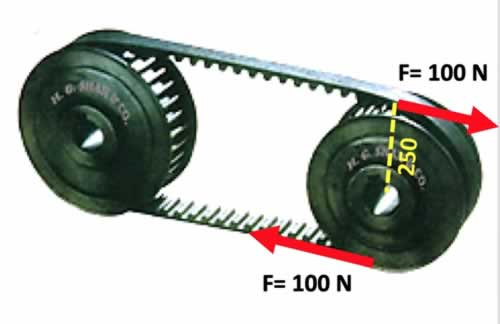
The forces acting on the pulley shown, which has a diameter of D = 500 mm, are shown in the figure. Find the resulting moment.

Solution: since both forces act in the clockwise direction, we add the effects of the forces together to find the total moment.

∑M = 100 . 0.25 + 100 . 0.25
∑M = 25 + 25
∑M = 50 Nm

Note: The moment arm is the pulley radius (250 mm), and its unit has been converted to meters. 

Problem 3 / Fixed Support
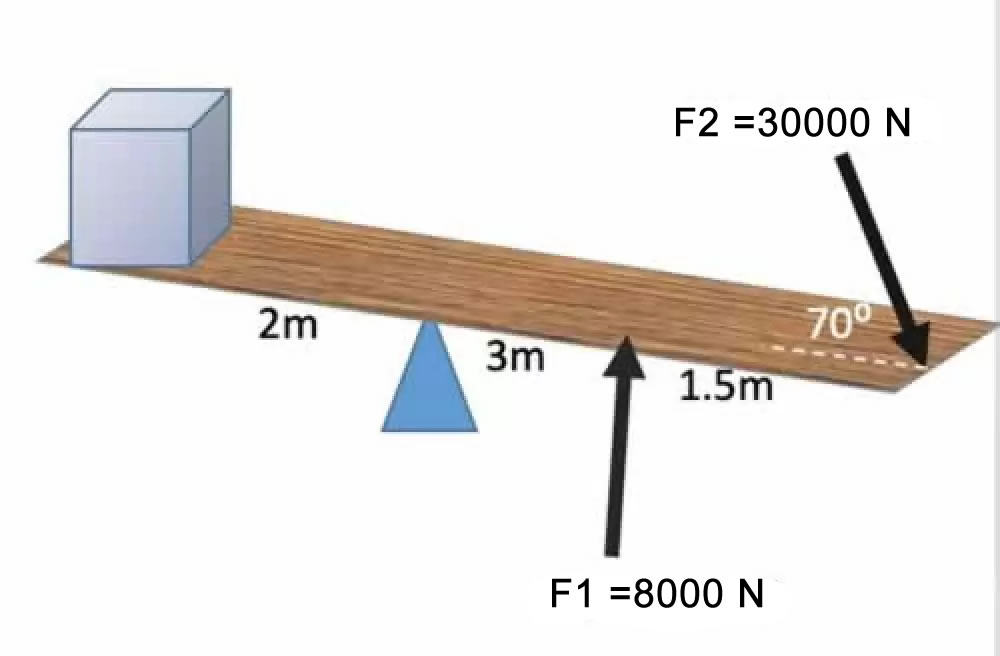
moment calculation problems

Application problem: The system shown in the figure is in equilibrium. Find the force the cube exerts on the system.

cos 70⁰ = 0.342      sin 70⁰ = 0.94 
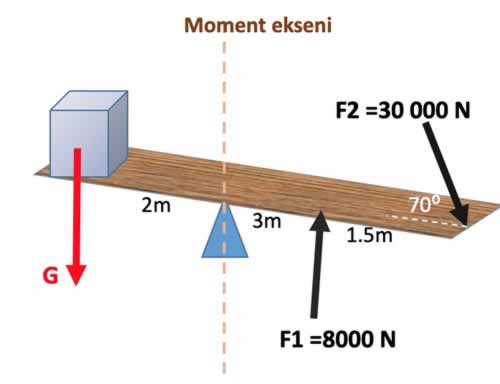
example moment problems

Solution:
∑MA=0
-G .2 – 8000 . 3 + 30000.sin70 . 4.5 =0
-G .2 – 24000 +30000 .0.94 . 4.5 =0
24000 +126900 = 2 G
102900 = 2 G
G = 51450 N

Problem 4 / Pinned and Sliding Support
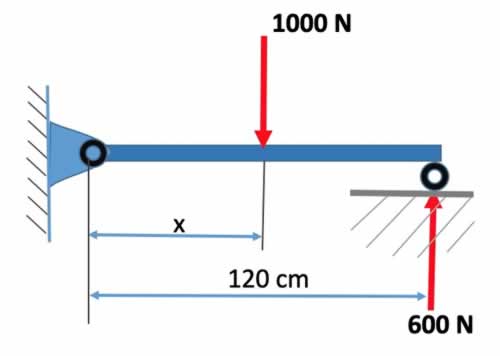
support problems and solutions

Problem: For the reaction at support B of bar AB, which is connected at point A with a frictionless pin, to be 600 N, how far from end A (x = ?) must a force of 1000 N be applied?

Solution: The system of forces acting on bar AB is in equilibrium. Therefore, the algebraic sum of the moments of these forces about any axis is zero. To keep the force acting on pin A out of the equation, if we take moments about an axis passing through it:
From the equation ∑ MA = 0
1000.X – 600.120 = 0
600 . 120 / 1000 = x
x = 72 cm

Problem 5 / Pinned Support

pinned joint problems and solutions

Problem: In the pinned lever arm system shown in the figure, what is the value of force F1?

Solution:  From the equation ∑ MA = 0
F1 . 400 – 100. 160 = 0
F1 .400 – 16000 =0
F1 .400 = 16000
F1 = 16000 / 400
F1 = 40 N

Moment Formula


Moment (torque) is calculated as the applied force multiplied by its perpendicular distance to the axis of rotation (M = F x d).

Unit of Measurement


Moment is expressed in Newton-meters (Nm), and is the measure of a turning effect in mechanical systems.

Effect of the Moment Arm


For the same force, increasing the moment arm (distance) directly increases the resulting moment.

Related Questions

A moment is the product of the force’s magnitude and the moment arm (the distance to the pivot point). Since the moment arm becomes very short near the hinge, the moment produced by the same force stays small, making it harder to turn the door.

For a moment to occur, the force needs to act at a certain distance — a moment arm — from the pivot point. If the force passes directly through the pivot point, the moment arm becomes zero, which makes the resulting moment zero as well.


Related Posts

How to Calculate the Resultant Force How to Calculate the Resultant Force Simple Machines Simple Machines Connecting Batteries in Series and Parallel Connecting Batteries in Series and Parallel Basic Topics in the Mechanics Course resultant force in a system of forces Finding the Resultant Force in a System of Forces What Is Pascal’s Principle? Where It Is Used What Is Pascal’s Principle? Where It Is Used Table of SI base units used in physics and engineering What Is the SI System of Units? Base and Derived Units Finding Component Forces Finding Component Forces
Mechanics of Materials
Share. Facebook Twitter WhatsApp Tumblr Email Telegram Copy Link

Leave A Reply Cancel Reply


Two Poets Who Lived the Fate They Wrote: Pushkin and Lermontov
Why Does the Traction Control System Light (TCS Light) Come On?
  • Contact
  • Terms of Service
  • Privacy & Cookie Policy

Type above and press Enter to search. Press Esc to cancel.