Close Menu
  • MAKİNELER ve İMALAT
    • Tools & Equipment
    • Computer-Aided Drawing
    • CAD/CAM Education
    • CNC Machine Programming
    • Casting Technologies
    • Electrical & Electronics Technologies
    • Hydraulics & Pneumatics
    • Manufacturing Processes
    • Manufacturing Technologies
    • Occupational Safety
    • Mold & Die Design
    • Solid Modeling
    • Welding Technology
    • Machine Elements
    • Mechanical Trade Drawing
    • Materials Science
    • Automotive & Vehicle Technologies
    • Robotics Technologies
    • Health Technologies
    • Defense & Aerospace Technologies
    • Descriptive Geometry
    • Technical Drawing
    • Software & Hardware Technologies
    • Innovative Manufacturing Methods
  • TEKNOLOJİ ve YAŞAM
    • OTOMOBİLLER ve TAŞIT
      • Vehicle & Engine Knowledge
      • Safe Driving
      • Sürüş Destek Sistemleri
    • Genel Kültür
      • Movies & TV Shows
      • Görsel ve Grafik Sanat
      • Books & Literature
      • Music
      • Sports
      • History
      • History of Technology
    • GÜNDELİK YAŞAM TEKNOLOJİLERİ
    • Hobbies & Entertainment
    • Internet Technologies
    • Health
    • Mobile Technologies
Makine Eğitimi
  • Machines & Manufacturing
    Machine Elements
    Hydraulics & Pneumatics
    Technical Drawing
    Computer-Aided Design & Manufacturing
    Basic Manufacturing Processes
    Manufacturing Processes
    Industry Technologies
    Other Technical Courses
    Motion & Power Transmission
    Simple Machines
    Chains & Sprockets
    Shafts & Journals
    Gears
    Cams
    Couplings
    Belts & Pulleys
    Springs
    Bearings
    Keys
    Fastening Joining
    Retaining Rings
    Screws, Bolts & Nuts
    Cotter Pins
    Flanges
    Welding
    Rivets
    Pins & Bolts
    Washers
    Calculators
    Gear Ratio Calculator
    Spring Constant Calculator
    Belt Pulley Ratio Calculator
    Other Machine Elements
    Slides & Linear Guides
    Brakes
    Flywheels
    Clamps
    Shock Absorbers
    Gaskets & O-Rings
    Seals & Sealing Elements
    Hydraulics
    Introduction to Hydraulics & Principles
    Hydraulic Systems & Applications
    Accumulators
    Filters
    Motors
    Pumps
    Valves
    Pneumatics
    Introduction to Pneumatics & Principles
    Pneumatic Systems & Applications
    Pneumatic Circuit Components
    Valves
    Cylinders
    Silencers
    Motors
    Compressors
    Dryers
    Conditioning Units
    Common Topics & Maintenance
    Hydraulic & Pneumatic Maintenance
    Study Notes, Exams & Tests
    Technical Drawing
    Introduction to Technical Drawing
    Geometric Drawings
    Perspective & Projection
    Orthographic Views
    Dimensioning
    Sectioning
    Assembly & Detail Drawings
    Tolerances
    Surface Finish Symbols
    Mechanical Engineering Drawing
    Screws, Bolts & Nuts
    Pulley Drawings
    Gear Drawings
    Shafts & Journals
    Bearing Drawings
    Pins & Bolts
    Spring Drawings
    Welds in Technical Drawing
    Washers
    Cotter Pins
    Technical Drawing Exercises
    Mechanical Drawing Exercises
    Gear Exercises
    View Extraction Exercises
    Pulley Exercises
    Pin & Bolt Exercises
    Threaded Fastening Exercises
    Descriptive Geometry
    Computer-Aided Drawing
    AutoCAD Drawing Lessons
    Solid Modeling & Animation
    Solid Model Drawing Files
    Solid Model Assembly Examples
    Solid Model Drawing Lessons
    3D CAD Software Reviews
    Solid Modeling Exercises
    CNC Programming
    CAM
    Measurement & Inspection
    Dial Indicators
    Calipers
    Gauges
    Micrometers
    Materials Science
    Steels
    Cast Iron
    Aluminum
    Plastics
    Material Testing & Hardness Measurement
    Occupational Safety
    Workshop Safety
    Safety When Working With Electricity
    Machine Safety Rules
    Hand Operations
    Filing
    Marking
    Cutting Operations
    Reaming
    Tapping
    Threading With a Die
    Drill Bit Sharpening
    Working With Machines
    Basic Turning Operations
    Basic Milling Operations
    Shaper Machine
    Machining
    Turning
    Milling
    Grinding
    Innovative Manufacturing Methods
    EDM (Electrical Discharge Machining)
    Laser Machining
    Waterjet Machining
    3D Printing
    3D Scanners
    Welding
    Rolling
    Casting
    Mold & Die Design
    Mechanical & Hydraulic Presses
    Blanking & Piercing Dies
    Bending Dies
    Drawing Dies
    Plastic Injection Molds
    Extrusion Dies
    Compound Dies
    Progressive Dies
    Blow Molds
    Spinning Dies
    Spray Molds
    Manufacturing of Machine Parts
    Automotive & Vehicle Technologies
    Motor Vehicle Manufacturing
    Raw Material Production
    History of Technology
    Health & Medical Technologies
    Defense & Aerospace
    Robotics Technologies
    Software & Hardware Technologies
    Mechanics - Strength of Materials
    Physics Topics
  • Technology & Life
    Hobbies & Entertainment
    Sports
    Music
    Vehicle & Engine Knowledge
    Vehicle Maintenance & Repair
    Safe Driving
    Driver Assistance Systems
    History
    Movies & TV Shows
    Books & Literature
    Computers & Internet
    Computer Tips
    Software Reviews
    Hardware & Peripherals
    Practical & Safe Internet Use
    Visual & Graphic Art
    Mobile Technologies
    Travel
    Science
    Health
    First Aid Knowledge
    Everyday Technologies
Makine Eğitimi
Home»Technical Drawing»Geometric Drawings 4 – Tangent Arc Connections
29 August 2026

Geometric Drawings 4 – Tangent Arc Connections

Geometric Drawings 4 - Tangent Arc Connections

In our Technical Drawing Lessons section, this publication’s topic will be tangent arc connections (blending with arcs) in technical drawing. Connecting the arms of a right angle with an arc. Connecting the arms of an acute angle with an arc. Connecting the arms of an obtuse angle with an arc. Connecting a point outside a circle to the circle with an arc. Connecting a circle to a line AB outside it with an arc. We’ll look at how to blend two circles with a concave arc, and how to blend two circles with a convex arc.

  • Tangent Arc Connections in Technical Drawing
    • Connecting the Arms of a Right Angle with an Arc
    • Connecting the Arms of an Acute Angle with an Arc
    • Connecting the Arms of an Obtuse Angle with an Arc
    • Connecting a Circle to a Point Outside It with an Arc
    • Connecting a Circle to a Line AB Outside It with an Arc
    • Blending Two Circles with a Concave Arc
    • Blending Two Circles with a Convex Arc
    • Drawing a Tangent from a Point Outside a Circle
    • Drawing an Internal Tangent Between Two Circles
    • Drawing an External Tangent Between Two Circles

Tangent Arc Connections in Technical Drawing

Connecting the Arms of a Right Angle with an Arc

technical drawing arc constructions

Draw the right angle.
Draw lines parallel to the angle’s arms, at a distance of R.
Find where the parallel lines intersect, at points A and B.
Then open the compass to R, place its point at M, and connect A to B with an arc of radius R.

Connecting the Arms of an Acute Angle with an Arc

technical drawing arc connections

Draw the acute angle.
Draw lines parallel to the angle’s arms, at a distance of R.
From the point M we find, drop perpendiculars to the angle’s arms.
Then open the compass to R, place its point at M, and connect A to B with an arc of radius R.

Connecting the Arms of an Obtuse Angle with an Arc

arc constructions in technical drawing

Draw the arms of the obtuse angle.
Draw lines parallel to the angle’s arms, at a distance of R.
From the point M we find, drop perpendiculars to the angle’s arms.
Then open the compass to R, place its point at M, and connect A to B with an arc of radius R.

Connecting a Circle to a Point Outside It with an Arc

tangent arc connections in technical drawing

Draw the circle of radius R1. Opening the compass to R1 + R from the circle’s center, draw an arc.
Then, drawing an arc of radius R from point A, find the center point M.
Connect center M to the circle’s center O to find point B.
Placing the compass point at center M, connect an arc of radius R passing through A, tangent to the circle at B.

Connecting a Circle to a Line AB Outside It with an Arc

connecting a circle to a line

Draw a circle of radius R.
Take a line AB outside the circle.
Draw a line parallel to AB, at a distance of R1.
Placing the compass point at center O, find point M with an arc of radius R+R1.
Connect M to center O and extend the line.
Placing the compass point at center M, connect tangent points D and C.

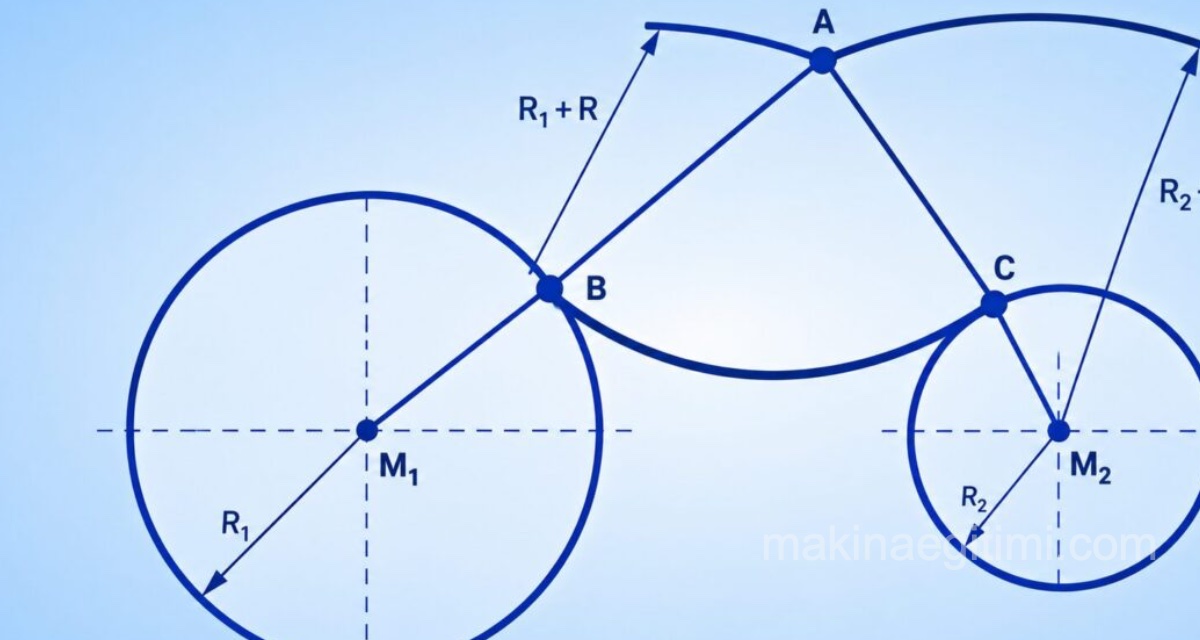
Blending Two Circles with a Concave Arc

blending two circles with a concave arc

1- Draw the axes centered on M1 and M2.
2- Draw circles of radius R1 and R2.
3- Opening the compass to R1+R, draw an arc centered on M1; opening it to R2+R, draw an arc centered on M2.
4- Mark point A.

5- Connect the point A we found to points M1 and M2.
6- Mark arms B and C.
7- Open the compass to R, place its point at A, and blend the tangent arms B and C together with a concave arc.

Blending Two Circles with a Convex Arc

1- Draw axes M1, M2.
2- Draw circles of radius R1 and R2.
3- Opening the compass to R – R1, draw an arc centered on M1; opening it to R – R2, draw an arc centered on M2. 4- Mark point A.

blending two circles with a convex arc

5- Extend lines from the point A we found through centers M1 and M2 to mark points B and C.
6- Place the compass point at A and blend the arms B and C together with a convex arc of radius R.

Drawing a Tangent from a Point Outside a Circle

drawing a tangent from a point outside a circle

1- Connect points M and S.
2- Find the midpoint P of line MS.
3- Open the compass to PM, draw an arc, and find point R.
4- The line passing through points R and S is tangent to the circle.

Drawing an Internal Tangent Between Two Circles

drawing an internal tangent between two circles

1- Draw a circle of radius R1+R2 centered on M1.
2- Find the midpoint O of line M1M2.
3- Placing the compass point at O, connect M1 and M2 with an arc to find point A.
4- Connect A to M1 to find tangent point B.
5- Connect A to M2, and from M2

drop a perpendicular from A to the line M2 to find tangent point C.
The line passing through points B and C will be tangent to circles R1 and R2.

Drawing an External Tangent Between Two Circles

drawing an external tangent between two circles

1- Draw a circle of radius R1-R2 centered on M1.
2- Find the midpoint O of line M1M2.
3- Placing the compass point at O, connect M1 and M2 with an arc to find point A.
4- Connect M1 to A and extend the line to find tangent point B.

5- Connect A and M2. From M2, drop a perpendicular from A to the line M2 to find tangent point C.
6- The line passing through points B and C will be tangent to circles R1 and R2.

Related Posts

Technical Drawing Paper Types Technical Drawing Paper Sizes and Folding Fit Tolerance Simulator Fit Tolerance Simulator Auxiliary Views in Technical Drawing Auxiliary Views in Technical Drawing Geometric Dimensioning and Tolerancing Geometric Dimensioning and Tolerancing What Is Perspective. Types of Perspective and Exercises What Is Perspective. Types of Perspective and Exercises Types of Sectioning in Technical Drawing? Sectioning Methods Types of Sectioning in Technical Drawing? Sectioning Methods What Does a T-Square Do, How Is It Used? What Does a T-Square Do, How Is It Used? Teknik resim kağıt çeşitleri Types of Technical Drawing Paper

Geometric Drawings
Share. Facebook Twitter WhatsApp Tumblr Email Telegram Copy Link

Leave A Reply Cancel Reply

Spark Plug Lifespan. How Do You Know When Its Time to Replace It?
How Is a Camshaft Checked?
  • Contact
  • Terms of Service
  • Privacy & Cookie Policy

Type above and press Enter to search. Press Esc to cancel.