
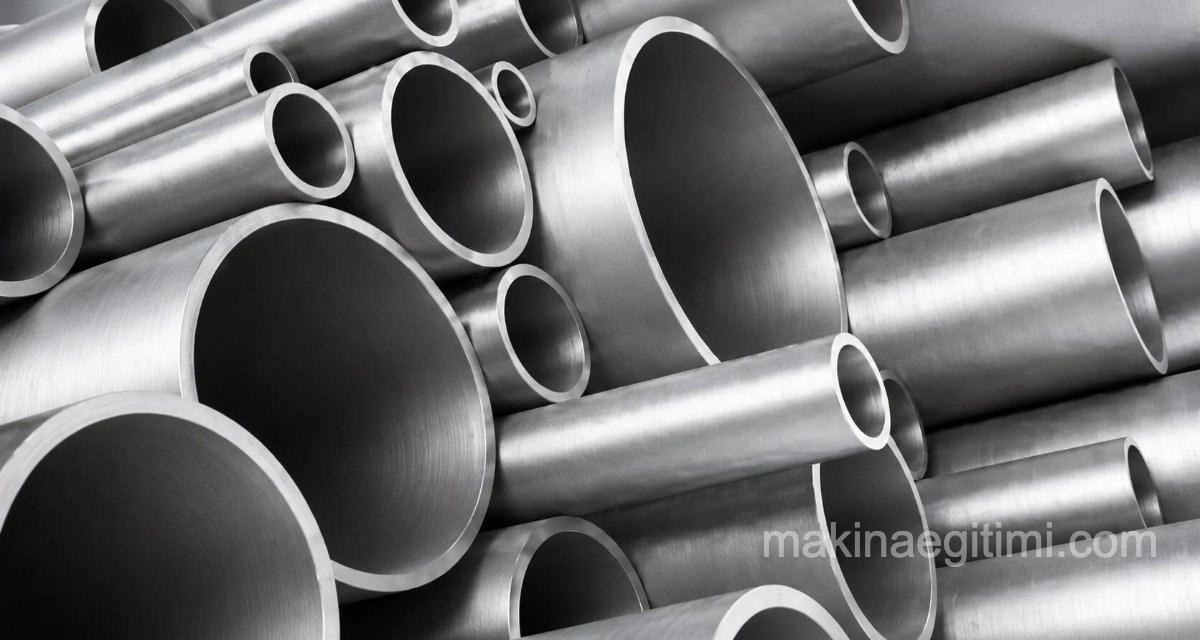
In materials science, the topic of this article will be the classification of steels according to the DIN standard. How are steels designated in DIN standards? What do the abbreviations in steel designations mean? We’ll cover the DIN designation, properties, and applications of unalloyed steels, case-hardening steels, free-cutting steels, and quenched and tempered steels.
Classification of Steels According to the DIN Standard
The German Institute for Standardization’s standard (German: Deutsches Institut für Normung) is abbreviated as DIN. The German standard is based mostly on the strength of steels. It does not take the chemical composition of the steel into account. In the DIN standard, the “St” symbol is generally used to give steels a short name. St is the initial letters of the German word Stahl = Steel. The numbers that follow, such as 37, 42…, indicate the steel’s tensile strength. Tensile strength is linked to the carbon ratio.

Abbreviations of steel and cast iron types according to the DIN standard (above)
For ST, GG, GS, GTS, and GTW, the minimum tensile strength (N/mm²) is obtained by multiplying the directly appended number by a factor of 9.81. For StE, on the other hand, this gives the guaranteed yield strength.

Explanation of the abbreviations used in the DIN standard (above). In this table, the numbers appended to the letters C and D indicate the carbon content as a percentage.
Classification of Alloy Steels According to the DIN Standard
The first number listed in the abbreviated names of the metals indicates the carbon content as a weight percentage. The letter C is not written here. What follows shows the chemical symbols of the alloying elements listed in order of weight percentage, along with the weight percentage multiplied by the factors below.

If the alloy content is more than 5%, the multiplication factor is not used. For unambiguous designation, an X is generally placed before the 100-times carbon (C) content. High-speed steels are designated with the letter S, along with their alloys. The listing order of the tungsten, molybdenum, vanadium, and cobalt alloy percentages is examined.

Designation of additional symbols with letters
Identifying letters written before each metal’s abbreviated name

The abbreviations and carbon ratios of the steels covered under the DIN standard that you are most likely to encounter are as follows.

General structural steels, gathered under DIN standard number 17 100, were consolidated under DIN standard number 10 025 following a revision made in 1991. This standard groups steels into three separate quality classes. Quality groups 1 and 2, for steels from St 33 to St 42, are designated according to the production method as follows: U = Non-deoxidized (during production, i.e. while molten, Mn, Si, and Al were not added to remove oxygen from the steel) structural steels. R = Deoxidized (during production, i.e. while molten, Mn, Si, and Al were added to remove oxygen from the steel) structural steels. Steels falling into quality group 3 are produced with particular attention to degassing. You can see examples of these steels in the table below.
Hot-Rolled Unalloyed Structural Steels According to the DIN Standard

Table of tensile strength, applications, abbreviations, and properties of hot-rolled unalloyed structural steels according to the DIN standard (above)
NOTE: Click the table to enlarge it.

Hot-rolled, unalloyed, weldable fine-grained construction steels according to the DIN standard. Properties and applications (above)

Classification of nitrided steels according to the DIN standard and their applications. (above)
NOTE: Click the table to enlarge it.
Free-Cutting Steels According to the DIN Standard

Free-cutting steels according to the DIN standard, properties and applications of free-cutting steels (above)
Designation of Quenched and Tempered Steels in the DIN Standard

Numbering, properties, and applications of quenched and tempered steels according to the DIN standard (above)

Numbering, properties, and applications of heat-treatable, hot-rolled spring steel (above)
NOTE: Click the table to enlarge it.
Designation of Case-Hardening Steels in the DIN Standard

Numbering, applications, and properties of case-hardening steels according to DIN standards (above)
Case-hardening steels are preferred in machine elements such as levers and screws, gears, machine tool spindles, measuring instruments, shafts, and piston pins.

Designation of ferritic, martensitic, and austenitic steels in the DIN standard and their applications. (above)
Ferritic steels can be cold-formed. They have poor machinability. They can be welded depending on conditions. For example, they are used in cladding parts and panels.
Martensitic steels can be hardened. They have good machinability. They are partially unweldable. They are used in high-strength parts, axles, shafts, and surgical instruments.
Austenitic steels can be cold-formed. They weld well. They have poor machinability. They are preferred in the chemical and food industries.

Unalloyed cold-drawn steels and their applications. (above)
Examples of the applications of unalloyed cold-drawn steels include tool components, hard-metal tool bodies, mining and road construction, tools exposed to compressed air, engraving dies, hand chisels, cold forming, knife making, band and circular saws used in woodworking, thread-cutting tools, press tools, and gauges.
DIN Standard Coding
The DIN steel classification expresses the material’s chemical composition and mechanical properties with coded letters.
St and C Series
In the DIN standard, “St” designates structural steels, while “C” designates steels with a specific carbon ratio.
International Use
Although of German origin, the DIN standard is widely referenced worldwide for steel classification.
Related Questions
In most engineering applications, what really matters is how much load the material can bear, not its exact chemical composition. Strength-based classification makes it easier for engineers to quickly select the right material.
This number is directly related to the steel’s tensile strength, and when multiplied by a specific factor, gives the material’s minimum tensile strength value. This makes it possible to understand a steel’s approximate strength level just by looking at its name.
Related Posts
 Steel Production Methods
 The Relationship Between Laser Cutting Quality and Material Composition
 Rockwell Hardness Testing Method
 Types of Plastics and Classification of Plastics
 What Is an Alloy, How Is It Formed? Properties of Alloys
 Properties of Aluminum. Information About Aluminum
 Vickers Hardness Testing Method
 Properties and Applications of Stainless Steel