
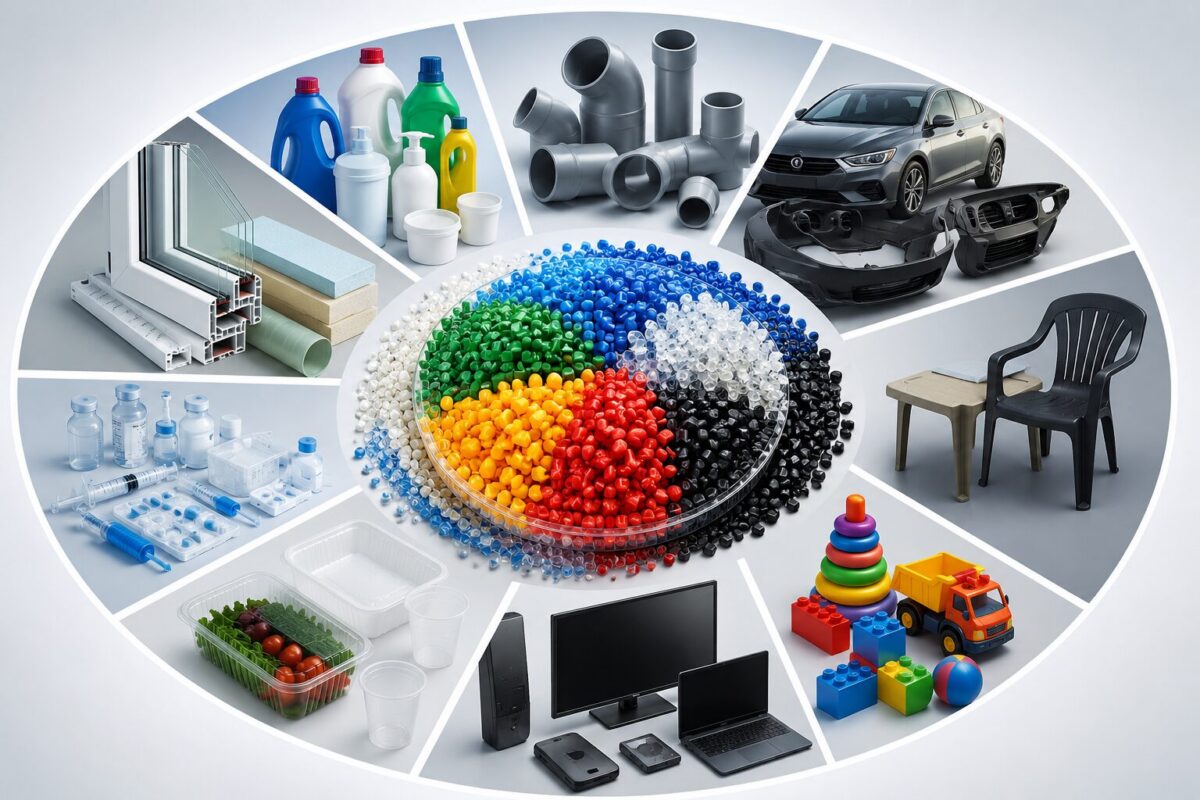
In our materials science section, we’ve devoted this article to the applications of plastics. We’ll give examples of how plastics are used in industry, in various fields, in household items, and in different areas of our lives, and look at where each type of plastic is used.
Applications of Plastics
When an engineer works with synthetic materials in technical applications, they need to know that the properties of this new material (mentioned earlier) don’t depend on the material alone, and must keep in mind that these properties also change according to the processing method and forming technique used. Plastic materials differ from familiar ferrous and non-ferrous materials in this respect. The injection molding methods used in the metal industry are often compared to the injection technique for synthetic materials. Since metals behave very differently from synthetic materials when injected, making this comparison isn’t accurate.
In many cases, it’s not possible to use blends made from various plastics. Also, it shouldn’t be assumed that the plastics used in a blend will retain their properties exactly as they were within the blend. However, it’s also necessary to check whether entirely new properties emerge as a result of the blend. On the other hand, whether the basic properties of the plastics change due to the blend is also examined at the end.
Applications of Plastics in Lighting Fixtures
Plastics are widely used today in lighting fixtures, and as the light reflector within these fixtures. Lighting fixtures are now made almost exclusively with plastic construction. Cellulose acetate, PVC, or acrylic glass are used as the material. The distinctive property of this covering material is its ability to channel light to a single point.
Acrylic glass is given a light transmission of 92%, a density of 1.2, 24-hour water absorption of 0.17%, tensile strength of 7.5 kg/mm², and an elastic modulus of 300 kg/mm².
Applications of Plastics in the Electrical Industry
ELECTRICAL INDUSTRY Plastics have been present in our homes in this field for many years. Pressboard is a very good insulating material against electric current. Phenolic plastics and the coating materials made from them are used extensively in electrical panels, junction boxes, handles, spark chambers, and similar places. For example, in electrical outlets. Phenolic plastics are used in black-colored outlets, while amino plastics are used in light-colored ones.

The downside of phenolic plastics is that in an electric arc, the top surface of the part can char and cause current tracking. In addition, the fracture strength drops significantly at the charred points. In many cases, even at normal workshop voltage, metal dust accumulated on the top surface of the part can be enough to cause tracking. For this reason, in many cases, polystyrene, which gives better results for such purposes, is used instead of thermoplastic synthetic materials.
In enclosed box-type equipment, fabric-reinforced phenolic press materials are used. Plastic-clad electrical distribution equipment is smaller and lighter than cast iron or sheet metal construction, while also having a more attractive appearance.
In the electrical cable and conductor industry, PVC and polyethylene (in high-frequency conductors) are used extensively. Polystyrene is used where higher performance is required. This material is foamed to reduce the dielectric constant from 2.2 to 1.08. (The dielectric constant of air is 1.0.) Using plastics together with metals in proper harmony in many constructions requires a separate study.

Another example of using plastics together with metals is printed circuits (conductors), which find application in small radios, hearing aids, and similar devices. In this method, the layout of the conductors that will form the electrical circuit is printed onto the insulating material with electrically conductive printing ink. The conductivity of the printing ink can be increased by adding a small amount of metal powder or graphite. In printed circuits, various components are connected via printed contacts or soldered lugs.
The field where plastics are used much more extensively is the radio, television, and radar industry. In this field, parts such as coils, capacitors, and tubes are produced from plastic. Very sensitive components are coated by dipping them in ester resin, epoxy resin, or PVC-carbazole.
Lamp sockets are made from phenolic plastics mixed with polyamide fibers or fluoroethylene. Electrical conductor wires are most often insulated with glass fiber impregnated with plastic.

We mentioned earlier that silicone is also widely used in this field. When used in cables and transformers in devices that need to be heat-resistant, silicone gives them high performance properties.
Applications of Plastic – The Vehicle Industry
In this field, plastics that are lightweight, have high fatigue resistance, are weather-resistant, and have as high an elastic modulus as possible are used. Initially, the use of plastics in the automotive industry was met with great understanding. Plastics found extensive application wherever quality was to be improved; first, appropriate plastics were accepted as a replacement for fabric. Later, other small parts such as handles, electrical distribution panels, armrests, and steering wheels also began to be made from plastic. The window glass of buses, trams, and other vehicles is now made from acrylic glass.

The main types of plastic used in the automotive sector are: phenolic plastics, cellulose acetate, polystyrene, acrylic resins, PVC, etc. One of the areas where plastic is used with great interest is applications made in sheet metal body construction to prevent vibrations. For this purpose, plastic mixed with absorbing materials is sprayed onto the inner surface of the sheet metal. There are also sprayed plastic coatings for gearboxes with a noise-reducing effect for this purpose.
Synthetic materials are also used directly in vehicle body manufacturing. Ester plastics are used for this purpose. This type of production is carried out on a series basis in America, in Germany, and in our country. In small production runs, plastic bodies cost less than sheet metal bodies. Plastic bodies are also lighter. Another good aspect is that they don’t corrode. Cracks formed in any collision are very easily repaired by welding and restored to their original condition.
Trucks and freight cars also continue to be manufactured from phenolic plastic, amino plastic, cellulose acetate, polystyrene, acrylic resin, PVC, and similar plastics.
Use of Plastics in the Packaging Industry
If the plastics used in the packaging industry are selected appropriately, a result suited to the purpose is achieved. Above all, plastic is lightweight, non-toxic, odorless and tasteless, and generally transparent. It also has a certain resistance to chemicals.
In the packaging industry, it’s most commonly used as tape, containers, wrapping (casing), varnish, and paint.
For detailed information, see: Plastics Used in Packaging

Applications of Plastic – Household and Kitchen Items
Plastic materials have long been used in the manufacture of household items. Applications in this field have become almost limitless. Both thermosetting plastics and thermoplastics are used as raw materials.
Generally, composite plastics made from a blend of many plastics are used. For example, no fewer than six types of plastic are used in an electric shaver.
Phenolic plastic, amino plastic, polystyrene, acrylic plastic, polyamide, and molding plastics are the materials used for this purpose.

Use of Plastic in Machine Manufacturing
Machine manufacturing is also among the applications of plastics. Sheets made from synthetic materials have long been used in gear manufacturing. The sheets are cut into plates of a thickness matching the width of the gears. Today, gear stock in round bar form is widely available on the market. Gears made from bar-shaped stock are more durable and cheaper. Another application area for the same type of material is bearing sleeves in plain bearings. This kind of sleeve is used especially in rolling mill equipment, crushing machines, cement mills, and similar heavy machinery.
One of the important applications of plastic is the production of tools and equipment used for sheet metal working. For this purpose, glass fiber or asbestos-reinforced phenolic resin along with epoxy resin or ester resin is used. When the die matrices (associated part) are cast from plastic, metal strips or angle brackets are often placed along the edges.
Use of Plastic in Precision Work
Among the places plastic is used are precision fields such as watchmaking, optics, and measuring instruments. Parts, handles, covers, and cases are generally made from whichever plastic suits the need, most often thermosetting plastics (duroplastics).
Plastic is also widely utilized in various optics-related production, measuring instruments, office machines, and the lighting industry.
Other Applications of Plastics
Phenolic resins are used as the bonding material in the manufacture of grinding wheels. Phenolic plastic or styrene rubbers are used for bonding asbestos fibers in friction clutches and in the manufacture of brake plates or linings in automobiles.
Plastics are used for tool handles and grips, protective screens and walls used in arc welding, all types of threaded fasteners, and parts such as gears, covers, and boxes. Plastics are also used in toys and recreational items, such as dolls, balls, cars, and model railway cars; foam-blowing pipes, dice, game marbles, colored sunglasses, masks, fishing gear, beach balls, curtains, cases and covers, suitcases, handbags, bags, various clothing items, buttons, chains, earrings, bracelets, raincoats, toothbrushes, and other notions items, as well as various materials in the construction industry.
The applications of plastics are increasing every day. It’s not yet possible to say for certain when the development and research on the applications of plastic will end, or when it will enter a period of stagnation.
Use in the Packaging Sector
Thanks to their light weight and ease of forming, plastics are the most widely used material group in the packaging sector.
Weight Reduction in Automotive
In the automotive sector, plastic parts reduce vehicle weight compared to metal parts, contributing to fuel efficiency.
Electrical Insulation Property
The non-conductive property of plastics enables their widespread use in the insulating parts of electrical equipment.
Related Questions
The same plastic material can show different mechanical strength or surface quality depending on whether it’s formed by injection or another method. So, along with material selection, which production method is used also determines the properties of the final product.
It can’t be assumed that the plastics going into a blend will retain their original properties exactly within that blend. The blend can produce unexpected new properties, so the behavior of blends needs to be tested individually.
Related Posts
 Electrodes Used for Welding Stainless Steels
 Material Types and Their Properties (per DIN Standard)
 Properties and Applications of Stainless Steel
 White Cast Iron
 Ductile (Spheroidal Graphite) Cast Iron
 Factors That Make Welding Stainless Steel Difficult
 What Is Steel, How Is It Made? Video Explanation of Steelmaking
 Differences Between Cast Iron and Steel