Close Menu
  • MAKİNELER ve İMALAT
    • Tools & Equipment
    • Computer-Aided Drawing
    • CAD/CAM Education
    • CNC Machine Programming
    • Casting Technologies
    • Electrical & Electronics Technologies
    • Hydraulics & Pneumatics
    • Manufacturing Processes
    • Manufacturing Technologies
    • Occupational Safety
    • Mold & Die Design
    • Solid Modeling
    • Welding Technology
    • Machine Elements
    • Mechanical Trade Drawing
    • Materials Science
    • Automotive & Vehicle Technologies
    • Robotics Technologies
    • Health Technologies
    • Defense & Aerospace Technologies
    • Descriptive Geometry
    • Technical Drawing
    • Software & Hardware Technologies
    • Innovative Manufacturing Methods
  • TEKNOLOJİ ve YAŞAM
    • OTOMOBİLLER ve TAŞIT
      • Vehicle & Engine Knowledge
      • Safe Driving
      • Sürüş Destek Sistemleri
    • Genel Kültür
      • Movies & TV Shows
      • Görsel ve Grafik Sanat
      • Books & Literature
      • Music
      • Sports
      • History
      • History of Technology
    • GÜNDELİK YAŞAM TEKNOLOJİLERİ
    • Hobbies & Entertainment
    • Internet Technologies
    • Health
    • Mobile Technologies
Makine Eğitimi
  • Machines & Manufacturing
    Machine Elements
    Hydraulics & Pneumatics
    Technical Drawing
    Computer-Aided Design & Manufacturing
    Basic Manufacturing Processes
    Manufacturing Processes
    Industry Technologies
    Other Technical Courses
    Motion & Power Transmission
    Simple Machines
    Chains & Sprockets
    Shafts & Journals
    Gears
    Cams
    Couplings
    Belts & Pulleys
    Springs
    Bearings
    Keys
    Fastening Joining
    Retaining Rings
    Screws, Bolts & Nuts
    Cotter Pins
    Flanges
    Welding
    Rivets
    Pins & Bolts
    Washers
    Calculators
    Gear Ratio Calculator
    Spring Constant Calculator
    Belt Pulley Ratio Calculator
    Other Machine Elements
    Slides & Linear Guides
    Brakes
    Flywheels
    Clamps
    Shock Absorbers
    Gaskets & O-Rings
    Seals & Sealing Elements
    Hydraulics
    Introduction to Hydraulics & Principles
    Hydraulic Systems & Applications
    Accumulators
    Filters
    Motors
    Pumps
    Valves
    Pneumatics
    Introduction to Pneumatics & Principles
    Pneumatic Systems & Applications
    Pneumatic Circuit Components
    Valves
    Cylinders
    Silencers
    Motors
    Compressors
    Dryers
    Conditioning Units
    Common Topics & Maintenance
    Hydraulic & Pneumatic Maintenance
    Study Notes, Exams & Tests
    Technical Drawing
    Introduction to Technical Drawing
    Geometric Drawings
    Perspective & Projection
    Orthographic Views
    Dimensioning
    Sectioning
    Assembly & Detail Drawings
    Tolerances
    Surface Finish Symbols
    Mechanical Engineering Drawing
    Screws, Bolts & Nuts
    Pulley Drawings
    Gear Drawings
    Shafts & Journals
    Bearing Drawings
    Pins & Bolts
    Spring Drawings
    Welds in Technical Drawing
    Washers
    Cotter Pins
    Technical Drawing Exercises
    Mechanical Drawing Exercises
    Gear Exercises
    View Extraction Exercises
    Pulley Exercises
    Pin & Bolt Exercises
    Threaded Fastening Exercises
    Descriptive Geometry
    Computer-Aided Drawing
    AutoCAD Drawing Lessons
    Solid Modeling & Animation
    Solid Model Drawing Files
    Solid Model Assembly Examples
    Solid Model Drawing Lessons
    3D CAD Software Reviews
    Solid Modeling Exercises
    CNC Programming
    CAM
    Measurement & Inspection
    Dial Indicators
    Calipers
    Gauges
    Micrometers
    Materials Science
    Steels
    Cast Iron
    Aluminum
    Plastics
    Material Testing & Hardness Measurement
    Occupational Safety
    Workshop Safety
    Safety When Working With Electricity
    Machine Safety Rules
    Hand Operations
    Filing
    Marking
    Cutting Operations
    Reaming
    Tapping
    Threading With a Die
    Drill Bit Sharpening
    Working With Machines
    Basic Turning Operations
    Basic Milling Operations
    Shaper Machine
    Machining
    Turning
    Milling
    Grinding
    Innovative Manufacturing Methods
    EDM (Electrical Discharge Machining)
    Laser Machining
    Waterjet Machining
    3D Printing
    3D Scanners
    Welding
    Rolling
    Casting
    Mold & Die Design
    Mechanical & Hydraulic Presses
    Blanking & Piercing Dies
    Bending Dies
    Drawing Dies
    Plastic Injection Molds
    Extrusion Dies
    Compound Dies
    Progressive Dies
    Blow Molds
    Spinning Dies
    Spray Molds
    Manufacturing of Machine Parts
    Automotive & Vehicle Technologies
    Motor Vehicle Manufacturing
    Raw Material Production
    History of Technology
    Health & Medical Technologies
    Defense & Aerospace
    Robotics Technologies
    Software & Hardware Technologies
    Mechanics - Strength of Materials
    Physics Topics
  • Technology & Life
    Hobbies & Entertainment
    Sports
    Music
    Vehicle & Engine Knowledge
    Vehicle Maintenance & Repair
    Safe Driving
    Driver Assistance Systems
    History
    Movies & TV Shows
    Books & Literature
    Computers & Internet
    Computer Tips
    Software Reviews
    Hardware & Peripherals
    Practical & Safe Internet Use
    Visual & Graphic Art
    Mobile Technologies
    Travel
    Science
    Health
    First Aid Knowledge
    Everyday Technologies
Makine Eğitimi
Home»Machine Elements»Bearing Selection. Which Bearing Is Used Where
29 August 2026

Bearing Selection. Which Bearing Is Used Where

How Bearings Are Selected

Our topics are as follows:

  • Ball Bearings
    • Deep Groove Ball Bearings
    • Angular Contact Ball Bearings
    • Self-Aligning Ball Bearings
    • Single-Direction Thrust Ball Bearings
    • Double-Direction Thrust Ball Bearings
  • Roller Bearings
    • Cylindrical Roller Bearings
    • Tapered Roller Bearings
    • Spherical Roller Bearings
    • Spherical Roller Thrust Bearings
  • Needle Bearings
  • Related Questions

When selecting a bearing, the first thing to consider is what types of loads it will be subjected to. A bearing can be subjected to two types of load: radial load and axial load.
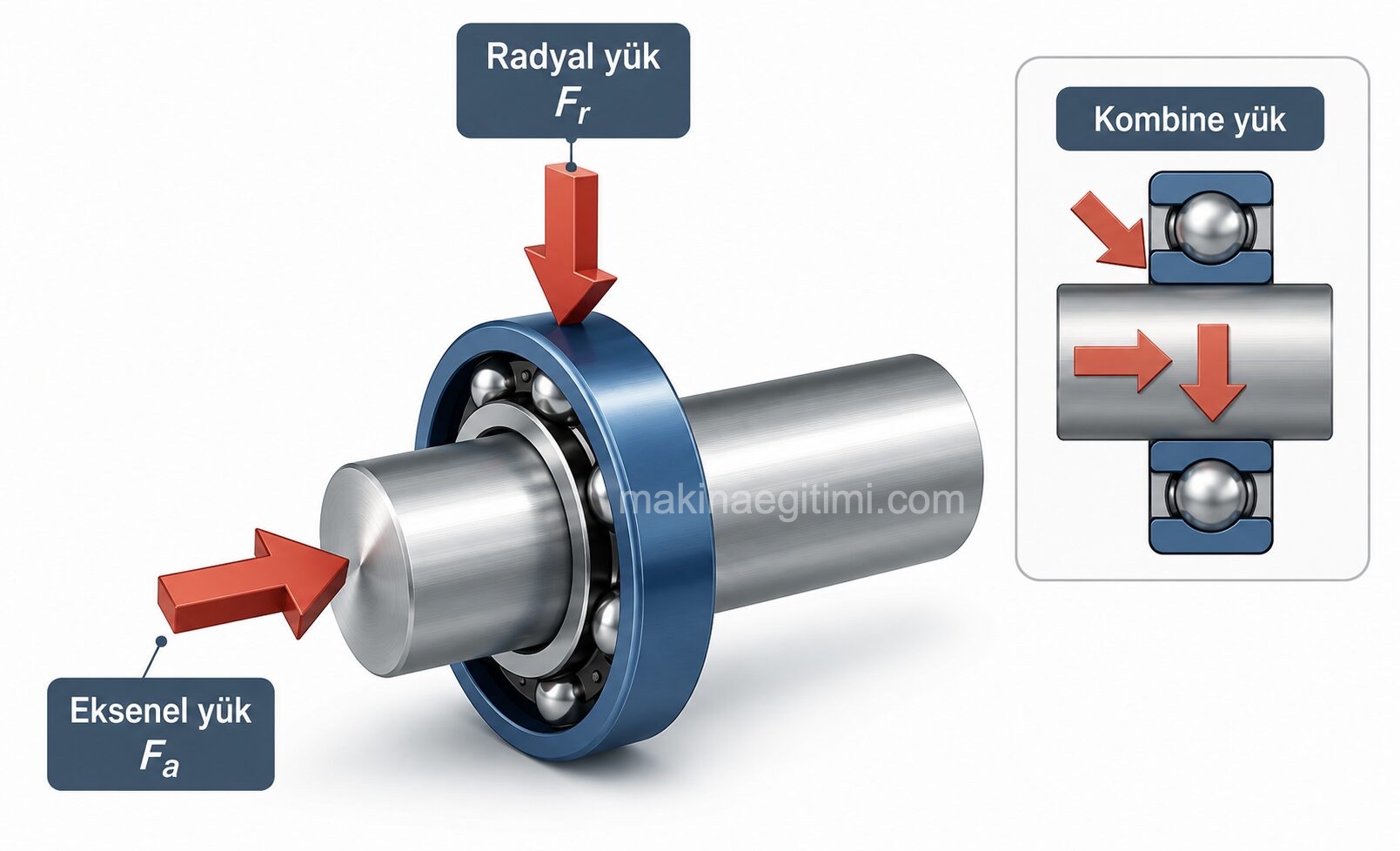
loads acting on a bearing

Besides these, factors such as heavy loads, high-speed operation, working in a vibrating environment, and working at an incline are also taken into account. Below, we’ll cover bearing types and where they’re used.

Ball Bearings

Ball bearings can carry both radial and axial loads. They are suitable for all speed ranges. They’re inexpensive and are the most widely used type of bearing.

Deep Groove Ball Bearings

deep groove ball bearing

Outside of normal applications, matched pairs of deep groove ball bearings are used in places where a single bearing isn’t sufficient to carry the load, or wherever axial location requires specific clearance values in both directions.

Angular Contact Ball Bearings
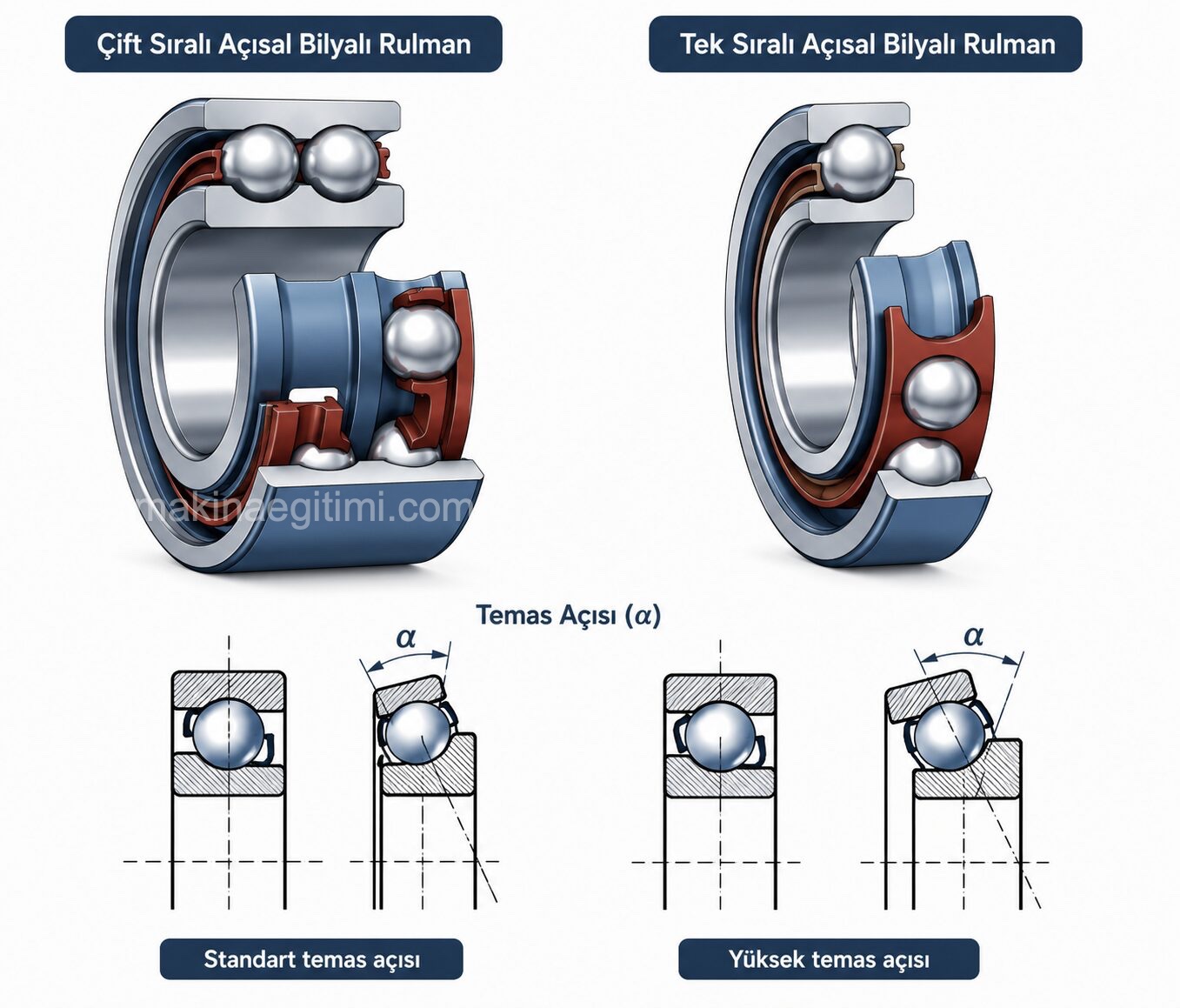
angular contact ball bearings

Contact angle α: the angle between the line formed by the contact points of the rolling element and the raceways, and the bearing’s center line.

They’re generally used for supporting machine-tool spindles.

Besides radial forces, these bearings also carry large axial forces.

α = 40o.

CNC lathe spindle support and bearings
CNC machine spindle

Support of a CNC machine spindle. Power: 25 kW Speed: 5000 rpm
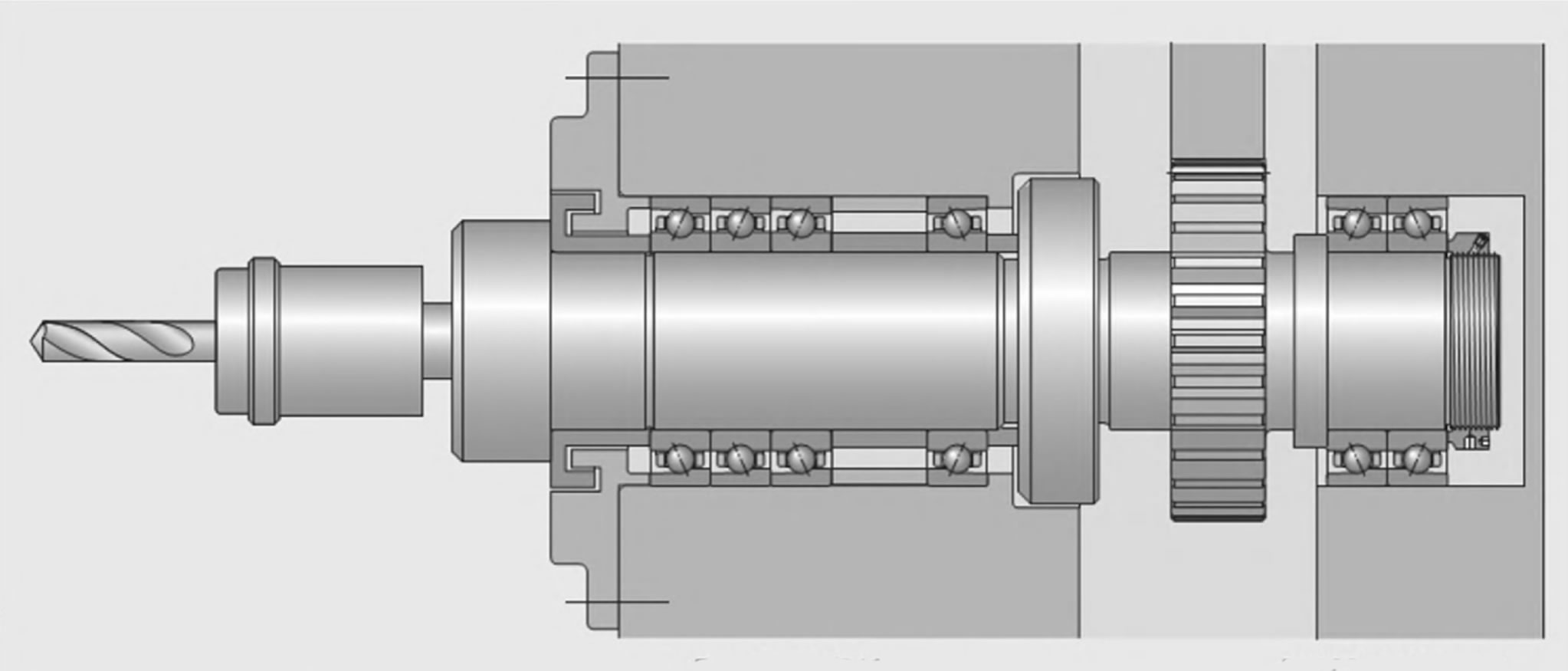
pillar drill spindle support
Pillar drill spindle

To provide rigidity, precision angular contact ball bearings are arranged in multi-bearing sets.
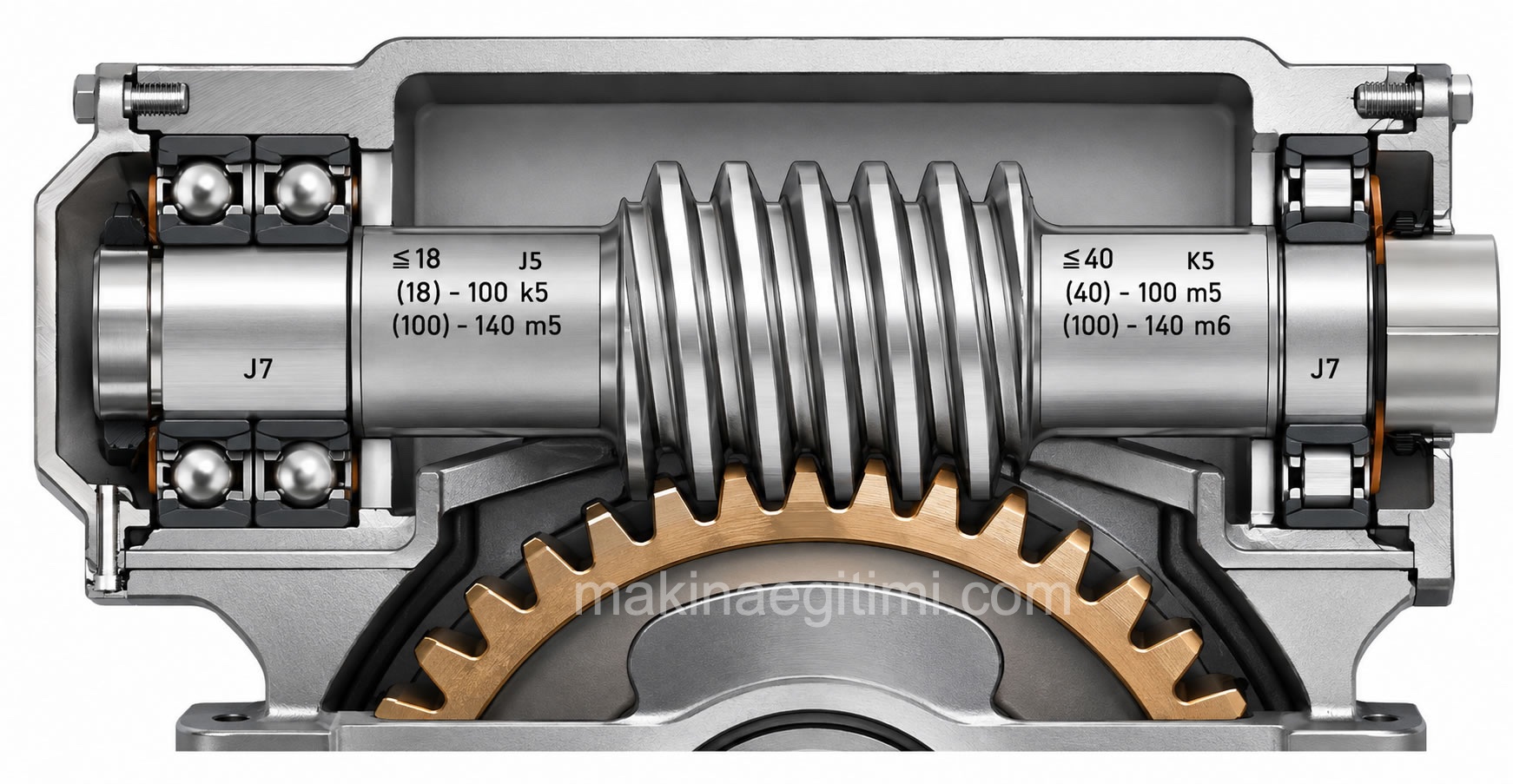
worm gear mechanism support and use of bearings
Support of a worm gear mechanism

Self-Aligning Ball Bearings

self-aligning ball bearings

Allows the shaft to tilt relative to the bearing housing. Usually double-row. The inner surface of the outer ring is spherical. The bearing self-aligns.

Depending on diameter, they can operate with up to a maximum of 3o of angular misalignment.

They must either be used in pairs, or the other bearing must have spherical freedom of its own.

woodworking machine drive shaft, full assembly section
The drive shaft of a woodworking machine

Single-Direction Thrust Ball Bearings
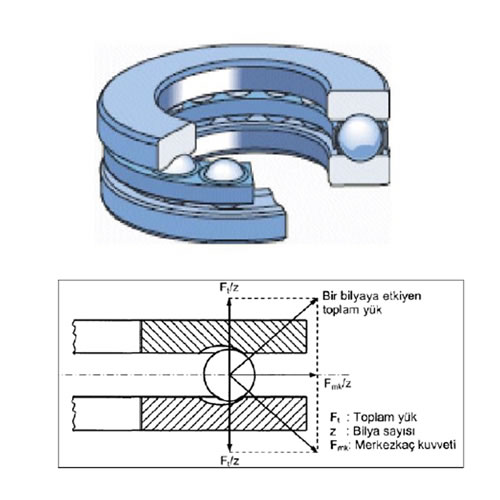
single-direction thrust ball bearings

Has a single row of balls running between grooved washers or rings.

Those carrying moderate axial loads do not carry radial loads.

During operation, the balls shift sideways under centrifugal force. Because of this, they aren’t suitable for high-speed operation.

Double-Direction Thrust Ball Bearings

double-direction thrust ball bearing

Has two rows of balls.

Each row carries the axial load in one direction.

The seating surfaces of the outer rings can be spherical.

Use of Ball Bearings


Ball bearings are widely used in moderate-load applications requiring low friction and high speed.

Roller Bearing Load Capacity


Thanks to their line contact area, roller bearings can carry higher radial loads than ball bearings.

Compactness of Needle Bearings


Thanks to their thin cylindrical rolling elements, needle bearings offer high load capacity in tight installation spaces.

Roller Bearings

Cylindrical Roller Bearings

cylindrical roller bearings

Carries twice the load of a single-row ball bearing with the same outer dimensions.

Can be single-row or double-row.

Contact is line contact.

They carry radial loads

Used in heavy-duty and shock-load applications.

loads on bearings, radial and axial force
support of a gear pump, full assembly technical drawing, cylindrical roller bearing
Support of a gear pump

Tapered Roller Bearings

tapered roller bearings

Because their rolling surfaces are angled, they’re well suited to carrying both axial and radial forces.

Always mounted in pairs, symmetrically.

support of a swash-plate axial piston pump, full assembly drawing, tapered roller bearing

Support of a swash-plate axial piston pump (image above)

roller support, full assembly drawing

Support for the rolls of a rolling mill (above)

Spherical Roller Bearings

spherical roller bearing

Allows the shaft to tilt. Depending on diameter, it can operate with up to a maximum of 3-5 degrees of angular misalignment.

Preferred for heavy-duty and shock-load applications.

Has two rows of rollers.

The inner surface of the outer ring is spherical.

Besides large radial loads, it also carries loads acting in both directions.

industrial fan, radial and axial loads on the bearings
two-stage industrial gearbox, full assembly section
A two-stage industrial gearbox
loom crank-connecting-rod linkage, full assembly drawing
The crank-connecting-rod linkage of a loom

Spherical Roller Thrust Bearings

spherical roller bearings

Has a very high load capacity.

Used where misalignment and shaft deflections are very large.

The bearing surface of the ring is spherical.

The bearing can self-align.

It also carries radial forces.

Needle Bearings

needle bearings

Needle roller bearings have thin, long, cageless cylindrical rollers.

Used in radially confined spaces.

Friction force is high; preferred for vibrating motions.

Related Questions

The direction of the load (radial or axial), operating speed, and whether the environment is subject to vibration all directly affect the bearing’s life and performance. That’s why all of these factors need to be evaluated together to make the right choice.

These bearings can carry large axial forces in addition to radial forces. Since a machine-tool spindle is subjected to force both while rotating and along its axis, this dual-direction load capacity provides a major advantage.


Related Posts
gears slide presentation Bevel Gear Strength Calculations Friction and Belt Slippage on Belt Pulleys Friction and Belt Slippage on Belt Pulleys Rack Gear Drawings Rack Gear Technical Drawings Types of pulleys and their applications Types of Pulleys, Their Applications Standard Representation and Dimensions of a Washer Standard Representation and Dimensions of a Washer Information About Pipe Threads Information About Pipe Threads cooling roller bearings Five Ways to Cool Roller Bearings Yaprak Yaylı ve Helezon Yaylı Süspansiyonun Farkları Differences Between Leaf Spring and Coil Spring Suspension
Bearings
Share. Facebook Twitter WhatsApp Tumblr Email Telegram Copy Link

Leave A Reply Cancel Reply

How Does a Manual Transmission Work? The Synchromesh Mechanism
Coilover (Coil Spring Shock Absorber) Advantages and Disadvantages
  • Contact
  • Terms of Service
  • Privacy & Cookie Policy

Type above and press Enter to search. Press Esc to cancel.