
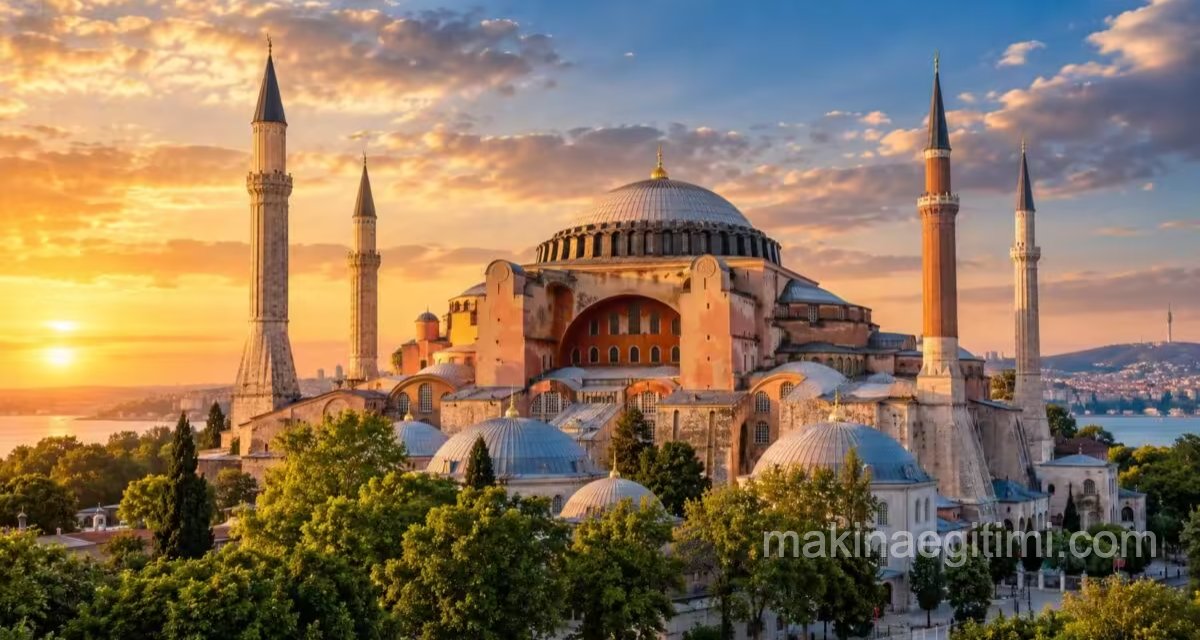
Dear readers, today we shall tell you the story of one of the most resilient and most debated structures in human history. This structure has stood the test of time for 1,500 years, despite earthquakes, fires, sieges and changes of regime. Moreover, during this period, it has taken on three completely different identities: first a church, then a mosque, subsequently a museum and finally a mosque once more.
Hagia Sophia, now one of Istanbul’s landmarks, is in fact the result of one of the most daring experiments in the history of engineering.
An Emperor’s Ambition: How Was It Built?
Today’s Hagia Sophia is, in fact, the third building to have been erected on the same site. The two previous churches had been destroyed as a result of uprisings and fires. When the Byzantine Emperor Justinian I decided to rebuild the city following a major uprising (the Nika Revolt) in 532, he wanted to build not just an ordinary church, but the most magnificent structure the world had ever seen.
Justinian entrusted this task to two figures—Isidoros of Miletus and Anthemios of Tralles—who were better known for their knowledge of mathematics and geometry than for their architectural experience. This choice was bold in itself; for at that time, even traditional architects regarded the construction of such a colossal dome as risky.
An Engineering Marvel: How Did It Stay Standing?
The most striking feature of the Hagia Sophia was that its enormous dome appeared to hang in the air without any visible supporting columns. This was an incredible feat of engineering for its time. The architects managed to distribute the dome’s weight across four large arches and the half-domes connected to them, thereby transferring the weight to the ground as if it were invisible.
However, this bold design came at a price. The first dome collapsed in an earthquake in 558, some twenty years after the building’s completion. Justinian did not give up; he had the dome rebuilt in a steeper and lighter form.
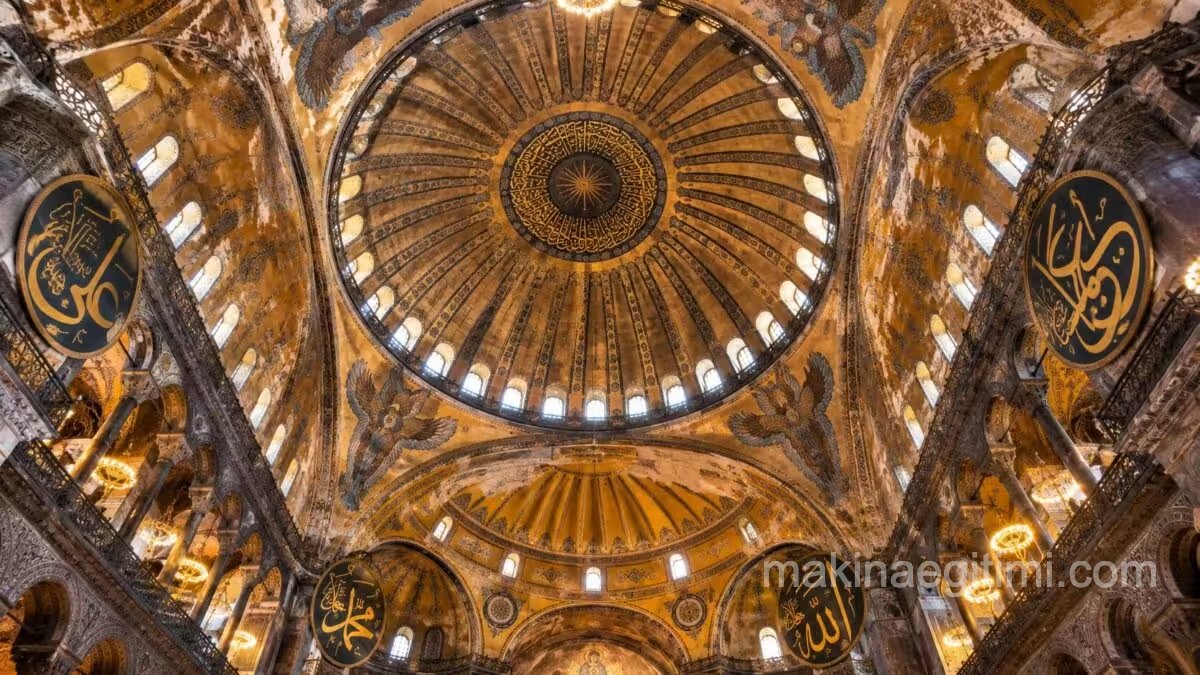
The dome we see today is, in fact, this second version, and it has managed to remain standing despite the dozens of major earthquakes it has withstood over the centuries.
What if the first dome had never collapsed?
Let’s pause for a moment and reflect. The collapse of the first dome actually gave the architects a second chance and taught them an important lesson. If the original design had remained standing without any problems, we might well have faced an even greater disaster in subsequent earthquakes; for the flatter and heavier form of the first dome could have made it more vulnerable in the long term.
Sometimes what makes a structure truly durable is not that it is perfect the first time round, but that lessons can be learnt from failure and it can be rebuilt anew and more wisely. The secret to the Hagia Sophia’s 1,500-year survival may well lie in this early failure.
1453: From a Church to a Mosque
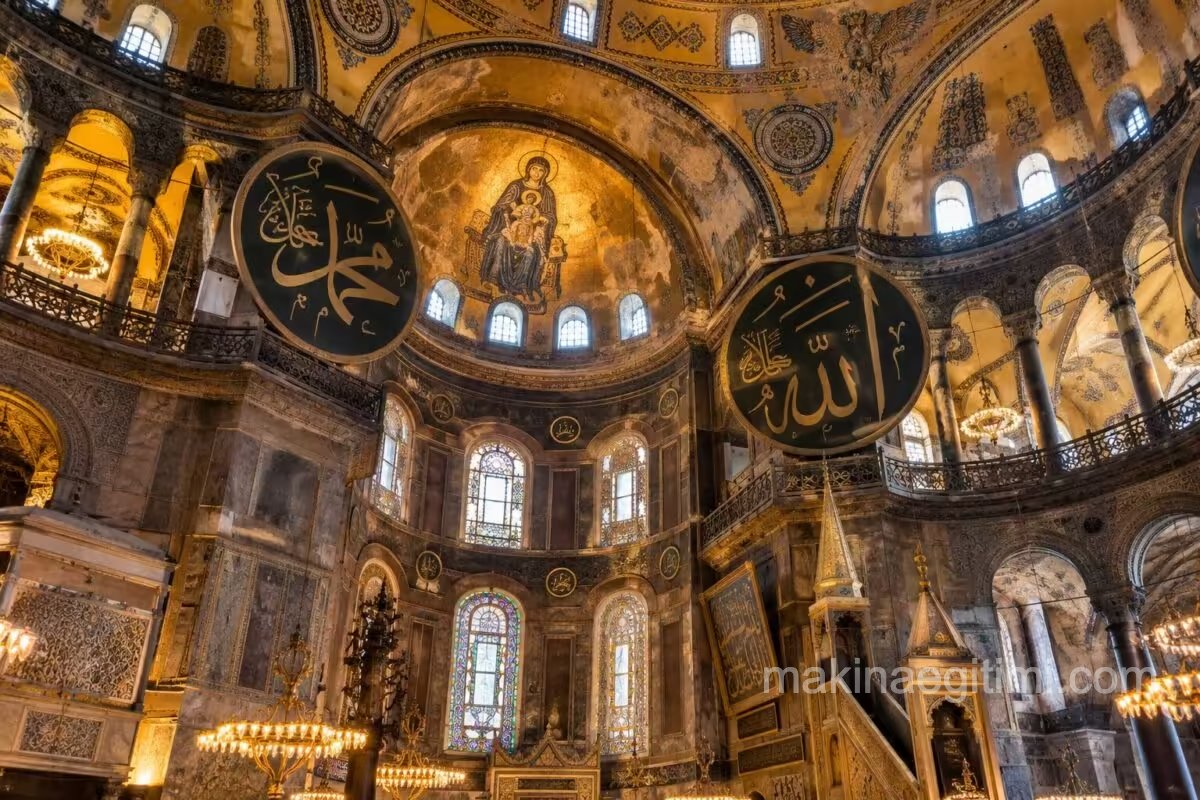
As we explained in our previous articles, with the conquest of Istanbul in 1453, the city came under Ottoman rule. When Sultan Mehmed the Conqueror entered the city, he went straight to the Hagia Sophia and decided to convert it into a mosque. However, rather than demolishing and rebuilding the structure, he chose to convert it whilst preserving the existing building; the mosaics on the walls were covered with plaster, minarets were added, and a mihrab and minbar were installed.
This approach, in fact, reflected Fatih’s general policy: rather than destroying the cultural heritage he had conquered, he sought to preserve it by adapting it to his own identity. Subsequent Ottoman sultans also transformed the Hagia Sophia into a külliye by adding minarets, madrasas and libraries to the complex.
The Republican Era: How Did a Mosque Become a Museum?
In 1934, the government of the Republic of Turkey decided to convert the Hagia Sophia into a museum. This decision was intended both to ensure the building’s preservation as a World Heritage Site and to reflect the secular state policy of the time. Following its designation as a museum, the Byzantine-era mosaics, which had been covered with plaster, were meticulously restored and brought to light.
In 2020, however, a court ruling in Turkey revoked the Hagia Sophia’s status as a museum, and the building was reopened for worship as a mosque. This decision sparked widespread debate both within Turkey and amongst the international public.
The Chain of Cause and Effect: A Building’s 1,500-Year Journey
- The devastation caused by the Nika Revolt prompted Justinian to undertake the construction of an unprecedented structure.
- A bold engineering design led to the collapse of the first dome during the earthquake.
- The lessons learnt from this failure led to the development of a second, far more robust dome design.
- The conquest of 1453 led to the building being converted into a mosque, following a decision to transform it rather than demolish it.
- The secular policies of the Republican era led to the building being converted into a museum in 1934.
- The court ruling in 2020 restored the building’s status as a mosque.
- Each transformation continued the tradition of preservation by adding to the structure rather than demolishing it, and this transformed the Hagia Sophia into a unique building that embodies both the Christian and Islamic heritages simultaneously.
A Little-Known Fact
The dome of Hagia Sophia was considered so innovative at the time of its construction that Procopius, a historian of the period, wrote that the dome appeared to be suspended ‘by a golden chain from the heavens’. Modern engineering analyses confirm that the special, lightweight and porous bricks used in the structure (made from a special clay brought from the island of Rhodes) played a critical role in making the dome so light yet strong. In other words, architects 1,500 years ago were already intuitively applying some of the principles of modern material science.
Related Videos

Hagia Sophia: Architecture That Defied Time | Full Documentary
Hagia Sophia – Istanbul's Ancient Mystery (2014) | Full Documentary | NOVA
Hagia Sophia: Istanbul's Ancient Mystery | Full Documentary | NOVA | PBS
The Story of Hagia Sophia | Istanbul, Turkey | Simple History
Frequently Asked Questions
The present-day structure was commissioned by the Byzantine Emperor Justinian I and built between 532 and 537 by the architects Isidoros of Miletus and Anthemios of Tralles.
The first dome collapsed in an earthquake in the year 558, some twenty years after the building’s completion. Justinian had the dome rebuilt in a steeper and lighter form.
Following the conquest of Istanbul in 1453, it was converted into a mosque on the orders of Sultan Mehmed the Conqueror.
It has changed its function three times in total: it was a church until 1453, a mosque from 1453 to 1934, a museum from 1934 to 2020, and has been used as a mosque again since 2020.
Related Posts
 Napoleon Bonaparte: How a Child of an Island Became the Master of Europe
  Berlin Streets After World War II. July 1945
  The Battle of Waterloo: The Afternoon That Decided Europe’s Fate
  The Sarajevo Assassination: How One Bullet Dragged the World Into War
  How Was the Enigma Code Cracked? Alan Turing and the Bombe Machine Explained
  The Financial Origins of the French Revolution: How a Kingdom Collapsed Into Bankruptcy
  The Black Death: How Did a Pandemic Bring About the End of the Middle Ages?
  The Tulip Mania: The Story of History’s First Financial Bubble and Manipulative Scheme