
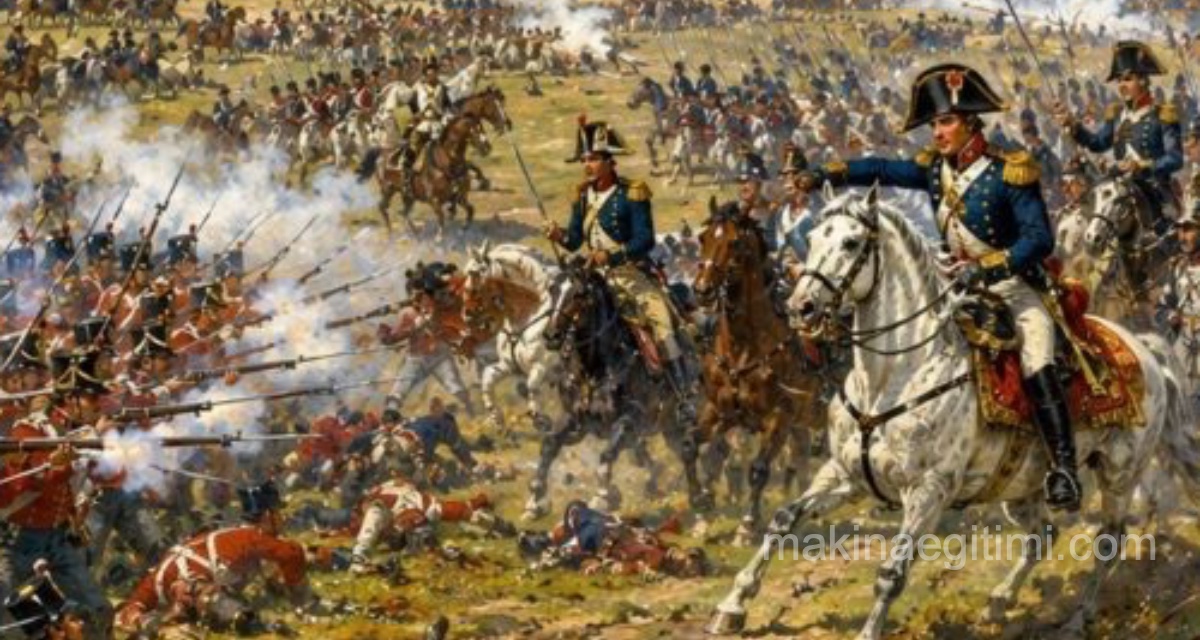
What happened at Waterloo, Napoleon’s last battle? How did one marshal’s delay bring down an empire? In this article, we lay it out through cause and effect.
How a marshal’s delay of just a few hours brought down an entire empire — that’s the story we’ll tell in this article. In our previous article we described how Napoleon was shaken by the disaster in Russia. Now we come to his final and most famous defeat: Waterloo.
June 18, 1815. In the muddy fields near a small town called Waterloo, in Belgium, the final act of more than twenty years of continuous warfare in Europe was about to play out.
An Emperor’s Incredible Return
After the disaster in Russia, Napoleon suffered defeat after defeat, and in 1814 he was deposed and exiled to the island of Elba. But he didn’t give up. In March 1815 he secretly escaped his exile, set foot back in France, and, remarkably, even the soldiers sent to capture him switched sides and rejoined him. He entered Paris within a short time and reclaimed his throne. This period is known in history as the “Hundred Days.”
Europe’s great powers, in the middle of negotiating a peace treaty in Vienna, were shaken by this news. They immediately reunited and prepared a great coalition army against Napoleon. Without wasting any time, Napoleon moved to strike his enemies one by one.
Ligny and Quatre Bras: Before the Storm
On June 16, 1815, Napoleon defeated the Prussian army under Marshal Blücher at Ligny. But he failed to destroy the Prussians completely, only forcing them to retreat. That same day, one of Napoleon’s commanders, Marshal Ney, clashed at Quatre Bras with the Anglo-Dutch army led by the Duke of Wellington, but achieved no decisive result.
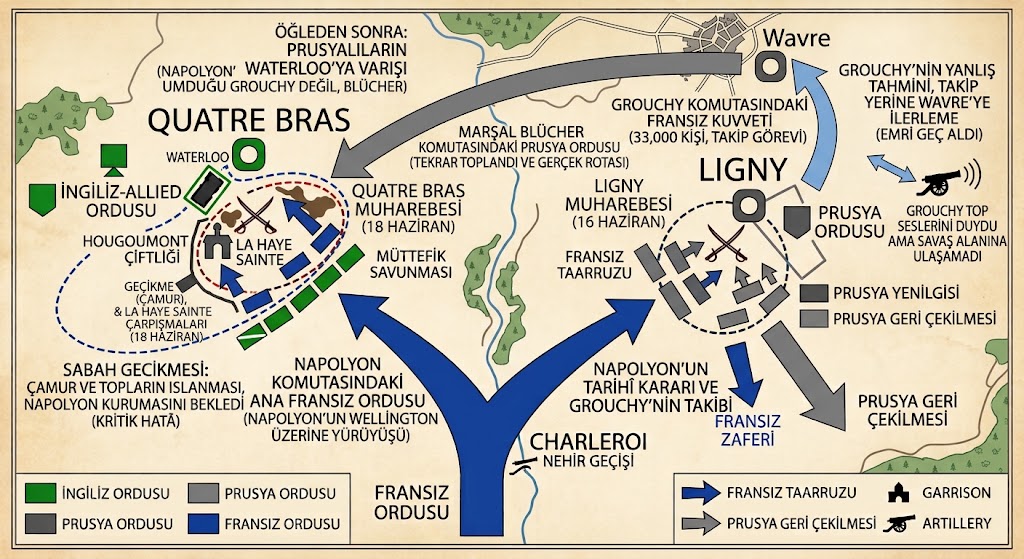
It was at exactly this point that Napoleon made one of the most controversial decisions in history: he assigned Marshal Grouchy to pursue the Prussians with a force of 33,000 men, while he himself marched with the main army against Wellington. The goal was simple: prevent the two enemy armies from joining forces.
June 18: A Rainy Morning, a Bloody Afternoon
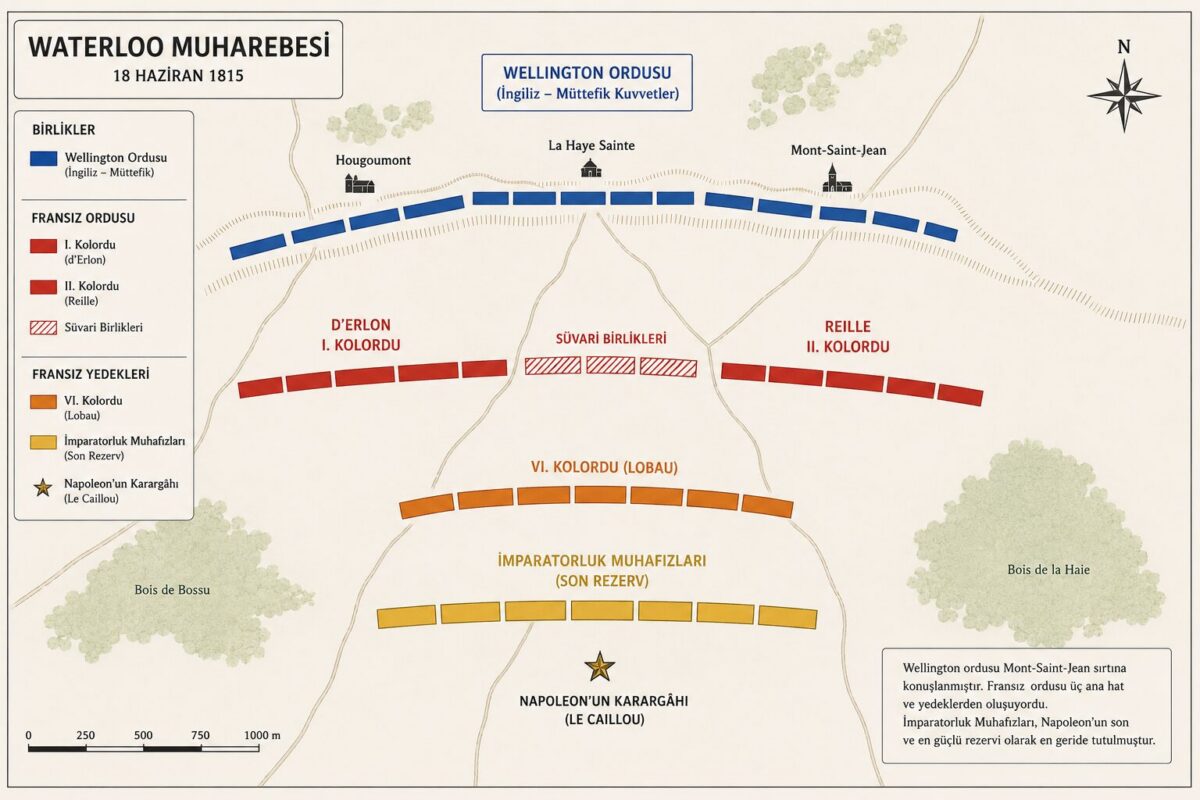
The battle at Waterloo began late in the morning, because heavy rain the night before had turned the ground to mud, and the cannons couldn’t be moved across the wet terrain. Napoleon delayed the attack, waiting for the ground to dry. This delay would later be judged a critical mistake, because every passing hour gave Blücher’s Prussians more time to reach the battlefield.
Napoleon’s army attacked Wellington’s defensive line repeatedly throughout the day. Hours of extremely bloody fighting raged around positions such as Hougoumont Farm and La Haye Sainte. Wellington’s line was shaken, but it did not break.
In the afternoon, movement was spotted to the east. Napoleon first hoped it was Grouchy’s forces. But what was approaching wasn’t Grouchy — it was the Prussian army under Marshal Blücher. Grouchy received his orders far too late, and instead of pursuing the Prussians, he misjudged their real route and marched off in another direction. Even though he could hear the sound of the cannons, he never reached the battlefield.
What If Grouchy Had Arrived in Time?
If Grouchy had managed to effectively pin down the Prussians, or had received Napoleon’s orders in time to reach the battlefield, Wellington’s army might well have collapsed before Prussian support arrived. Napoleon might have won this battle, and perhaps even held on to power a while longer. But history took a different course because one marshal marched in the wrong direction.
The Final Gambit: The Imperial Guard

Toward evening, as the pressure from the Prussian forces mounted, Napoleon played his last card: he sent the elite Imperial Guard, which had never been defeated up to that day, into battle. This unit was the morale of the French army and its last hope. But Wellington’s men stopped this legendary unit with a wall of close-range rifle fire. When the rest of the French army saw the Imperial Guard falling back, panic set in, and the entire front collapsed.
Napoleon was forced to leave the battlefield. Within a few days he was deposed for the second time, this time exiled far further away, to the island of Saint Helena in the Atlantic Ocean. He would never return.
The Chain of Cause and Effect: From One Battle to a Century
- Napoleon’s escape from Elba forced the European powers to unite again.
- The unfinished victories at Ligny and Quatre Bras pushed Napoleon toward a risky strategy.
- Grouchy’s failure to neutralize the Prussians allowed Blücher to reach the battlefield.
- The attack, delayed by rain, transferred the advantage of time from Napoleon to Wellington.
- The repulse of the Imperial Guard’s final assault caused the complete collapse of the French army.
- Napoleon’s second and final fall laid the groundwork for a new balance of power in Europe (the decisions of the Congress of Vienna).
- This order brought roughly a century of relative peace to continental Europe, lasting until the First World War.
Films About the Battle of Waterloo
1. Waterloo (1970)
Directed by Sergei Bondarchuk, this British-Italian-Soviet co-production was one of the most expensive films of its era. Rod Steiger plays Napoleon, while Christopher Plummer plays the Duke of Wellington. It’s famous for its massive battle scenes filmed with thousands of real soldiers, and it covers the period from Napoleon’s return from Elba to his final defeat at Waterloo. The film stands out both for its fidelity to historical detail and its magnificent battle scenes.
2. Sharpe’s Waterloo (1997)
An episode of the TV film series based on Bernard Cornwell’s “Sharpe” novels. It tells the story of the Battle of Waterloo through the eyes of the fictional character Richard Sharpe.
3. Napoleon (2023)
Directed by Ridley Scott, starring Joaquin Phoenix as Napoleon. Although the film covers Napoleon’s entire life, one of its final scenes is devoted to the Battle of Waterloo.
5. The Duke of Wellington (short/documentary productions)
There are also numerous TV documentaries dealing directly with Waterloo (such as BBC and History Channel productions), though these are documentary format rather than dramatic film.
A Little-Known Fact
In 2015, the 200th anniversary of the Battle of Waterloo, a treasure recovered from the battlefield went up for auction: a diamond brooch that Napoleon left behind as he fled the battle.
This historic piece found a buyer at an auction in Geneva in 2025 for far more than expected — over 3.5 million Swiss francs. Even centuries later, the traces of Waterloo continue to draw the interest of history enthusiasts.

Waterloo Savaşı
Avrupa Tarihi'ni Değiştiren Savaş , Waterloo Savaşı "18 HAZİRAN 1815" Napolyon'un Son Savaşı

Napolyon Waterloo Savaşı'nı Neden Kaybetti?
Frequently Asked Questions
It took place on June 18, 1815, near the town of Waterloo, in what is now Belgium.
The Anglo-Dutch-German army under the Duke of Wellington and the Prussian army under Marshal Blücher fought against Napoleon as a united coalition.
Grouchy was tasked with pursuing the Prussian army but failed to neutralize it, and despite hearing the sound of the cannons, he never reached the battlefield in time. This allowed the Prussians to arrive and support Wellington at the critical moment.
He was deposed for the second time and exiled to the island of Saint Helena in the Atlantic Ocean. He never returned, and he died there in 1821.
Related Posts
 The Battle of Gallipoli: How One Front Changed a Nation’s Fate
 Berlin Streets After World War II. July 1945
 The History of Hagia Sophia: One of the Most Enduring and Controversial Structures in Human History
 How Was the Enigma Code Cracked? Alan Turing and the Bombe Machine Explained
 The Tulip Mania: The Story of History’s First Financial Bubble and Manipulative Scheme
 The October Revolution: How a Tsardom Fell Overnight
 The Financial Origins of the French Revolution: How a Kingdom Collapsed Into Bankruptcy
 The Boston Tea Party: How a Crate of Tea Gave Birth to a Nation