

Fuel and air alone aren’t enough for a gasoline engine to run. The air-fuel mixture drawn into the cylinder needs to be ignited at the right moment. This job falls to the ignition system.
The ignition system starts the combustion process by producing a powerful spark at the right moment in each of the engine’s cylinders. A healthy ignition system provides easy starting, smooth idling, low fuel consumption, and strong engine performance.
What Does the Ignition System Do?
The ignition system’s basic job is to produce the high-voltage spark the engine needs.
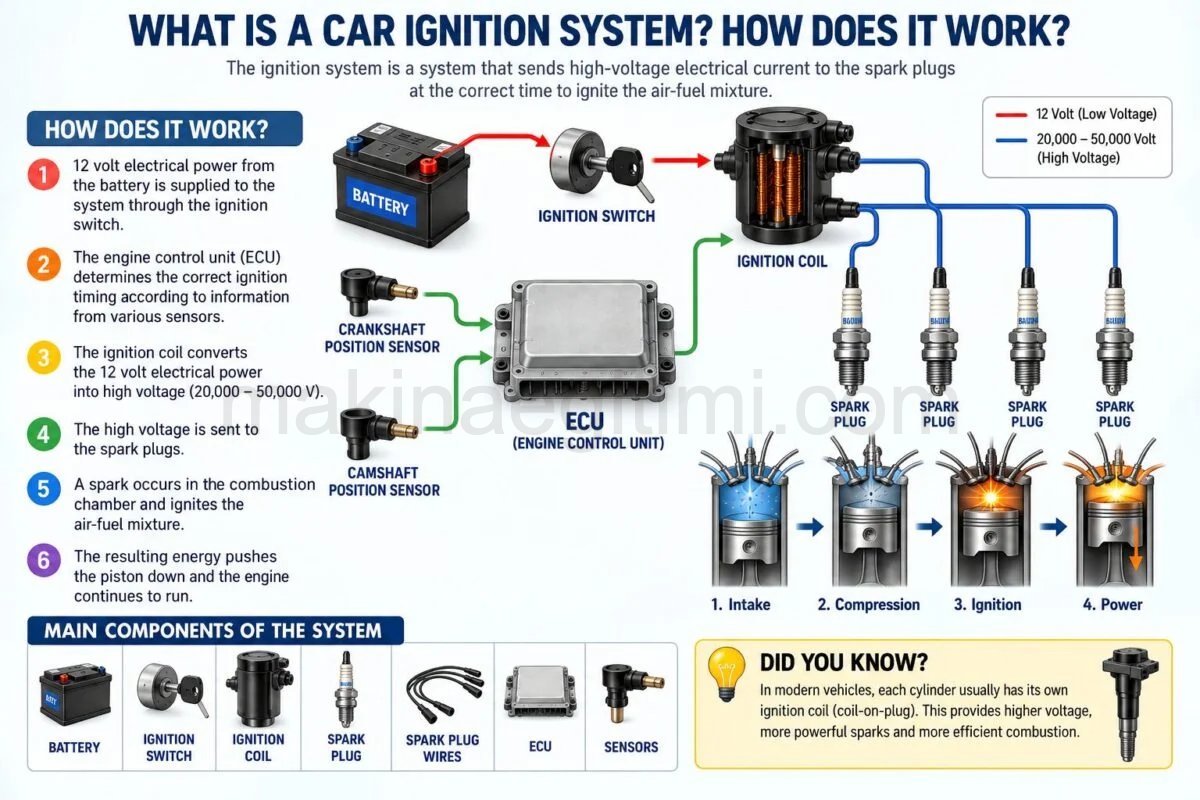
The 12 volts of electricity in the vehicle’s battery is stepped up to roughly 20,000 to 50,000 volts by the ignition coil. This high voltage reaches the spark plug, and the spark that jumps between the plug’s electrodes ignites the air-fuel mixture inside the cylinder. This process repeats dozens of times per second for as long as the engine runs.
How Does the Ignition System Work?
The ignition system works through a simple sequence of steps.
- The ignition is switched on and power comes from the battery.
- The engine control unit (ECU) determines the ignition timing.
- The ignition coil steps up the voltage.
- The high voltage is delivered to the spark plug.
- A spark forms at the spark plug.
- The air-fuel mixture burns.
- The resulting energy pushes the piston down and the engine keeps running.
In modern vehicles, all of this happens electronically within milliseconds.
Spark Plug Gap
The electrode gap on spark plugs is typically between 0.6-1.1 mm; an incorrect gap lowers ignition quality.
Ignition Voltage
Coils step up the 12V in the primary circuit to 20,000-40,000V to create a spark at the plug.
Direct Ignition System
Modern vehicles favor “coil-on-plug” systems, which use a separate coil for each spark plug instead of a distributor.
Basic Components of the Ignition System
- Battery: The ignition system’s initial power source. It supplies the necessary electricity before the engine starts.
- Ignition Coil: The coil converts the 12 volts from the battery into a much higher voltage. This is what makes it possible for the spark plug to produce a spark.
- Spark Plug: The spark plug is one of the most important parts of the ignition system. When the high voltage reaches the spark plug, a spark forms between its electrodes and ignites the fuel-air mixture.
- Spark Plug Wires: On some vehicles, these carry the high voltage from the coil to the spark plug. Many newer vehicles don’t use spark plug wires at all, since each spark plug has its own dedicated coil.
- Engine Control Unit (ECU): In modern vehicles, this manages ignition timing electronically. Based on engine RPM, load, and sensor data, it ensures the spark occurs at exactly the right moment.
- Crankshaft and Camshaft Position Sensors: These tell the ECU what position the engine is in. Without this information, ignition can’t happen at the correct time.
The Difference Between Old and New Ignition Systems
In older vehicles, the ignition system was mostly made up of mechanical parts. These systems included components like the distributor, contact points, condenser, distributor cap, and rotor.
Today, electronic ignition systems have replaced these parts. Electronic systems are more reliable, more precise, require less maintenance, and last longer.
The Most Common Ignition System Failures
- Spark Plug Failure: Spark plugs wear over time and spark strength decreases. As a result, starting becomes harder, the engine starts misfiring, and fuel consumption can increase.
- Ignition Coil Failure: When a coil fails, it can’t produce enough voltage. In this case, the vehicle can be hard to start, may not start at all, or may misfire.
- Spark Plug Wire Problems: On older-style ignition systems, spark plug wires can harden or crack over time. This weakens the spark.
- Sensor Failures: If the crankshaft or camshaft position sensor fails, the ECU can’t calculate the correct ignition timing. In this case, the engine may not start at all.
Symptoms of an Ignition System Failure
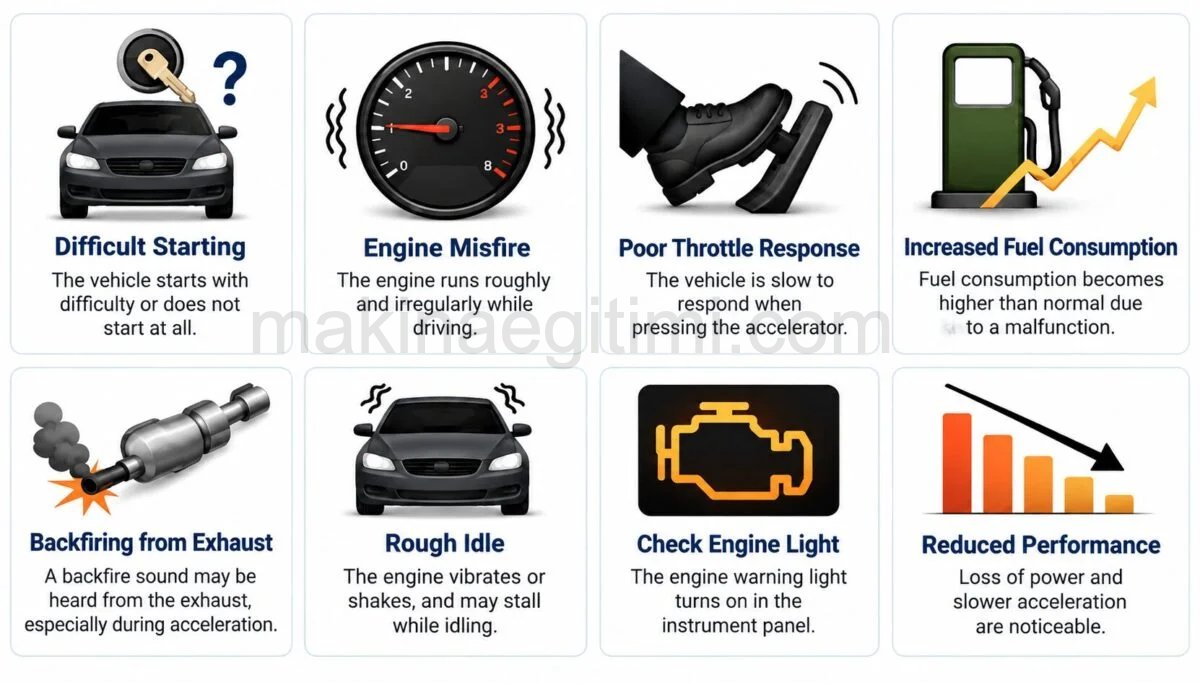
The following symptoms can be a sign of a problem in the ignition system:
- The vehicle starts with difficulty.
- The vehicle cranks but won’t start.
- The engine misfires.
- Idle is uneven.
- The vehicle responds to the throttle with a delay.
- Traction drops.
- Fuel consumption increases.
- A popping sound comes from the exhaust.
- The check engine light comes on.
If your vehicle cranks but won’t start, we covered the possible causes in detail in our article;
These symptoms may not always be caused by the ignition system alone. Fuel system or sensor failures can cause similar problems.
What Can the Driver Do on Their Own?
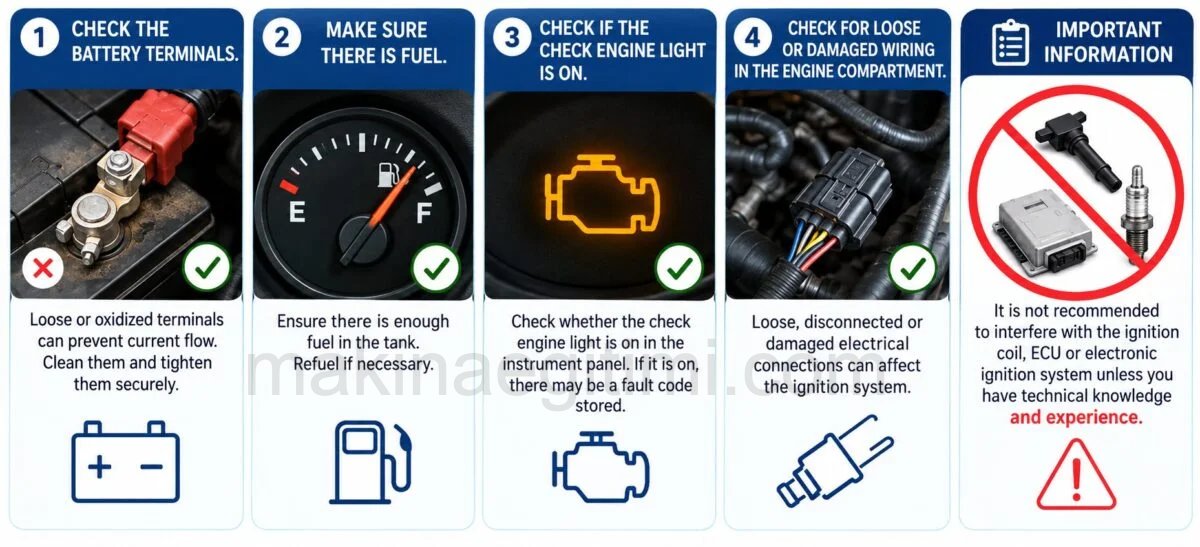
If you think there’s a problem with your vehicle’s ignition system, you can perform these simple checks:
- Check the battery terminals.
- Make sure you have fuel.
- Look to see whether the check engine light is on.
- Visually check whether there’s a loose electrical connector in the engine bay.
Beyond this, it’s not recommended to work on the coil, ECU, or electronic ignition system yourself.
Extending the Ignition System’s Lifespan
For the ignition system to have a long service life, the following points should be observed:
- Replace spark plugs at the recommended mileage.
- Use quality spark plugs that suit your engine.
- Don’t skip periodic maintenance.
- Get your battery serviced regularly.
- Avoid washing the engine bay with pressurized water.
- Have the vehicle checked whenever the check engine light comes on.
In conclusion;
The ignition system is one of the most important systems for the proper operation of gasoline engines. It converts the low voltage from the battery into high voltage, creates a spark at the spark plugs, and keeps the engine running. Thanks to electronic ignition systems today, vehicles run more reliably, more economically, and with better performance. Regular maintenance, using quality replacement parts, and not ignoring failure symptoms all help the ignition system provide trouble-free service for many years.
Frequently Asked Questions
12 volts isn’t enough to produce a spark strong enough to ignite the compressed air-fuel mixture. The ignition coil boosts this voltage to 20,000-50,000 volts, producing a powerful spark jump at the plug.
As long as the engine runs, each cylinder produces dozens of sparks per second. This number varies with engine RPM — as RPM rises, so does the number of sparks.
Related Posts
 Car Cranks But Won’t Start: What Could Be the Cause?
 How Does a Manual Transmission Work? The Synchromesh Mechanism
 The Importance of Using Original Parts on a Motorcycle
 How Hydraulic Brakes Work
 What Is a Camshaft? What Does It Do? How Does It Work?
 Engine Lubrication System and Its Parts
 What the Markings on a Car Tire Mean
 Disc Brake & Drum Brake. Which Is Better?