
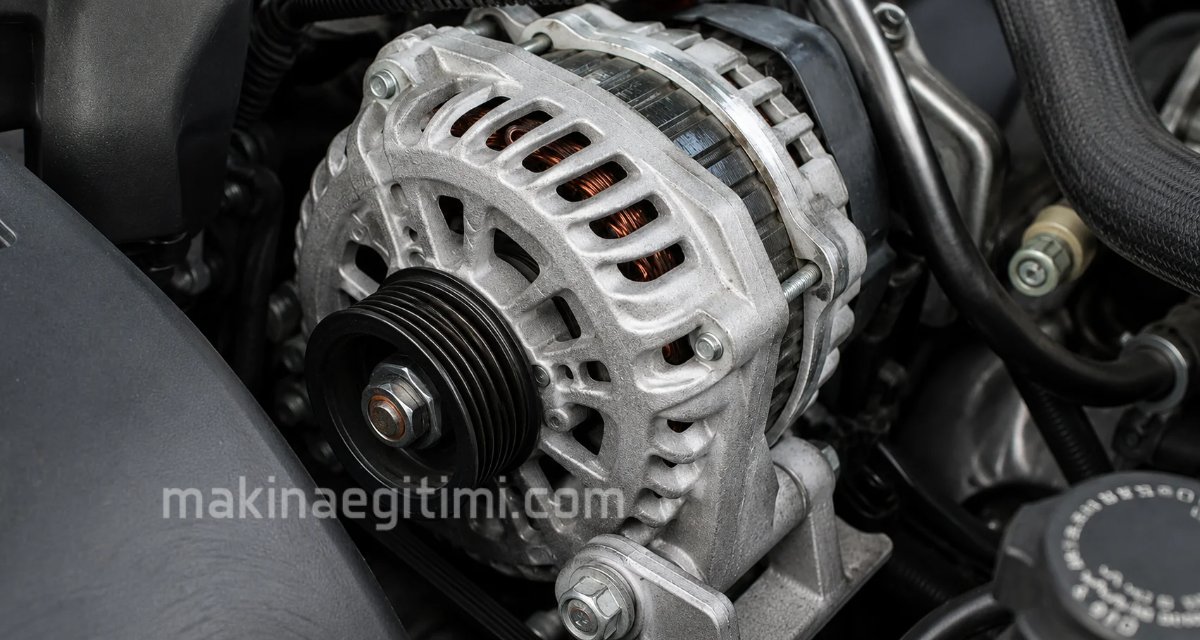
The charging system is the system that converts the engine’s mechanical energy into electrical energy and delivers that energy to both the battery and the vehicle’s electrical system.
Fuel alone isn’t enough for a car to run. Once the engine is running, the headlights, wipers, air conditioning, radio, engine control unit (ECU), and other electrical systems all need a continuous supply of energy. The system that provides this energy is called the charging system.
The charging system charges the battery while the engine runs and supplies the necessary electricity to every electrical consumer in the vehicle. If the charging system fails to do its job, the battery drains quickly and the vehicle eventually becomes unable to run.
Electricity generation continues the whole time the engine runs. This way, the battery only expends energy during starting, and then regains that lost energy afterward.
The Charging System’s Jobs
The charging system’s basic jobs are:
- Continuously charging the battery
- Generating electricity while the engine runs
- Powering the headlights and other electrical equipment
- Extending the battery’s lifespan
- Ensuring electronic control units run at the correct voltage
Components of the Charging System
Alternator
The alternator is the most important part of the system. It generates electricity using the engine’s rotational motion. The alternating current (AC) it produces is converted into direct current (DC) by diodes inside the alternator, then sent to the battery. On vehicles with an alternator, the battery terminals should be disconnected before doing any electrical welding on the vehicle.
The Alternator’s Jobs: Generating electricity, charging the battery, and powering the vehicle’s electrical consumers.
If the Alternator Fails: The battery won’t charge. The charge warning light comes on. The headlights dim. The battery drains quickly. The vehicle eventually stalls.

2. Voltage Regulator
This is the component that controls the voltage the alternator produces. As engine RPM rises, the alternator tends to generate more electricity. The regulator keeps the voltage within roughly 13.8-14.7 volts, protecting both the battery and the electronic systems.
The Voltage Regulator’s Jobs: Keeping the voltage constant, preventing overcharging, and preventing low voltage.
If the Voltage Regulator Fails: The battery may be overcharged. The battery may lose water. The battery may not charge enough. Bulbs may blow out frequently. If your vehicle’s bulbs keep blowing, this can be a sign of a regulator fault. A faulty regulator can also cause failures in electronic systems.
3. Charge Indicator (Battery Warning Light)
This is the battery-symbol light on the dashboard. It briefly lights up when the engine starts and should turn off once the engine is running. The charge indicator’s job is to inform the driver about the state of the charging system.
If the Charge Indicator Light Is On, it could be one of the following faults:
- Alternator fault
- Voltage regulator fault
- The V-belt may have snapped.
- An electrical wire may have broken.
- The battery isn’t charging.

4. Charge Sensor
The charge sensor is the electrical circuit component that monitors the alternator’s operation and charging status. While the engine runs, it detects the voltage coming from the alternator and controls whether the charge warning light on the dashboard illuminates.
The Charge Sensor’s Jobs: Detecting the charging status, controlling the charge warning light, and alerting the driver to a fault.
If the Charge Sensor Fails: The charge warning light may stay on continuously. The charge warning light may never come on. Incorrect fault warnings may appear.

5. V-Belt
The V-belt is what connects the alternator to the engine. As the engine turns, the V-belt turns with it, driving the alternator to generate electricity. The V-belt’s job is to transmit the engine’s mechanical motion to the alternator.
When pressed with a finger, the V-belt’s tension should deflect by about 1-1.5 cm. If the V-belt is too loose, the vehicle can overheat, or it won’t charge properly. If the V-belt is too tight, overheating usually isn’t an issue, but it wears down the alternator bearings.
If the V-Belt Fails: The alternator won’t turn. The battery won’t charge. The charge warning light comes on. Steering and the water pump can also be affected (depending on the vehicle model).
6. Camshaft Pulley
The camshaft pulley transmits the engine’s rotational motion to related components via the belt system. In some engines, the alternator is driven from the crankshaft pulley, while in other layouts, the camshaft pulley also plays a role in the belt system. The camshaft pulley’s job is to drive the belt system and contribute to turning the alternator. If the pulley doesn’t turn smoothly or gets damaged, the belt system can’t work properly.
If the Camshaft Pulley Fails: The belt can make noise. The belt can come off. The alternator may not spin fast enough. The charging system may not operate efficiently.
Charging Voltage Range
A healthy alternator produces a steady voltage of 13.5-14.8V at the battery terminals while the engine runs.
Alternator Output Power
Modern vehicle alternators can deliver an output of 70-250 amps, depending on the electrical load.
The Regulator’s Role
The voltage regulator protects electronic components by keeping the output voltage constant even as engine RPM changes.
How Does a Vehicle’s Charging System Work?
The charging system operates in the following sequence:

- The engine runs.
- The engine turns the V-belt.
- The V-belt turns the alternator.
- The alternator generates electricity.
- The voltage regulator controls the voltage.
- The electricity is sent to both the battery and the vehicle’s electrical systems.
- The battery is recharged.
- The charge indicator turns off and the system continues operating normally.
This is why the battery doesn’t drain even if the vehicle runs for a long time.
Charging System Failure: Symptoms, Causes, and What to Do
Even a small fault in the charging system, if not caught in time, can lead to a fully drained battery, a vehicle stranded on the road, and serious problems in the electronic systems. For this reason, the warnings given by the charge indicator should be taken seriously, and components like the V-belt, alternator, and voltage regulator should be inspected regularly.
Symptoms of Charging System Failure
The following symptoms may appear when the charging system develops a fault:
- The charge warning light turning on
- Dim headlights
- Difficulty starting the engine
- The battery draining frequently
- Slow-operating power windows
- Erratic air conditioning operation
- Flickering dashboard lights
- Electronic systems throwing errors
- The engine stalling while driving
Causes of Charging System Failures
- Alternator fault
- Voltage regulator fault
- Diode fault
- Worn brushes
- Worn-out bearings
- A loose V-belt
- A snapped V-belt
- Loose cable connections
- Corroded battery terminals
- Fuse failures
- Charge sensor fault
Checks to Perform When the Charging System Fails
If the charge warning light comes on, you should stop the vehicle. In the event of a fault, the following checks should be performed:
- Battery voltage is measured.
- Charging voltage is checked with the engine running.
- V-belt tension is inspected.
- Alternator connections are checked.
- The voltage regulator is tested.
- Battery terminals are cleaned.
- Fuses are checked.
- Whether the charge warning light is functioning correctly is observed.
Maintaining the Charging System
For the charging system to have a long service life, the following maintenance should be performed regularly:
- V-belt tension should be checked.
- If the belt shows cracking or wear, it should be replaced.
- Battery terminals should be kept clean.
- Alternator connections should not be left loose.
- Charging voltage should be measured periodically.
- Battery maintenance should not be neglected.
The charging system is one of the most important systems in meeting a vehicle’s electrical needs. Thanks to the electricity the alternator produces, the battery is continuously charged and all of the vehicle’s electrical equipment can run safely.
A charging system that’s regularly inspected and maintained both extends the battery’s lifespan and keeps the vehicle running reliably.
Frequently Asked Questions
All electrical systems, like the headlights, air conditioning, and radio, constantly consume energy. Since the battery can’t supply this consumption on its own, the alternator generates electricity while the engine runs, both recharging the battery and powering the systems.
Usually it doesn’t stop right away. When the alternator can no longer generate electricity, the vehicle keeps running for a while on the energy stored in the battery, but as the battery drains, the headlights dim and the engine eventually stalls.
Related Posts
 What Is an Alternator? What Does It Do?
 Alternator (Charging Dynamo) Faults
 Why Does the Battery Warning Light Come On? Signs of a Battery Fault
 Disc Hydraulic Brakes and Their Working System
 The Importance of Using Original Parts on a Motorcycle
 Vehicle Fuel System Components and Their Functions
 10 Basic Things Every Driver Should Know
 Differences Between Leaf Spring and Coil Spring Suspension