

Parts of a Waterjet
1) Reservoir:
The reservoir is used to store the water to be used as the jet. Water is supplied from the reservoir for the waterjet cutting process.

2) Pump:
This pump draws water from the reservoir and delivers it to the intensifier. The pump is used to generate a pressure of 1500 to 4000 bar in the water. An electric motor between 50 and 100 HP is used to produce this pressure.
3) Intensifier:
The intensifier is used to increase the waterjet pressure and generates a high-pressure liquid jet. This intensifier is connected to the accumulator. It takes in low-pressure water and discharges it at high pressure through an accumulator. It operates via a hydraulic piston mechanism.

4) Accumulator:
The accumulator is used to temporarily store water as needed. This accumulator is connected to the control valve. It ensures a continuous flow of high-pressure water and eliminates pressure fluctuation.
5) Control Valve:
This control valve controls both the amount of water passed through and the water’s pressure, and directs it toward the flow regulator. This is where pressure energy is converted into kinetic energy.

6) Flow Regulator:
The flow of water coming from the control valve is regulated using the flow regulator. After adjusting the flow regulator, pass the water into the nozzle — in other words, high water pressure will be converted into high-speed water.
7) Nozzle:
The nozzle converts the high-pressure jet’s pressure into kinetic energy. Since the area at the nozzle’s tip narrows, kinetic energy increases. This energy is directed from the nozzle onto the workpiece.
8) Orifice:
The water directed from the nozzle exits through this opening.
9) High-Pressure Tubing:
High-pressure tubing is required for the flow of high-pressure water. Their diameters are approximately 6 to 14 mm. They also allow flexible movement of the cutting head.
10) Catcher or Drain:
The catcher or drain is used to collect the water after it cuts the workpiece. From here, the water is either sent for further purification or can be recirculated.
Waterjet Cutting Head
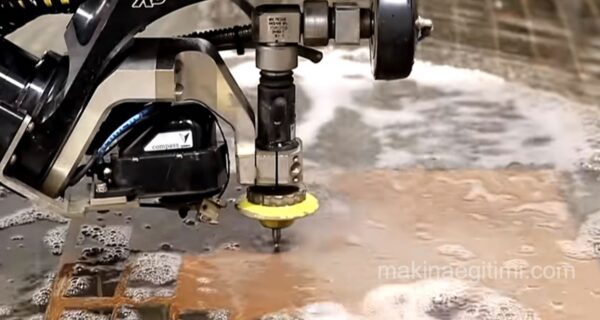
The waterjet’s cutting head contains an orifice that turns the high-pressure water and abrasive mixture into a fine stream.
High-Pressure Pump
The high-pressure pump, the heart of the system, provides the cutting power by raising the water to thousands of bar.
Abrasive Feed System
The abrasive feed system adds an abrasive substance, such as garnet, into the water stream in a controlled way.
Related Questions
The high-pressure water coming from the intensifier may not flow at a constant speed at all times. The accumulator temporarily stores this water, balancing pressure fluctuations in the flow and ensuring the cut proceeds smoothly.
The pressure produced by the pump is often not enough to cut the material. The intensifier raises this pressure even further, turning the water into a jet stream powerful enough to cut.
Related Posts
 Tips for Reducing 3D Printing Costs
 Laser or Waterjet, Which Is Better?
 Laser Welding, Its Properties and Working Principle
 What Is Sinker EDM, How Does It Work. Where Is It Used
 The Best 3D Scanners of 2022 – Buying Guide
 3D Scanning – What Is 3D Scanning?
 What Is Electrical Discharge Machining (EDM). Machining with EDM
 Stages of Manufacturing with 3D Printers