
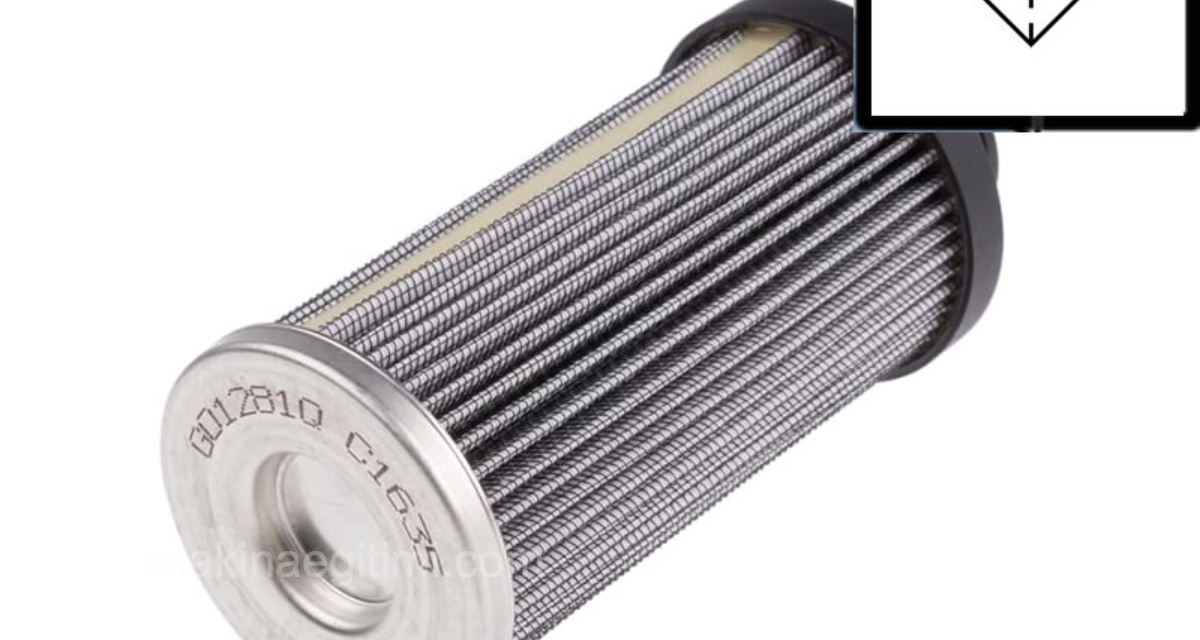
In our Machine Education pages, under the Hydraulic Pneumatic category, we’ve dedicated this article to the suction filter among the types of hydraulic filters. We’ll cover subtopics such as: What is a suction line filter? What are the characteristics of a suction filter? What happens if a suction filter clogs? What are the types of suction filters, and how are they shown symbolically and in a hydraulic circuit diagram?
Suction Filter
What is a Suction Filter:
Placed on the pump’s suction line, these filters clean the fluid flowing from the tank to the pump. The suction filter is installed in the suction line so that hydraulic fluid is drawn from the tank through the filter. This way, only filtered oil enters the hydraulic system.

The pressure drop occurring in these filters must not cause cavitation in the pump, and the filter must be selected with the appropriate capacity. In locations requiring very fine filtration, a large-area filter element is needed to reduce the pressure drop; as a practical rule, suction filters are recommended to have a filtration capacity around 0.13 mm.
These filters are typically used mounted at the end of the suction pipe inside the hydraulic reservoir. Because they sit inside the hydraulic tank, cleaning them is more of a hassle compared to other filter types.
What Happens If the Suction Filter Clogs?
If the suction filter clogs, the hydraulic pump is strained and draws air into the circuit. This can cause foaming in the fluid and also reduces the pump’s efficiency.
For these reasons, suction line filters are chosen with a large filtration capacity. Suction line filters are available with filtration capacities ranging from 100 microns up to 0.1 mm.
Suction filters make it possible to protect the pump’s functionality only.
Because pumps are sensitive to low pressure, the pressure differential across the filter should not be large. For this reason, large-surface filters are generally used. In addition, a bypass valve and a contamination indicator should also be installed in the system.
In the suction region, filtration is generally limited to filtering out dirt particles larger than 100 µm. A special model exists for filtration in hydraulic drives; here, a suction filter with a filter pore size of 20 µm is used.
Types of Suction Filter
There are 2 types of suction line filters.
- Housing-less suction line filter
- Housed suction line filter
Housing-less Suction Filter:
Housing-less suction filters are mounted on the pump’s suction line. Care must be taken to install the suction filter sufficiently below the minimum oil level.
To protect the pump, a low-pressure switch should be installed between the filter and the pump.
Special housing-less suction filters can also be used as a fluid diffuser on the return line.
These prevent foam formation and its settling into the tank. Under certain conditions, the use of baffle walls may not be needed.
Housed Suction Filter:
These filters can also be mounted below the fluid level in the tank. This way, the housing doesn’t stay empty while the element is being replaced.
The housing must be filled with leakage barriers.
Characteristics of Suction Line Filters:
Filter fineness: 60-100µm
These filters are mostly used in hydraulic systems where the required cleanliness for the hydraulic fluid cannot be ensured in the tank. They only protect the pump. Since particles on the order of 0.06-0.1 mm can pass through the filter, their filtering effect is limited.
Additionally, a high degree of pressure drop or an increased contamination level in the filters makes it harder for the pump to draw fluid. This is because the low pressure that can occur through the pump would cause cavitation. To prevent such suction difficulties, suction line filters are equipped with a bypass valve.
Advantages of the Suction Line Filter
Easy installation
-Cost
-Protects hydraulic components from coarse dirt
Disadvantages of the Suction Line Filter
Poor mounting position within the hydraulic system
-Bypass is required
-Since it’s submerged in oil, maintenance access is poor
-Only coarse filtration is possible due to cavitation risk
-Contamination indicators are possible.

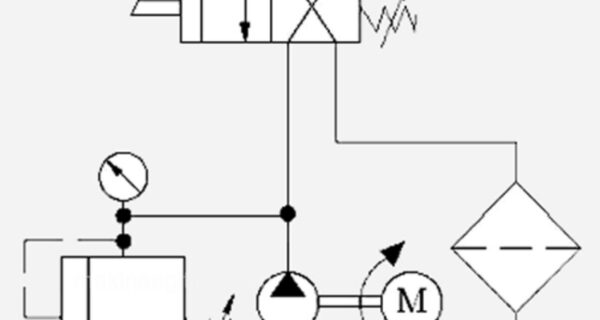
representation of the suction line filter in a hydraulic circuit diagram
Suction Line Protection
Suction filters are placed right before the pump to prevent large particles from damaging it.
Coarse Filtration Role
Suction filters generally have a coarser filtration rating, such as 100-150 microns.
Pressure Drop Risk
A severely clogged suction filter can cause cavitation (void formation) at the pump inlet.
Related Questions
A clogged filter can cause excessive vacuum to build up on the suction side of the pump. This excessive vacuum can trigger a damaging effect called cavitation, in which bubbles form in the fluid, eroding the pump’s internal parts.
This filter is usually located inside the hydraulic reservoir, mounted at the end of the suction pipe. Since reaching it generally requires opening the tank, its maintenance is more time-consuming compared to other filter types that are easily accessible from the outside.
Related Posts
 Types of Pneumatic Compressors
 Pressure Gauges and Types of Pressure Gauges
 What Is a Hydraulic Accumulator Used For
 Force Calculations in Pneumatic Cylinders
 What Is a Hydraulic Return Filter. Return Line Filters
 Hydraulic Cylinder Force Calculator
 Safety Rules for Workers on Hydraulic and Pneumatic Machines
 Hydraulic Applications – Feed Speed Adjustment on a Lathe