
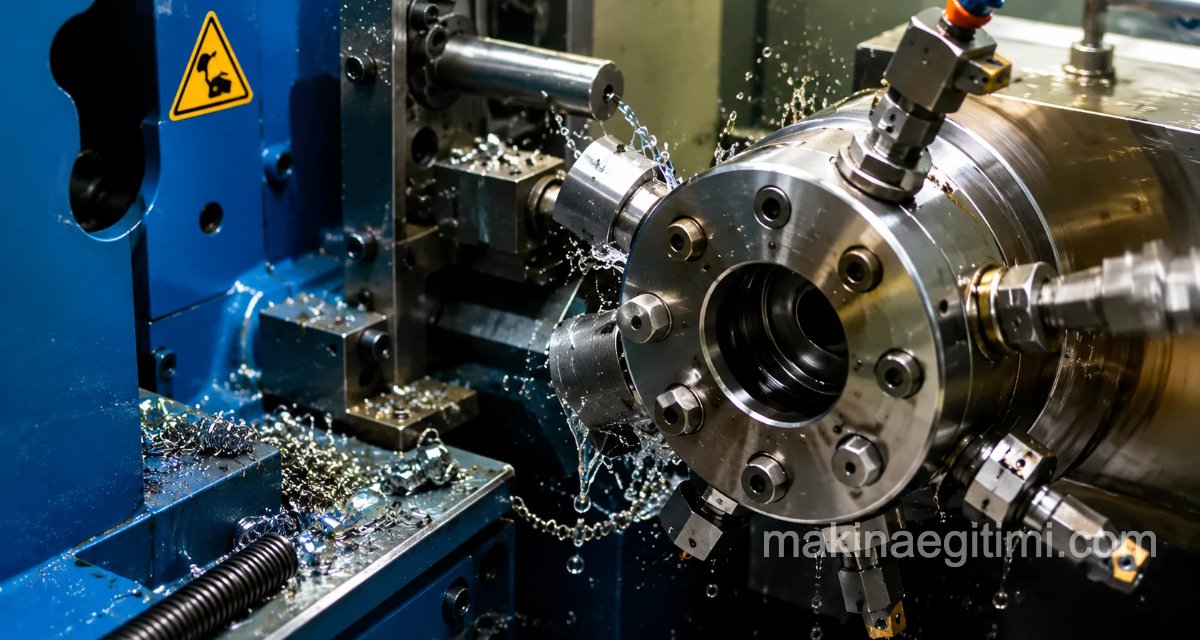
What Is an Automatic Lathe?
Automatic lathes are industrial machines that use a mechanical system to machine cylindrical parts in series through a set cycle. These lathes use cam profiles to control the motions, and these motions repeat cyclically.
Cam-based automatic lathes are used for regular, repeating operations, such as shaping, cutting, knurling, drilling, reaming, and thread cutting. These help provide very high efficiency and accuracy and are usually easy to find at a low cost. CNC and pneumatic automatic lathes also exist.
Cam Control
Classic automatic lathes are controlled by mechanical cams that synchronize the tool motions.
Swiss-Type Automatic Lathe
Swiss-type automatic lathes pass the material through a guide bushing, allowing precise machining of long, thin parts.
Production Speed
Automatic lathes can produce hundreds of small parts per hour by running continuously without human intervention.
How Does an Automatic Lathe Work?
This machine uses cam profiles to control motions and automatically carries out repetitive operations. The cam profiles define a specific sequence and speed of motions required for each cycle. Cam-based automatic lathes are used for operations such as cutting, machining, drilling, and thread cutting on cylindrical parts.
Take a look at how the cam-mechanism toy in the video works. The movements of the cat and mouse are created by cams and followers that track the cams’ motion, transmitting that motion.
Automatic lathes operate with a very similar system. We can compare the motions of the tool holders in an automatic lathe to the movements of the cat and mouse. With one small difference: in automatic lathes, the motion of the cams is driven by an electric motor.

Working Principle of an Automatic Lathe
- Programming: A specific sequence and speed of operations is defined, either through a CNC system or through manual programming.
- Cam loading: The cam profile is loaded and positioned on the lathe.
- Starting: The lathe begins carrying out the programmed operations.
- Cam motion: The cam profile makes the motions required to complete the operation and controls the lathe tools.
- Completion of the operation: Once the cam motion is complete, the lathe stops automatically and the results of the operation can be examined.
Cam-based automatic lathes provide efficiency and accuracy for repetitive operations and help businesses shorten their production times.
Features of Automatic Lathes
The surface roughness of the machined part, for example for copper material, can be as low as Ra0.04-0.08.
The feed mechanism automatically feeds the bar stock.
The process requires no manual inspection and provides a fully automatic production process.
An operator can run multiple machines at the same time.
Each rotation of the cam completes the machining of one part. Cam speed is 1.0~36 rpm, adjustable according to different workpieces, and the fastest operation is 36 parts per minute.
Since five cutting tools can operate at the same time, machining efficiency is very high. Because five tools on the tool post and two tailstock spindles can work simultaneously during the machining process, automatic lathes can machine parts 4-6 times faster than CNC lathes.
Related Questions
Cam profiles mechanically determine which motion the tools will make at which moment. This allows the same cycle to be repeated over and over without needing to write any program.
In these lathes, the material is supported by being passed through a guide bushing. This support prevents the thin part from bending or vibrating during machining.
Related Posts
 Professional 3D Scanners and Their Applications
 What Is a Turret Lathe. How Is It Used
 Heat Treatments Applied to Cast Iron
 How Is a Crankshaft Made
 Laser Cutting Working Principle, Advantages and Disadvantages
 How Are Piston Rings Made? How Are Piston Rings Manufactured?
 How Are Washers Made
 What Is Honing? How Is It Done? Where Is It Used?