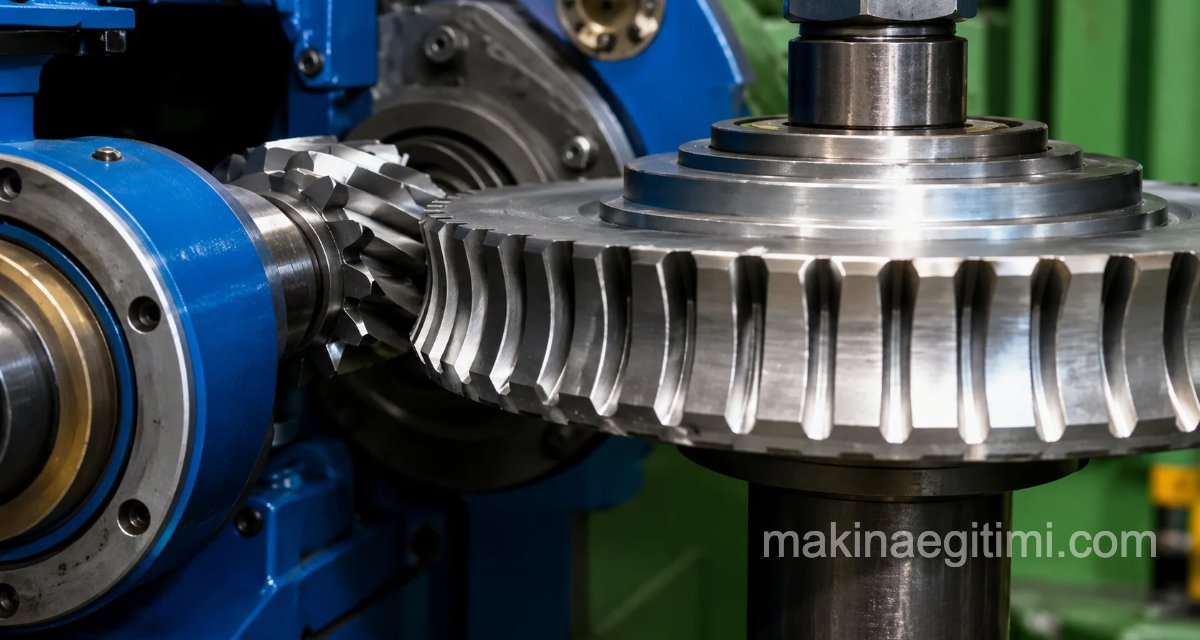
Advantages and Disadvantages of the Hobbing Method
In work that takes hours to cut a single gear, and days for large gears, the hobs wear down significantly. The hobs used in this very widespread system are expensive.
As with the Fellows system, only a single hob is needed for each module size.
A single skilled operator can easily manage eight to ten of these machines on their own. This is also an economic benefit.
As with other systems that work on the generating (rolling) principle, several gear wheels stacked on top of each other can be cut at once.
To manufacture a spur gear, these worm-shaped helical hobs need to be mounted on the gear-cutting machine tilted by their own helix angle. This is how a spur gear wheel is obtained.
To cut a helical gear, either the indexing on the mandrel table the hob is mounted on is adjusted, or the helix angle is set using change gears.
If the helix angle is to be set based on the indexing on the mandrel table, the hob’s lead angle must be added to or subtracted from the hob’s helix angle, depending on the gear’s helix direction. The value of the hob’s helix angle is written on the hob itself, and if the hob is left-handed, the hob’s helix angle is added where it would normally be subtracted, or subtracted where it would normally be added.
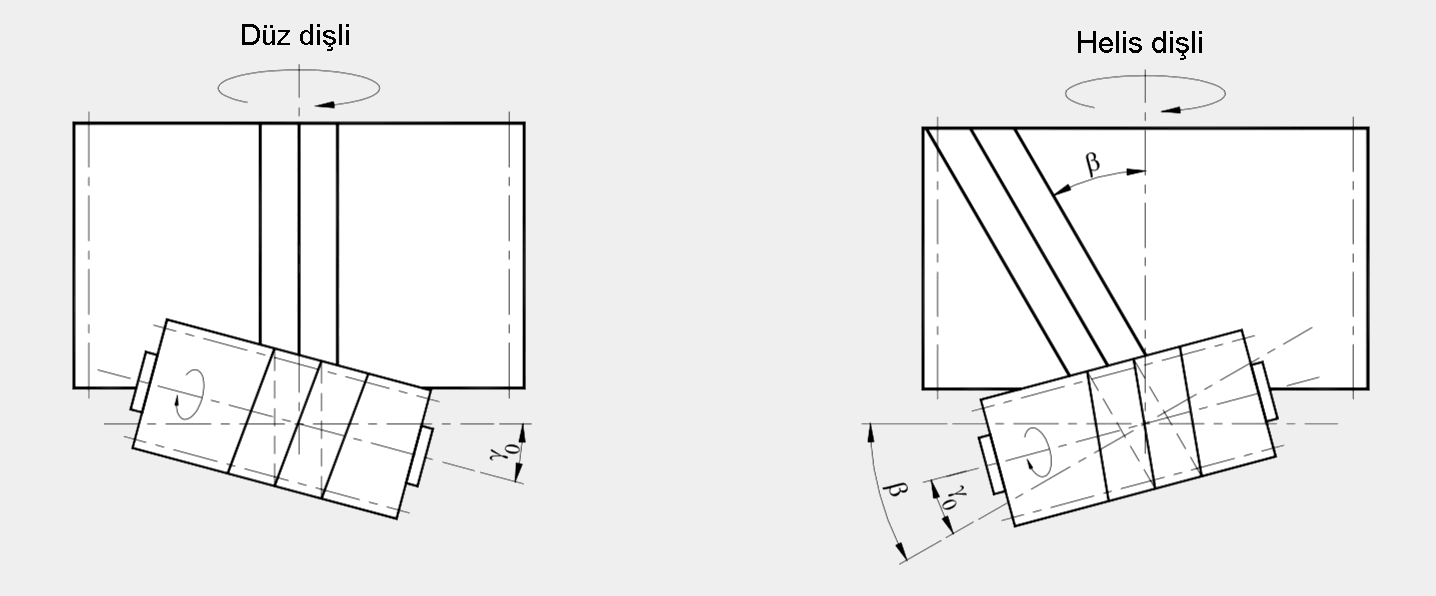
To machine a spur gear (above left), the tool’s axis needs to be tilted γ0 to the right. In the picture above on the right, we see the cutting of a helical gear. To obtain a left-hand helix, the tool’s axis needs to be tilted β − γ0 to the left.
The worm-shaped hobs known commercially as “hobs” can have a single start or multiple starts. Generally, single-start hobs are used for roughing cuts, while double-start worm hobs are used for finishing cuts.
Good-quality gears are obtained with single-start hobs. However, because of their higher productivity, multi-start worm hobs have started being used in recent years for both roughing and finishing cuts.
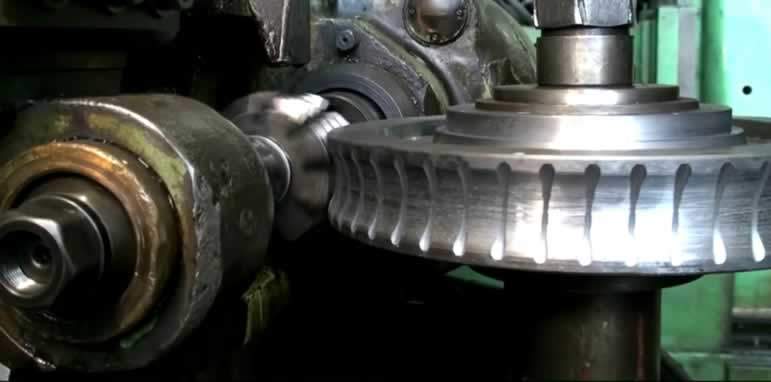
A view of a worm wheel being made by the hobbing method (above)
Continuous Cutting Principle
The hobbing method continuously cuts the teeth through the synchronized rotation of the hob and the workpiece.
High Production Efficiency
The hobbing method is one of the most efficient and fastest methods for mass-producing spur and helical gears.
Multi-Purpose Tool Use
A single hob can produce many gears of the same module with different numbers of teeth.
Properties of Hobbing Cutters
Generally, gear wheels with a DIN-standard quality grade of 8 or finer than 8 are cut with a single-start hob, while those with a quality grade coarser than 8 are cut with a double-start hob. For gears with a very large number of teeth, hobs with 5 or even 7 starts can be used. Here, care must be taken that the number of starts on the worm-shaped hob does not divide evenly into the number of teeth being cut on the gear. If it divides evenly, the same teeth of the hob will always cut the same teeth of the gear wheel every time, and manufacturing errors can increase due to wear on that section of the cutting edge.
For hobs with more than one start (thread), the following point should be noted: if the smallest number of teeth that can be produced on the machine is 8, then with a double-start (2-thread) hob, only a gear with 16 teeth can be produced, and with a triple-start (3-thread) hob, only a gear with 24 teeth can be produced.
Related Questions
While some other methods may require a different cutter for each tooth count, in the hobbing method only a single hob matching the module size is needed. This greatly reduces both tool cost and tool-change time.
The teeth of a helical gear run at an angle, not parallel to the shaft axis. Mounting the hob tilted to match this angle allows the cutter to correctly follow the tooth direction and produce the desired helix angle.
Related Posts