
The topic of this article is the history of electric arc welding. How did welding technology develop. On this page, we will find answers to questions such as the discovery of the first arc welding machine, when the portable welding machine was invented, and when it began to be widely used.
The History of Electric Arc Welding and the Discovery of the Arc
In 1801, Sir Humphry Davy discovered the arc by bringing together the ends of a circuit carrying a high voltage. However, the term “arc” itself did not come into use until 20 years after this date.
In 1856, James Joule of England discovered that heating a material using electricity and internal resistance could produce an effective weld. Resistance welding was later perfected by Elihu Thomson. His techniques would later develop into what became known as incandescent welding (electric welding using the incandescent method).
Meanwhile, in the 1860s, acetylene was discovered by the French chemist and politician Pierre Eugène Marcellin Berthelot. Because of its highly reactive chemical structure, this compound is widely used in the welding industry today. The gas produces a very high flame above 6000°F (3300°C), which is excellent for gas welding and cutting.
In 1865, two metals were joined by electric arc welding by an Englishman named Wilde. The first electric welding patent was taken out around this time.
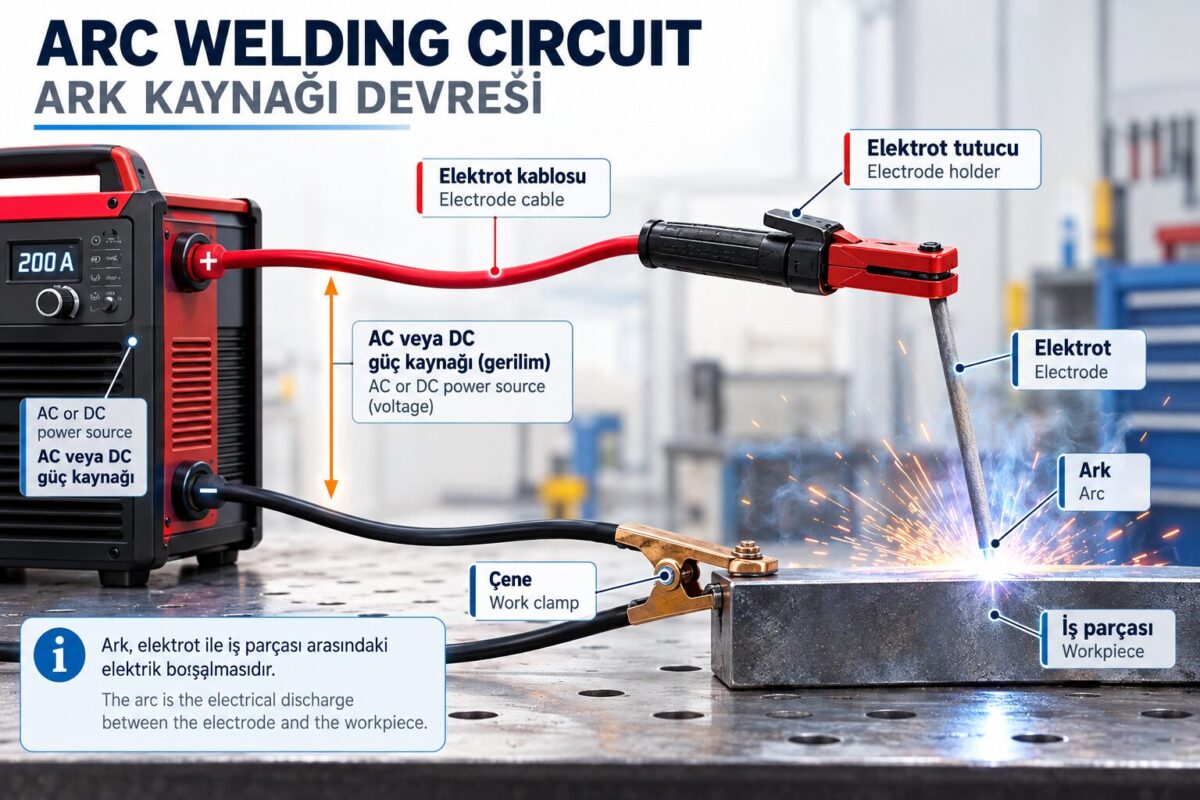
In the early 1880s, attempts were made to create a heat source for fusion welding by forming an arc between a carbon electrode and a metal workpiece, using the basic circuit shown in the figure above. As in gas welding, filler metal was added in the form of a metal wire, and later this metal wire was used as the bare electrode itself.
This rod both formed the arc and, by melting, also served as the filler material. But the results were highly inconsistent. Because the arc was not stable, keeping it going required great skill, and the weld metal became contaminated and oxidized due to exposure to atmospheric conditions in the high-temperature zone. Meanwhile, the metallurgical effects were either barely understood or not understood at all.
In 1881, DeMeritens used a carbon electrode to join battery storage cells.
In 1887, Bernardos and Olszewski received a patent for the insulation and holding of the carbon electrode.
In 1889, the Russian Slavianoff and the American Coffin discovered the metal rod electrode for the first time. This method was later developed into the coated electrode.
The first welding machine
In 1902, the American company Lincoln Electric TDT developed the first electric motor. This company began experimental work with welding and produced the first welding machine in 1912.
Discovery of the First Electric Arc
The electric arc was discovered by Humphry Davy in the early 1800s and later developed for welding purposes.
The Coated Electrode Revolution
The development of coated electrodes greatly improved weld quality by shielding the weld seam from the atmosphere.
Prevalence of Modern Arc Welding
Electric arc welding has become one of the most widely used metal-joining methods in industry today.
The development of welding electrodes
The first electrodes were made of bare iron rod by a Swedish company. These electrodes produced fairly weak and brittle welds.
In 1907, the Swede Oscar Kjellberg took out the first patent for a coated arc welding electrode.

In 1911, the first portable welding machine, developed by Lincoln Electric, came into use.
In 1912, Strohmenger patented producing quality welds with coated electrodes. However, the first electrodes were quite expensive.
In 1927, the development of the extrusion method lowered the cost of producing coated electrodes. This also made it possible to produce electrodes with different compositions.
The driving force behind the historical development of arc welding
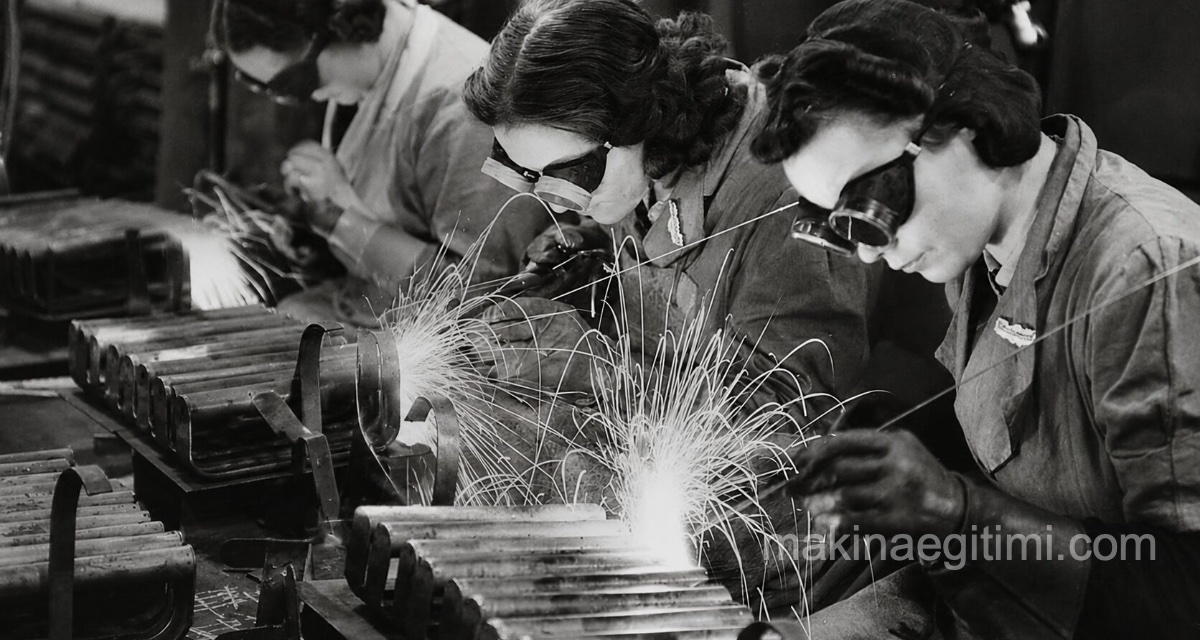
The two world wars, which broke out in 1914 and 1939, greatly increased the demand for manufacturing and repair work. At the same time, welding techniques and processes also developed, because ships, vehicles, weapons, bridges, and general construction such as larger and more advanced scaffolding structures had to be produced quickly and in large numbers under a variety of conditions. The technological development stages of electric arc welding, and the history of electric arc welding, naturally were shaped by the world wars.

A tank used in World War I. The use of rivets in place of welding technology stands out
As an answer to the question many people interested in welding technology wonder about — ”was arc welding used in World War I?” — arc welding technology did exist in those years, and was even used in many fields. However, due to difficulties in using electricity, electrodes not yet being developed to the desired level, and portable welding machines not yet being widespread, we can say that arc welding was used much more extensively in World War II.
In the end, despite the great potential of this process, it saw little use until after World War I. During World War I, the need to produce war machines as quickly and in as great a number as possible created a demand for arc welding applications. Additionally, because of the gas shortage in Britain during World War I, electric arc welding became the primary production method.
Many ships and pieces of equipment were joined with bolts and rivets. Welding emerged as a fast and quite inexpensive method. The driving force of the war industry, as in many other technological fields, was influential in the development of welding technology as well.

In 1920, the British produced the first welded-joint ship, which they named the Fullagar.
In 1923, the American Welding Society was founded in the U.S.A.
By the mid-1930s, the period known as the Great Depression, employment was once again beginning to recover. At that time, many new techniques and welding methods were developed. Stud welding began to be replaced by submerged arc welding, a new process in shipbuilding. In addition, underwater welding was also first carried out during this period.

In 1939, World War II changed the welding process enormously. Advances in industry led to a series of processes that created huge demand and provided countless new turning points in the development of welding. The use of aluminum spot welding was recognized as valuable in aviation.

An image from Britain under German bombardment. The war industry was strengthened by the high level of participation of women as well.
Between 1940 and 1945, Gas Tungsten Arc Welding (GTAW) was adopted as an auxiliary technique for repairs. After decades of development, it was perfected in 1941 and patented in 1942. It was also known as Heliarc, or TIG welding.
For detailed information about gas metal arc (shielded gas) welding, SEE: What is gas shielded arc welding?
The first female welders on record, Alyce R. Sawyers (left) and Josephine L. Hollingworth (right), photographed at a U.S. Navy base in 1942

In 1943, Gas Metal Arc Welding (GMAW) was invented by C.B. Voldrich, P.J. Rieppel, and Howard B. Cary. It was developed at the Dow and Northrup companies and licensed to Linde Corporation. GMAW (Gas Metal Arc Welding) is a process that makes it possible to weld non-ferrous materials quickly, but it requires expensive shielding gases. In the same year, the Sciaky company began selling three-phase resistance welding machines.

A welder adding extra armor plating to a tank on Okinawa during World War II (1945) (picture above)
In 1948, the inert gas metal arc process (MIG) was developed at the Air Reduction Company, and SIGMA (Shielded Inert Gas Metal Arc welding) was developed for welding thicker plates.

In 1949, Westinghouse introduced selenium rectifier welding machines.
In the early 1950s, welding was gaining popularity not only in large-scale industry but also for individual use. Developments, mainly in Eastern Europe and Russia, resulted in the release of the flux-coated consumable electrode, which was very popular at its launch.
Also, although it would not see large-scale use until 1958, electroslag welding (ESW) was developed.
In 1953, the CO2 welding process, popularized by Lyubavskii and Novoshilov, became a preferred welding process for steels because it was relatively economical.
In 1955, ten years after the end of World War II, the plasma torch, which revolutionized cutting, was released.
By 1957, two years after the plasma torch came into use, plasma arc welding (PAW) was invented.

The 1960s were the developing years of the space industry. In 1962, the Sciaky company used welding technology to create an inner and outer titanium shell for the Mercury Space Capsule.
That is the history of electric arc welding. Electric arc welding went through many stages before reaching its development of today; some of the methods discovered along the way remained only at the research stage, but the great majority found wide practical use.
Related Questions
The discovery of the arc was merely the observation of an electrical phenomenon; using it as a controlled heat source required separate technical developments. Intermediate inventions such as resistance heating and incandescent welding allowed this knowledge to turn into a practical welding method.
When it burns, acetylene produces a flame that reaches a very high temperature (over 3300°C). Because this high temperature makes it possible to melt and join metals quickly and efficiently, it is preferred for gas welding.
Related Posts
 How Was the Enigma Code Cracked? Alan Turing and the Bombe Machine Explained
 The Story of the Tiger I Tank. The War Machine That Became a Legend
 The History of the Automobile. The Evolution of Vehicle Technology From Then to Now
 Nazi Germany’s Mega Structures – Super Tanks
 The History of Weaving
 Leonardo da Vinci’s Machines: The Flying, Fighting and Walking Inventions of a Renaissance Genius
 The History and Evolution of Robotics: From Ancient Automata to AI-Powered Robots
 From Rivet to Weld: How and Why an Era Ended