
Machines take up an important place in our lives. When you consider factors like a machine’s efficiency, quiet operation, precision, long service life, and the money and time spent on maintenance and repair, hydraulic-pneumatic systems are sometimes preferred over mechanical systems.
Applications of Hydraulics and Pneumatics
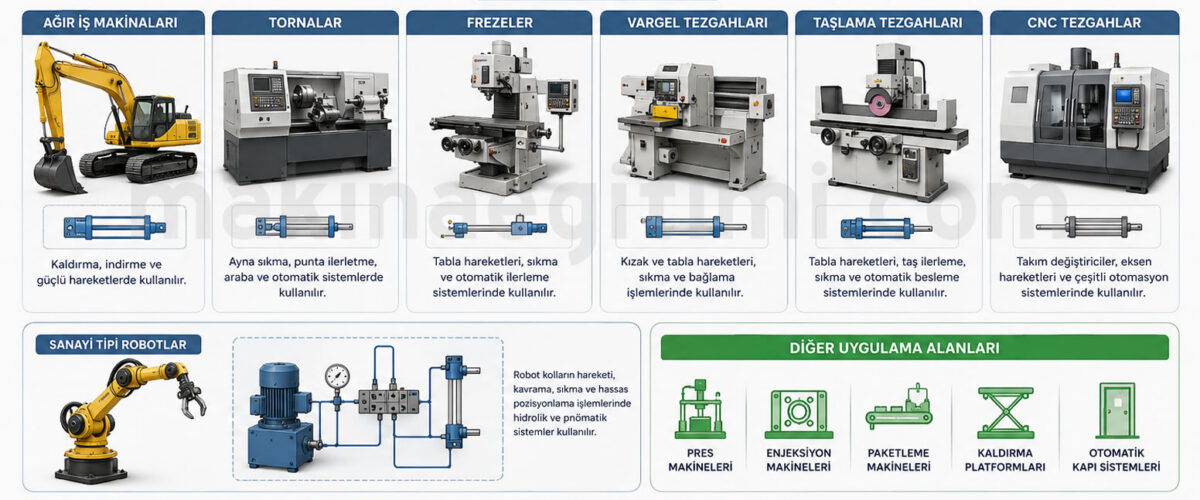
Heavy construction equipment used in industry, lathes, milling machines, shapers and grinding machines, CNC machines, industrial robots, and many production machines are machines and equipment that run on hydraulic systems.
We see hydraulic systems especially widely used in construction equipment. Even in garbage trucks, which we come across often.
What lets a garbage truck move almost like a robot — picking up the bin and emptying it into the hopper, compacting the full hopper with tremendous force — is hydraulics itself.
High Power Density
Hydraulic systems can produce very high forces from compact actuators.
Precise Control
Hydraulic and pneumatic systems allow speed and force to be controlled precisely via valves.
Widespread Industrial Use
These systems are used across a wide range of industrial applications, from construction equipment to production lines.
The Importance and Advantages of Hydraulics and Pneumatics
It Can Be Designed for Extreme Power / Force
Building on Pascal’s law, one of the fundamental laws of hydraulics, it has become possible to convert forces into much greater forces.
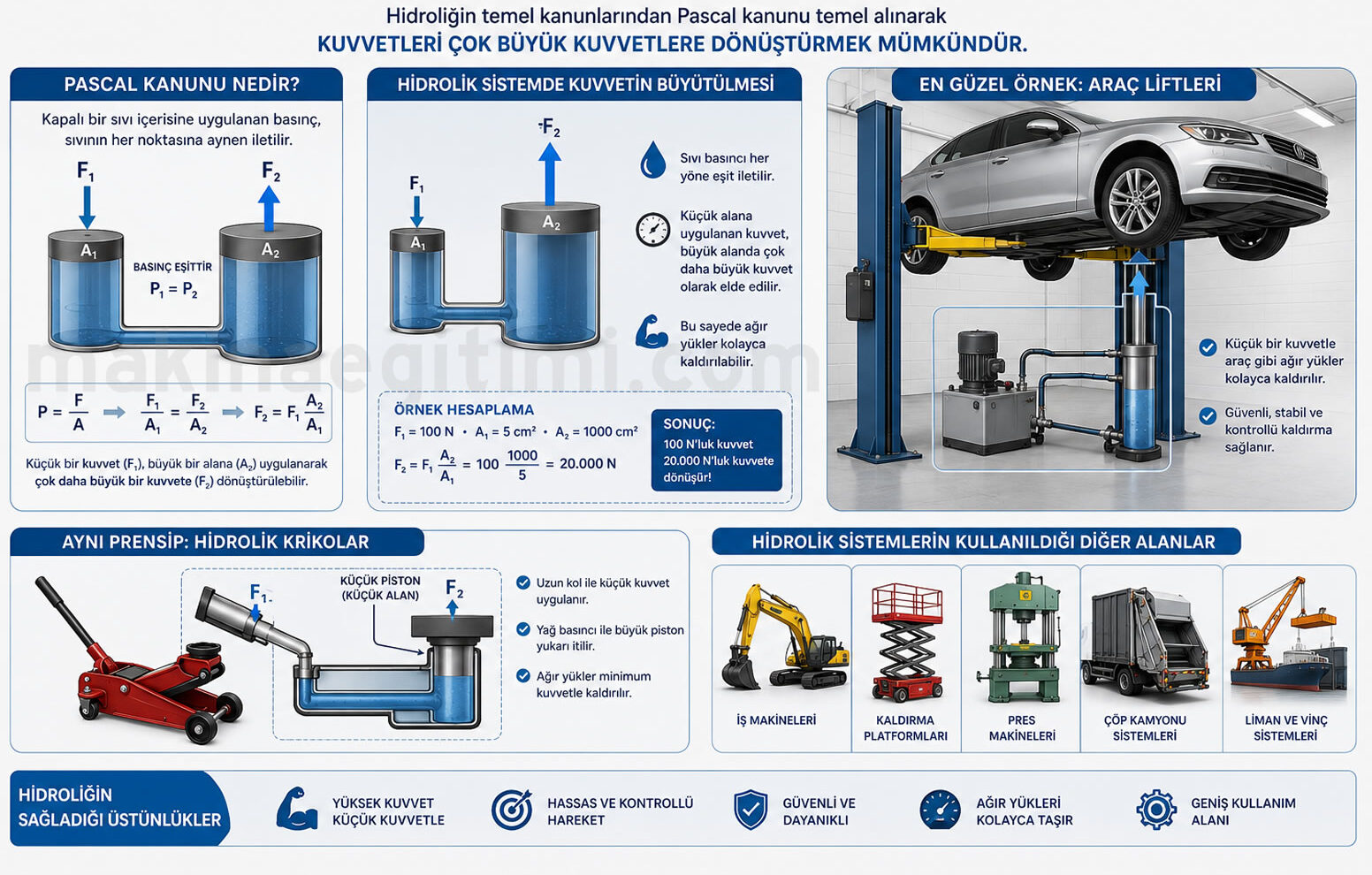
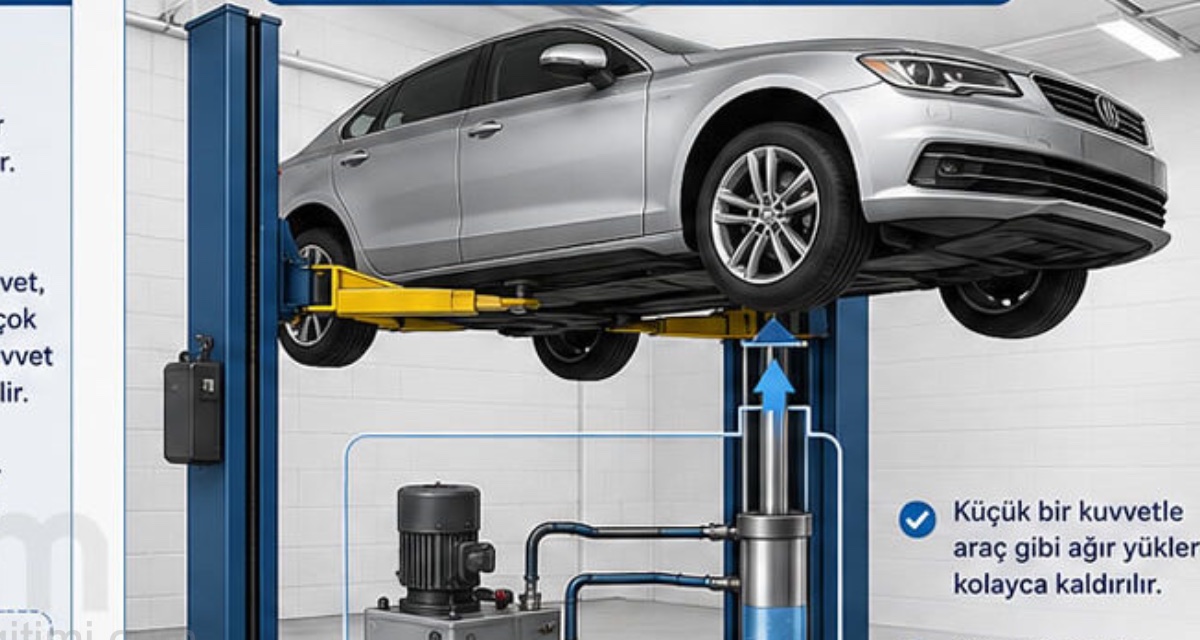
One of the best examples of this is vehicle lifts. Using the power of hydraulics, this type of lifting platform, and hydraulic jacks that operate on nearly the same principle, were designed.
Hydraulic presses were also designed using this same hydraulic law. With hydraulic presses, we can apply great force to press objects.
Today, hydraulic presses of various powers are used in industry, and their capacities can reach up to 6,000 tons.

It’s Free of Complexity, Easy to Maintain
In machines, the energy supplied by motors usually can’t directly drive the components doing the actual work. For this, power-transmission components (shafts, gears, belts and pulleys) are used. As the distance between the work and the motor increases, the number of transmission components needed grows, the system becomes more complex, and both its own cost and its maintenance/repair cost increase.
This is, of course, an undesirable situation.

An example from history:
In World War II, the Germans used the highest technology of the era to build a weapon that became the nightmare of their enemies: the Tiger tank.
But this weapon had one significant disadvantage: its drive mechanism was extremely complex, which meant it broke down very often and was very difficult to repair. When a Tiger tank broke down on the battlefield, the crew often couldn’t repair it, and to keep it from falling into enemy hands, they had to destroy their own tank.

In hydraulic and pneumatic systems, on the other hand, energy is transmitted through a fluid — as long as the equipment is connected to a hydraulic/pneumatic pipe, energy transmission is possible. Just like electricity being transmitted through cables.
Today, on many pieces of construction equipment, the motion desired at the far end can be achieved using hydraulic power, without long shafts, gears, or complex mechanisms.
Hydraulics is a simple way to provide a direct connection from input to output without a transmission. Instead of gears and drive shafts, you have two cylinders and a pressure line.
This way, both the high power needed can be supplied, and that power can be transmitted to remote points without using complex mechanical systems.

Precise Force Metering Is Possible
In hydraulics, by adjusting the ratio of cylinder bore diameters, force/distance can be increased or decreased. A large-diameter input and a small-diameter output is the same as turning a small gear with a larger one. Swap the cylinders and get the reverse effect.
It’s Safer
Large forces, as in a large press, can be metered very precisely. In large presses, alongside precise metering, various measures can also be taken for worker and workplace safety. For example, the pressure control valves, safety valves, and hydraulic accumulators used in hydraulics allow for this kind of safety measure.
In situations where an electrical spark could cause a disaster, hydraulic systems are used instead of electrical systems. For example, since electrical sparks on an oil tanker could cause an explosion, the pumps below deck on ships are usually hydraulically driven.
Hydraulic drive components offer a big advantage in mobile equipment because of their low weight per unit of power transmitted.
Precise Positioning
When hydraulics is used in elevators, it can stop at exactly the desired point.
For example, the workholding mechanism (chuck) on a CNC lathe relies on a hydraulic system. This way, the workpiece is clamped with sufficient pressure without expending much power. And the chuck, spinning at high speed, can be stopped at the desired positions.
We also see this advantage of hydraulics in robots.
It Allows Speed to Be Changed While the System Is Running
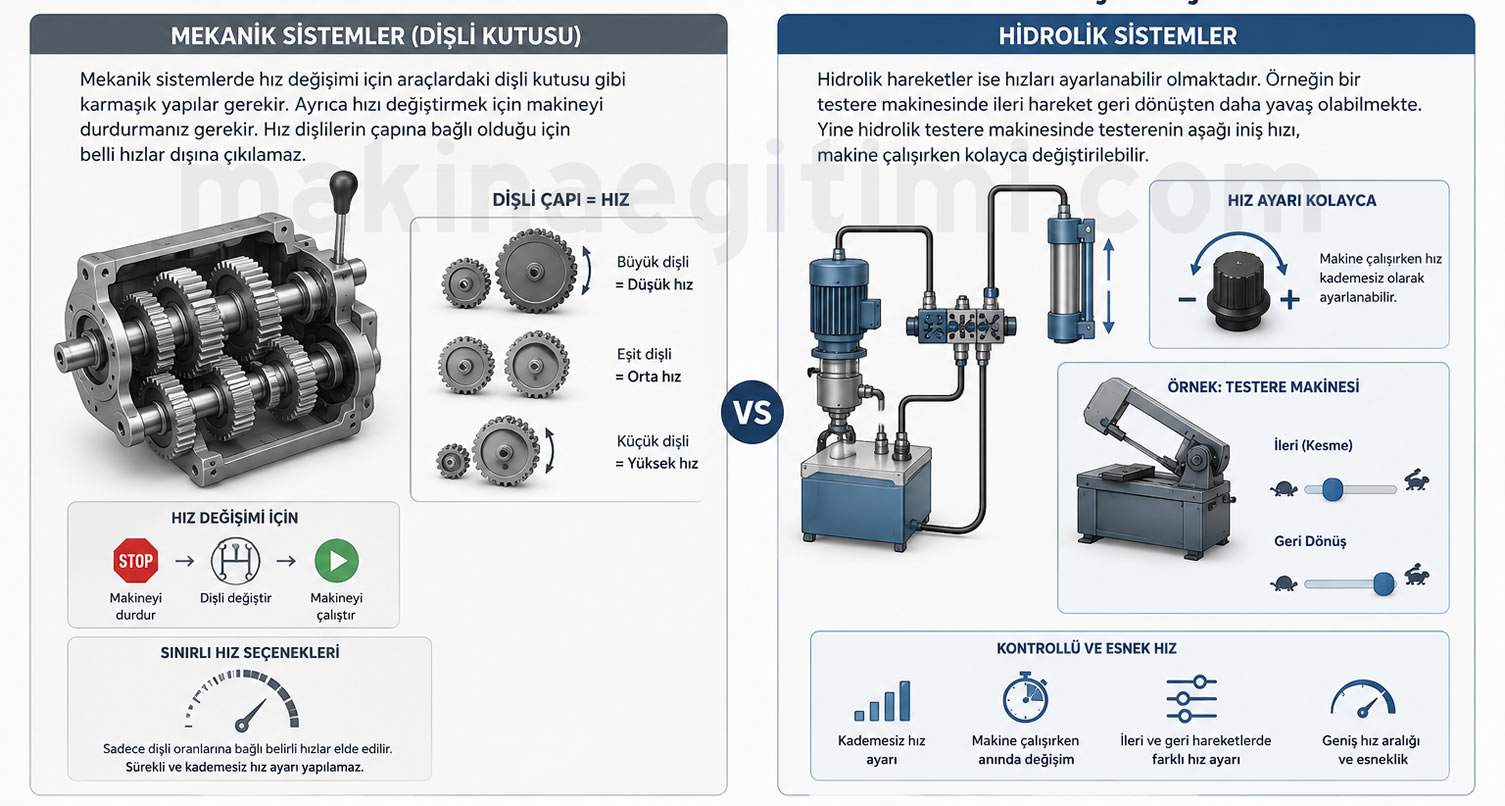
In mechanical systems, changing speed requires complex structures like a vehicle’s gearbox. You also have to stop the machine to change speed. Since speed depends on gear diameters, you can’t go outside certain fixed speeds.
Hydraulic motions, on the other hand, have adjustable speeds. For example, on a saw machine, the forward stroke can be slower than the return stroke. Likewise, on a hydraulic saw machine, the blade’s downward feed speed can be easily changed while the machine is running.
Video on the Importance and Applications of Hydraulics and Pneumatics
Related Questions
Hydraulic systems can produce very high forces even from compact components. This offers a compact yet powerful solution for jobs requiring great force, such as compacting the hopper of a garbage truck.
The valves in the system determine how fast and with how much force the actuator moves, by adjusting the amount and direction of the fluid. Thanks to these valve settings, motion can be controlled with very fine precision according to need.
Related Posts
 Introduction to Pneumatics and Definitions
 What Is a Solenoid Valve, How Does It Work?
 Cushioning in Pneumatic Cylinders
 Hydraulic Applications – Clamping Fixture
 Types of Hydraulic Pumps
 Elements of a Hydraulic Cylinder
 Hydraulic Applications – Feed Speed Adjustment on a Lathe
 Types of Hydraulic Motors