Close Menu
  • MAKİNELER ve İMALAT
    • Tools & Equipment
    • Computer-Aided Drawing
    • CAD/CAM Education
    • CNC Machine Programming
    • Casting Technologies
    • Electrical & Electronics Technologies
    • Hydraulics & Pneumatics
    • Manufacturing Processes
    • Manufacturing Technologies
    • Occupational Safety
    • Mold & Die Design
    • Solid Modeling
    • Welding Technology
    • Machine Elements
    • Mechanical Trade Drawing
    • Materials Science
    • Automotive & Vehicle Technologies
    • Robotics Technologies
    • Health Technologies
    • Defense & Aerospace Technologies
    • Descriptive Geometry
    • Technical Drawing
    • Software & Hardware Technologies
    • Innovative Manufacturing Methods
  • TEKNOLOJİ ve YAŞAM
    • OTOMOBİLLER ve TAŞIT
      • Vehicle & Engine Knowledge
      • Safe Driving
      • Sürüş Destek Sistemleri
    • Genel Kültür
      • Movies & TV Shows
      • Görsel ve Grafik Sanat
      • Books & Literature
      • Music
      • Sports
      • History
      • History of Technology
    • GÜNDELİK YAŞAM TEKNOLOJİLERİ
    • Hobbies & Entertainment
    • Internet Technologies
    • Health
    • Mobile Technologies
Makine Eğitimi
  • Machines & Manufacturing
    Machine Elements
    Hydraulics & Pneumatics
    Technical Drawing
    Computer-Aided Design & Manufacturing
    Basic Manufacturing Processes
    Manufacturing Processes
    Industry Technologies
    Other Technical Courses
    Motion & Power Transmission
    Simple Machines
    Chains & Sprockets
    Shafts & Journals
    Gears
    Cams
    Couplings
    Belts & Pulleys
    Springs
    Bearings
    Keys
    Fastening Joining
    Retaining Rings
    Screws, Bolts & Nuts
    Cotter Pins
    Flanges
    Welding
    Rivets
    Pins & Bolts
    Washers
    Calculators
    Gear Ratio Calculator
    Spring Constant Calculator
    Belt Pulley Ratio Calculator
    Other Machine Elements
    Slides & Linear Guides
    Brakes
    Flywheels
    Clamps
    Shock Absorbers
    Gaskets & O-Rings
    Seals & Sealing Elements
    Hydraulics
    Introduction to Hydraulics & Principles
    Hydraulic Systems & Applications
    Accumulators
    Filters
    Motors
    Pumps
    Valves
    Pneumatics
    Introduction to Pneumatics & Principles
    Pneumatic Systems & Applications
    Pneumatic Circuit Components
    Valves
    Cylinders
    Silencers
    Motors
    Compressors
    Dryers
    Conditioning Units
    Common Topics & Maintenance
    Hydraulic & Pneumatic Maintenance
    Study Notes, Exams & Tests
    Technical Drawing
    Introduction to Technical Drawing
    Geometric Drawings
    Perspective & Projection
    Orthographic Views
    Dimensioning
    Sectioning
    Assembly & Detail Drawings
    Tolerances
    Surface Finish Symbols
    Mechanical Engineering Drawing
    Screws, Bolts & Nuts
    Pulley Drawings
    Gear Drawings
    Shafts & Journals
    Bearing Drawings
    Pins & Bolts
    Spring Drawings
    Welds in Technical Drawing
    Washers
    Cotter Pins
    Technical Drawing Exercises
    Mechanical Drawing Exercises
    Gear Exercises
    View Extraction Exercises
    Pulley Exercises
    Pin & Bolt Exercises
    Threaded Fastening Exercises
    Descriptive Geometry
    Computer-Aided Drawing
    AutoCAD Drawing Lessons
    Solid Modeling & Animation
    Solid Model Drawing Files
    Solid Model Assembly Examples
    Solid Model Drawing Lessons
    3D CAD Software Reviews
    Solid Modeling Exercises
    CNC Programming
    CAM
    Measurement & Inspection
    Dial Indicators
    Calipers
    Gauges
    Micrometers
    Materials Science
    Steels
    Cast Iron
    Aluminum
    Plastics
    Material Testing & Hardness Measurement
    Occupational Safety
    Workshop Safety
    Safety When Working With Electricity
    Machine Safety Rules
    Hand Operations
    Filing
    Marking
    Cutting Operations
    Reaming
    Tapping
    Threading With a Die
    Drill Bit Sharpening
    Working With Machines
    Basic Turning Operations
    Basic Milling Operations
    Shaper Machine
    Machining
    Turning
    Milling
    Grinding
    Innovative Manufacturing Methods
    EDM (Electrical Discharge Machining)
    Laser Machining
    Waterjet Machining
    3D Printing
    3D Scanners
    Welding
    Rolling
    Casting
    Mold & Die Design
    Mechanical & Hydraulic Presses
    Blanking & Piercing Dies
    Bending Dies
    Drawing Dies
    Plastic Injection Molds
    Extrusion Dies
    Compound Dies
    Progressive Dies
    Blow Molds
    Spinning Dies
    Spray Molds
    Manufacturing of Machine Parts
    Automotive & Vehicle Technologies
    Motor Vehicle Manufacturing
    Raw Material Production
    History of Technology
    Health & Medical Technologies
    Defense & Aerospace
    Robotics Technologies
    Software & Hardware Technologies
    Mechanics - Strength of Materials
    Physics Topics
  • Technology & Life
    Hobbies & Entertainment
    Sports
    Music
    Vehicle & Engine Knowledge
    Vehicle Maintenance & Repair
    Safe Driving
    Driver Assistance Systems
    History
    Movies & TV Shows
    Books & Literature
    Computers & Internet
    Computer Tips
    Software Reviews
    Hardware & Peripherals
    Practical & Safe Internet Use
    Visual & Graphic Art
    Mobile Technologies
    Travel
    Science
    Health
    First Aid Knowledge
    Everyday Technologies
Makine Eğitimi
Home»Manufacturing Processes»Information About End Mill Cutters
29 August 2026

Information About End Mill Cutters

Information about end mill cutters

This article’s topic will be end mill cutters. What is an end mill cutter. Where are end mill cutters used. What material are end mills made from. We’ll cover details like how it’s mounted on a milling machine.

  • End Mill Cutters
    • Where are end mill cutters used?
    • Types of End Mills by Shape
    • Helix Angles on End Mill Cutters
    • What material are end mills made of?
    • Can vertical cutting be done with end mill cutters?
  • Related Questions

End Mill Cutters

What is an end mill cutter? An end mill is one of the types of cutting tools with helical cutting edges used in the milling process, which has an important place in the manufacture of machine parts and in mold making. In English it’s called an “End milling cutter,” but in Turkish it’s called “parmak freze” (finger mill) because of its shape.

end mill cutter

End mill cutters are made in many different shank and cutting-edge shapes. They’re also called “shank-type cylindrical mills.” Because small-diameter mills can’t be mounted onto milling arbors, small-diameter ones are generally manufactured as one piece with their shank.

end mill cutters

Shank shapes are made straight, tapered, or with a drawbar tapping hole. Tooth forms, as shown in the figure, are cut both on the periphery and on the end face; for diameters larger than 6 mm, the peripheral teeth are cut as helical flutes. (You could compare it to a small-diameter helical cylindrical mill.)

Where are end mill cutters used?

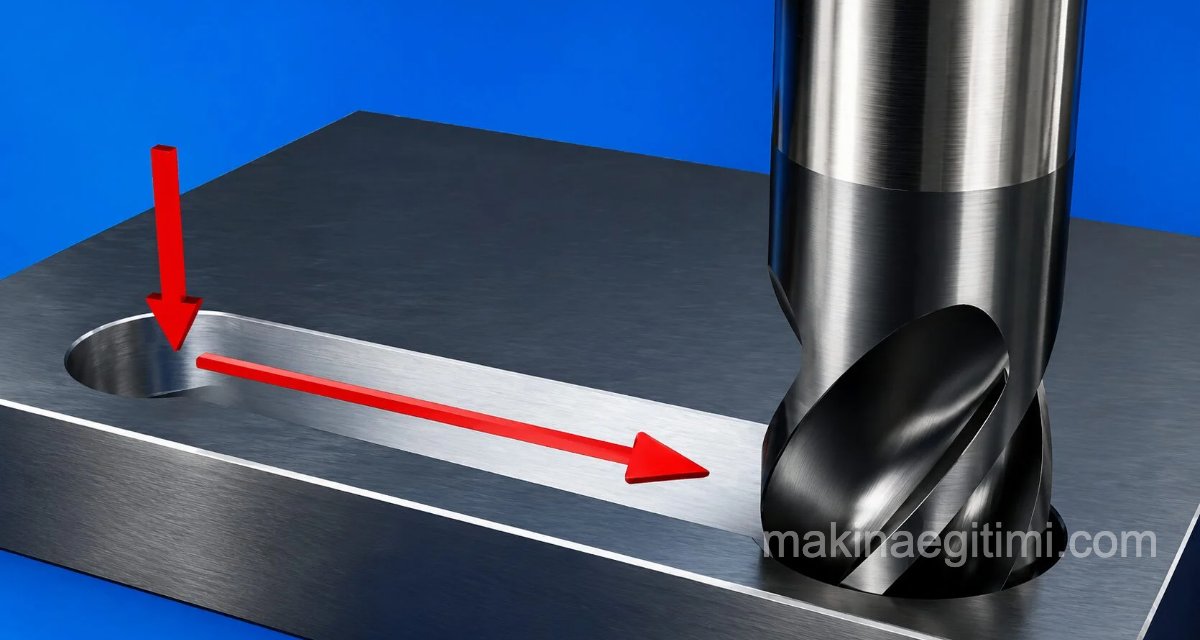
Those with two or three peripheral cutting edges/teeth are used for cutting keyways, and for drilling and hole enlarging operations. Their cutting edges are sharpened so they can also make vertical (plunge) feeds.

When cutting broadly with the side faces of these mills, heavy chip loads shouldn’t be given, since the cutter could break. Their cutting action could be thought of as similar to that of cylindrical helical mills, but they are weaker.

pocket milling with an end mill

Pocket milling with an end mill (above)

T-slot end mill internal groove

A T-slot end mill used for cutting internal T-slots

cutting a groove with an end mill

Cutting a groove with an end mill (above)

A hobbing cutter or module cutter is usually preferred, but in some cases end mills can also be used for cutting gear teeth.

Shank sections are made cylindrical or Morse-taper shaped, matching the mill’s diameter. They’re mounted on the milling machine by way of collet chucks and Morse taper sleeves.

For detailed information, see: How Are End Mill Cutters Mounted


The shapes of the cutting-tooth sections of end mills are made either “straight” or “helical” fluted. Helical flutes, matching the direction of cut, are at helix angles of 10° to 15°, either right- or left-handed.

Types of End Mills by Shape

There are as many different types of end mills as possible: profiling, contouring, slotting, chamfering, drilling… Here’s a brief overview of the main ones.

end mill shapes

Square end mills are the most common type and can be used for many milling applications including slotting, profiling, and plunge cutting.

Corner-radius end mills can produce flat-bottomed grooves with slightly rounded internal corners.

Roughing end mills are used to remove large amounts of material. Their design allows little to no vibration, but leaves a rougher surface finish.

Tapered end mills are cutters that can be used for plunging and are designed for machining angled pockets. They are generally used on castings and molds.

end mill types

Ball nose end mills have rounded tips and are used for milling 3D shapes or rounded grooves.

T-slot end mills can be used to create applications containing T-slots such as piston-ring grooves and machine table slots, and for cutting keyways.

Straight-flute end mills have a zero-degree helix. They work well for materials such as wood, plastic, and composites, where the lifting effect of a spiral flute could cause undesirable results. For these materials, a straight flute minimizes edge chipping and provides a better surface finish than helical general-purpose end mills.

Helix Angles on End Mill Cutters

End mills typically have a helix angle around 30°. Increasing the helix angle will reduce cutting forces and the amount of heat and vibration. For this reason, end mills with a higher helix angle tend to produce a better surface finish on the workpiece.

However, an end mill with a large helix angle will be weaker and won’t be able to sustain high feed rates and heavy depths of cut. For this reason, cutters with a lower helix angle are stronger, but they produce a rougher surface finish.

helix angle on end mills

What material are end mills made of?

HSS end mill

HSS End Mills
High speed steel, or “HSS,” end mills are the cheapest, provide good wear resistance, and can be used to mill many materials such as wood and various metals.

Another easy way to improve the performance of your end mills is to add a good coating. The most common is TiAlN (titanium aluminum nitride), which lets you cut on average 25% faster without spending too much money.

carbide end mill

Carbide end mills are more expensive than HSS, but provide better hardness and can be run 2 to 3 times faster than HSS. They’re also extremely resistant to heat, making them suitable for milling hard materials.

indexable insert end mill

Another option is indexable “carbide-tipped” end mills. The ability to replace their inserts is their biggest advantage. They’re used to machine hard materials.

Can vertical cutting be done with end mill cutters?

End mills have teeth cut where the straight or helical peripheral flute meets the end-face tooth surface. Even though they can cut on vertical feeds, this feed shouldn’t exceed 0.5-1 mm. Because once the chip space between the end-face teeth fills up, the feed stalls, and if forced, the tool breaks. Better results are always obtained if feed is made from the side surface with these tools.

vertical feed groove cutting with an end mill

When they go dull, large-diameter ones are sharpened both on the periphery and on the end face (until the tooth depth runs out). Small-diameter ones can’t really be sharpened on the end face. But by hollowing out the surface, they can be used a bit longer for side-cutting operations.


In this article we covered end mill cutters. What is an end mill cutter. Where are end mill cutters used. What material end mills are made from. We touched on details like how they’re mounted on a milling machine. In one of our upcoming articles, we’ll take a look at the details of machining with end mills.

Versatile Cutting Ability


End mills are used in versatile milling operations, both for surfacing and for cutting slots.

Effect of Tooth Count


End mills with fewer teeth make chip evacuation easier, while those with more teeth provide a smoother surface finish.

Carbide-Tipped Choice


Carbide-tipped end mills offer the advantage of running at high speeds and having a longer tool life.

Related Questions

A very small-diameter mill can be too delicate to be securely mounted to a separate arbor. Manufacturing it integrated with the shank ensures this small mill is held firmly and reliably on the machine.

The helical tooth structure allows chips to evacuate more smoothly and continuously during cutting. This helps achieve a smoother cutting action and a better surface finish compared to straight teeth.

Related Posts
Lathe Tool Bits by Material and Area of Use Lathe Tool Bits by Material and Area of Use Groove Turning Groove Turning Types of Files - Lesson Types of Files – Lesson Types of Milling Machines Types of Milling Machines Information About Module Milling Cutters Information About Module Milling Cutters Micrometer Reading Examples Micrometer Reading Examples Gear Making by the Hobbing Method Gear Making by the Hobbing Method 1/10 Vernier Caliper Reading Online Test 1/10 Vernier Caliper Reading Online Test
Milling kesici takımlar Basic Milling Operations
Share. Facebook Twitter WhatsApp Tumblr Email Telegram Copy Link

Leave A Reply Cancel Reply

What Is a Forklift. What Are the Types of Forklifts
The Best 5 Vehicle Maintenance Tips for Summer Vacation
  • Contact
  • Terms of Service
  • Privacy & Cookie Policy

Type above and press Enter to search. Press Esc to cancel.