

Wire EDM is a non-contact machining process that uses an electrically charged, thin electrode wire that follows a precisely programmed path in dielectric fluid to cut a metal part into different shapes. The process produces small chips and precise cutting lines by melting or vaporizing the material rather than cutting it. As a result, it can easily machine parts that aren’t suitable for traditional machining techniques. However, the parts must be electrically conductive.
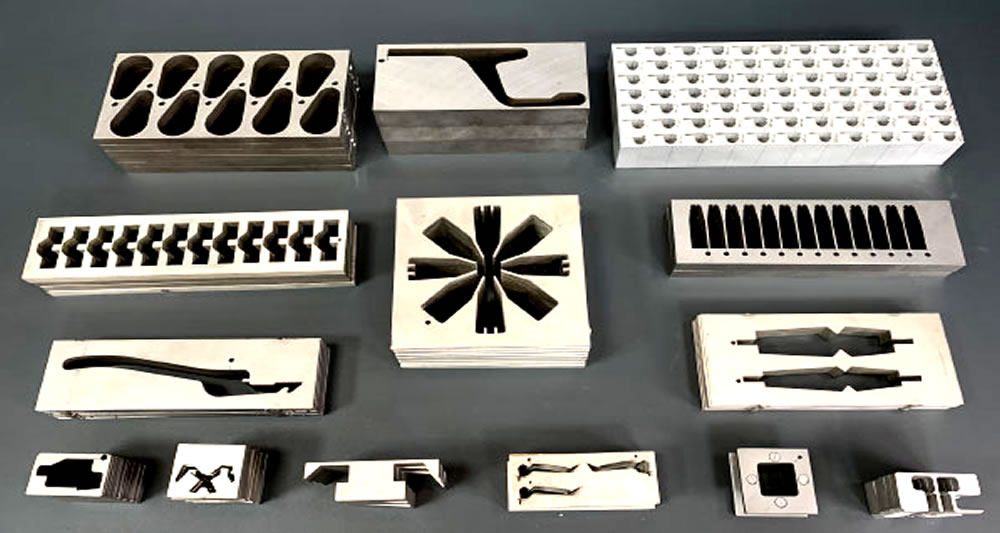
Wire EDM (Wire-Cut EDM) is defined as wire electrical discharge machining. Wire electrode diameters are typically in the range of 0.10mm – 0.30mm, but smaller and larger diameters are also available.
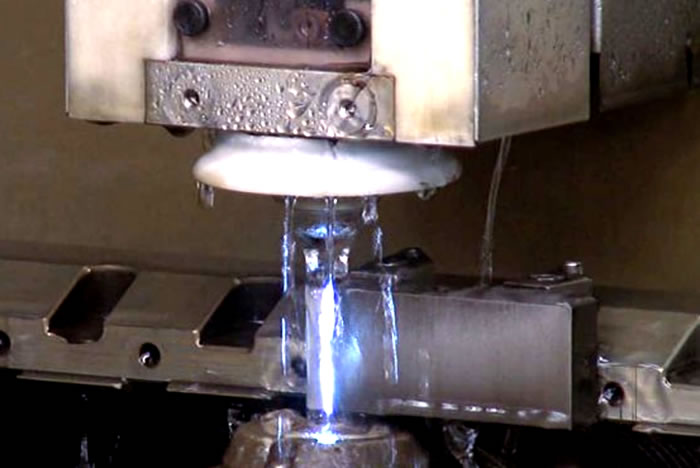
During the wire cutting process, there’s no direct contact between the wire and the workpiece, which allows machining without causing any distortion in the wire’s path or the material’s shape. To achieve this, the wire is rapidly charged to the desired voltage. The wire is also surrounded by dielectric fluid. When the voltage reaches the correct level, a spark jumps the gap and melts a small section of the workpiece. The fluid cools and flushes the small particles out of the gap.

The hardness of the workpiece material has no negative effect on cutting speed. Extrusion dies and blanking punches are often machined with wire EDM.
How Does Wire EDM Work?
In wire EDM cutting, an electrode made of brass or copper wire, with a diameter between 0.01 mm and 0.35 mm, moves while rigidly attached to a spool via rollers and guides. In this process, deionized (desalted) water is generally used as the electrolyte.
By numerically (CNC) controlling the machine table, or by moving the wire electrode sideways, a wide variety of internal and external shapes can be manufactured.
Wire EDM cutting is always done all the way through the workpiece. To start machining with the wire, it’s first necessary to drill a hole in the workpiece or start from an edge.
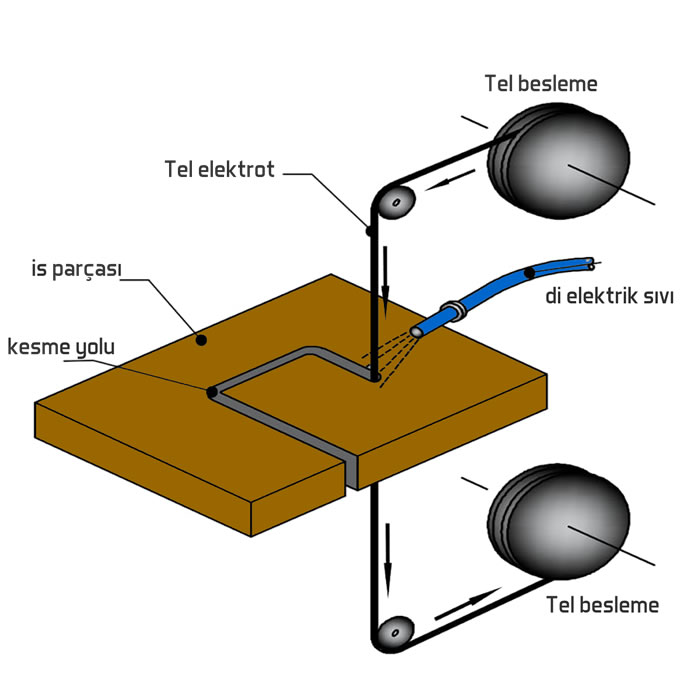
In the machining area, the wire can be tilted, making it possible to produce parts with tapered or different profiles at the top and bottom. There’s never any mechanical contact between the electrode and the workpiece. The wire is usually made of brass and has a diameter of 0.05 mm to 0.35 mm. To avoid using a burned wire and to ensure a precise cut, new wire is automatically spooled throughout the machining process.
In a single cut, the wire ideally passes all the way through a solid part, and when finished, drops a part or a scrap piece. This will provide sufficient accuracy for some jobs, but often review is required.
As in milling, in the EDM process, the path the wire will follow can also be arranged to machine the perimeters of internal and external shapes. In this method, a die’s guide plate, cutting plate, and its corresponding upper punch die section can be manufactured with the same program.
Spark Gap
In EDM machining, the machine generates sparks in the form of pulses. Each spark opens a small crater-shaped pit in the workpiece. The resulting workpiece shape is a result of the number of these pits. Erosion (wear) also occurs on the electrode.

The spark gap is the distance between the tool electrode and the workpiece. The smaller the spark gap, the greater the erosion capacity and forming precision. The size of the spark gap is kept constant depending on the ignition voltage, thanks to the feed setting. Depending on the desired erosion capacity and surface quality, the spark gap ranges between 0.03 and 0.1 mm.

Components of a Wire EDM Machine
The machine consists of several parts working together to give a material the desired shape. Below are the machine’s components.
- CNC CONTROLS: Controls the entire operation of the wire EDM machining process.
- POWER SUPPLY: The component that generates power in the range of 100V to 300V to the welding wire and the workpiece. It also controls the frequency and power of the electrical charges passing through the wire electrode to interact with the workpiece.
- WIRE: The wire serves as the electrode to create the electrical discharge. The workpiece’s shape and thickness directly affect the wire’s diameter. Typically, wires with diameters ranging from 0.05 to 0.25 mm can be used. Brass, zinc-coated, or diffusion-annealed wires with increased zinc content are used as wire materials.
- DIELECTRIC MEDIUM: The wire-cut EDM process must be carried out in a tank filled with dielectric fluid. This fluid prevents small particles from the workpiece from sticking to the welding wire.
For detailed information, SEE: What Is Dielectric Fluid, What Is It For? - ELECTRODES: The electrodes in the machine are the wire (cathode) and the workpiece (anode). A servo motor controls the wire electrode, ensuring it never contacts the workpiece at any point during the wire EDM cutting process.
Thin Wire Electrode
Wire EDM typically uses a thin copper or brass wire electrode, usually 0.1-0.3 mm in diameter.
Water-Based Dielectric
Unlike sinker EDM, wire EDM generally uses deionized water as its dielectric fluid.
High Cutting Precision
Wire EDM is preferred for cutting die and tool parts that require micron-level tolerances.
Materials a Wire EDM Machine Can Cut
Wire EDM machines can create complex shapes and patterns on a workpiece. In addition, they can machine most materials that conduct electricity, including hard and delicate ones. Common shapes and materials you can cut with the machine include:
Aluminum
Aluminum has excellent thermal and electrical conductivity properties. However, aluminum is naturally soft and can be difficult to cut with the process because it can cause a gummy buildup after machining.
Brass:
Since it has high tensile strength, brass is easily cut using the machine. However, since it’s a soft metal, cutting speed should be slow.
Steel
Steel is a very strong metal. As a result, many manufacturers prefer to use a wire EDM machine instead of a CNC machine. However, the material produces a lot of heat, so necessary precautions need to be taken.
Titanium
Wire EDM cutting is excellent for titanium because the process can withstand this alloy’s stickiness and break up long chips. However, you need dielectric water to help control heat buildup during machining.
Graphite:
Cutting graphite using traditional cutting tools can be difficult. However, the wire EDM process is suitable because the wire is sharp and prevents particles from escaping.
Advantages and Disadvantages of Wire EDM Machining
Advantages of Wire EDM
- Makes precise and accurate cuts that eliminate the need for further machining and finishing of the workpiece.
- Suitable for creating complex designs and shapes that are difficult to produce using traditional CNC machining.
- Applicable for machining small parts and cutting highly detailed pieces.
- Wire EDM is ideal for brittle materials.
- The machine cuts materials without leaving burrs or distortion.
- The machining process cuts continuously without interruption. Even if the wire breaks while cutting, the process resumes immediately.
Disadvantages of Wire EDM
- Only compatible with materials that conduct electricity.
- An oxide layer can develop on the cut surface of some materials, such as aluminum. Therefore, this may require additional finishing, which increases cost.
- Initial investment and maintenance costs are high.
This process will produce incredibly precise cuts. However, if you want to cut sharp internal corners, it’s important to remember that wire EDM alone can’t provide you with truly square corners. The wire and spark gap will form a small radius of roughly 0.13 mm to 0.15 mm, though this can be smaller or larger depending on the wire’s diameter.
Uses and Applications of Wire EDM
Ideal for precise or small workpieces that could be damaged during traditional machining or other traditional techniques:
- Thick parts requiring good finish and/or accuracy.
- Complex shapes or narrow slots
- Larger parts that need to have accurate tolerances
- Delicate, hard, exotic/expensive, or weak materials
As a result, as strongly recommended by many CNC machine shops, many parts manufacturers across various industries use it.
Medical Industry
Wire EDM machines produce complex parts with a high degree of accuracy for use in all medical fields, including optometry and dentistry. In addition, metals that work well with wire EDM services are frequently used to manufacture medical equipment.
Since the diameter of the wire determines the size of the cut, a wire EDM machine adds small features to parts such as dental implants and syringe components without compromising their structural integrity.
Automotive Industry
Parts in the automotive industry come in complex shapes and sizes and are often hard. Since wire EDM machining is ideal for complex-shaped, hard parts, it’s preferred in the automotive sector.
Aerospace Industry
Wire EDM cutting produces parts with tight tolerances and is an indispensable machining process for aerospace parts manufacturers. Alongside waterjet cutting, this process is used especially for parts that cannot withstand the high temperature and stress associated with traditional cutting tools.
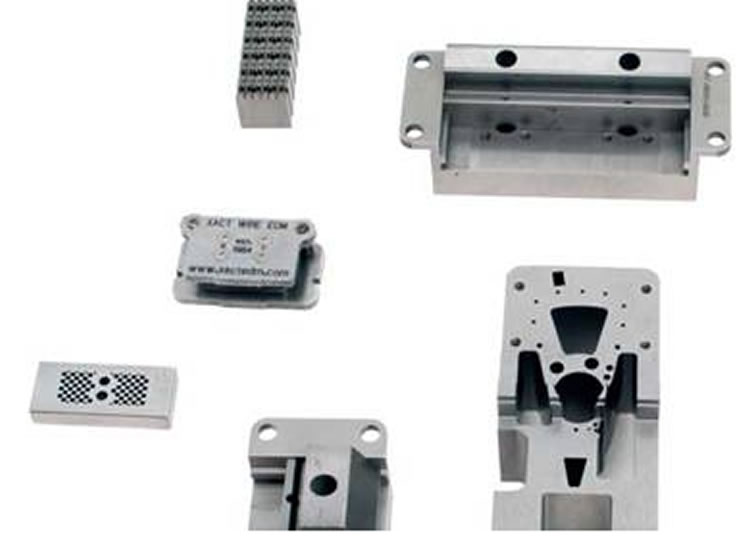
Parts in the aerospace industry need to have an excellent surface finish and be precise and accurate. Manufacturers have used the wire EDM process for years to make engines, turbine blades, landing gear parts, and much more.
Related Questions
Cutting occurs as the electrical sparks produced by the wire melt the material; no mechanical cutting force is applied. This non-contact structure prevents both the thin wire from bending and distorting, and the workpiece’s shape from being strained.
The process relies on electric current passing from the wire to the workpiece and that current forming a spark. If the material doesn’t conduct electricity, this spark formation never occurs, so the erosion process can’t start either.
Related Posts
 Comparing Waterjet Cutting to Other Cutting Methods
  What Is Sinker EDM, How Does It Work. Where Is It Used
  Properties of Laser and Laser Devices Used in Medicine
  Waterjet Cutting Basics
  What Is Electrical Discharge Machining (EDM). Machining with EDM
  Materials Used in 3D Printing
  What Can a Waterjet Cut? What Can It Not Cut?
  Advantages and Disadvantages of Waterjet Cutting