
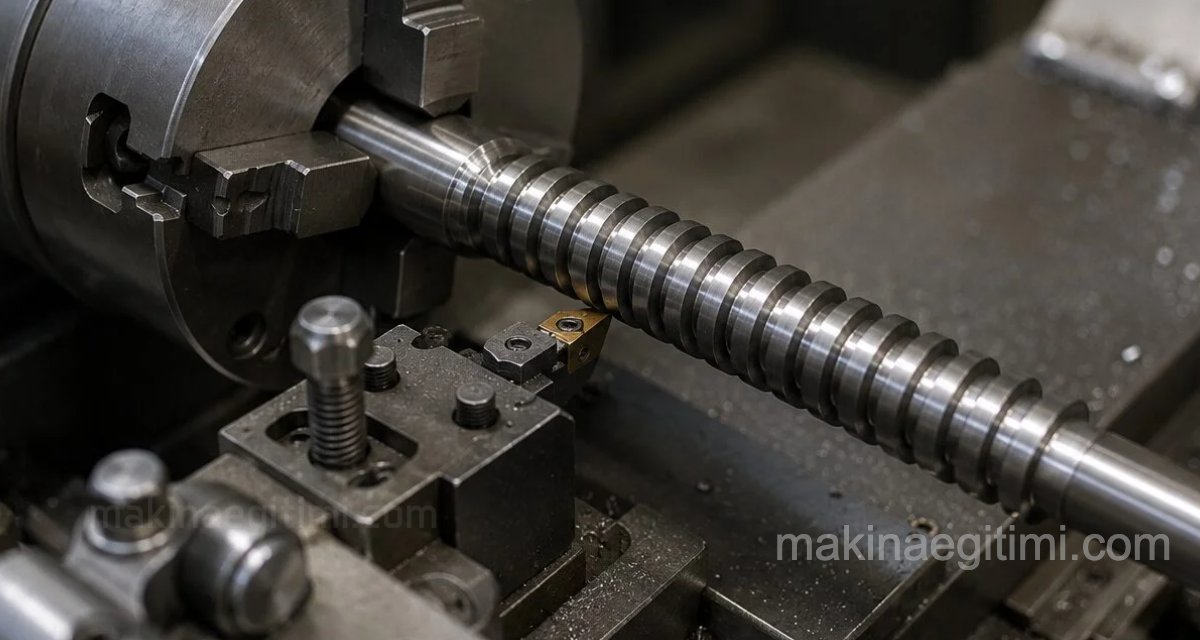
Topics for cutting a square thread on a lathe;
Elements of a Square Thread and Their Calculation:
Tooth thickness and tooth height are approximately half the pitch. For the thread to work easily, the tooth space is made 0.05 mm larger than the tooth thickness.
ELEMENTS OF A SQUARE THREAD
D : Major diameter
P : Pitch diameter at the flank
H : Tooth height = (P/2)
D1 : Minor (root) diameter = ( D1 = D –2H)
D2 : Flank (pitch) diameter = (D – H = D – P/2)
B : Tooth thickness = (P/2 – 0.05)
A : Tooth space = (P/2 + 0.05)

Example:
A square thread with a pitch of 8 mm will be cut on a shaft with a diameter of 40 mm. Calculate its elements.
H = P/2 = 8 / 2 = 4 mm
D1 = D – 2 x H = 40 – 2 x 4 = 32 mm
A = P/2 + 0.05 = 8 / 2 + 0.05 = 4.05 mm
B = P/2 – 0.05 = 8 / 2 – 0.05 = 3.95 mm
Preparing the Square Thread Cutting Tool
Grinding the Tool According to the Pitch

Due to the thread’s helix angle, the tool’s lower side may rub against the thread. To prevent this, the tool’s tip is ground at an angle equal to the helix angle (α).
The helix angle varies depending on the thread’s pitch and major diameter.


The tip width equals the tooth space (tip width = A).
A back-relief clearance angle (δ) must be given so the tool doesn’t jam inside the thread.
APPLICATION:
A square thread with a pitch of 8 mm will be cut on a shaft with a diameter of 40 mm. What should the angle (α) given to the tool during grinding be?
D = 40 mm
P = 8 mm
H = P/2
α = ?
D2 = D – H
D2 = 40 – 8/2
D2 = 40 – 4 = 36 mm
Tan α = P / π • D2
Tan α = 8 / 3.14 • 36
Tan α = 8 / 113.04
Tan α = 0.07
α = 4o 10′ (4 degrees 10 min)
Mounting and Setting the Tool on the Lathe
For the thread to run correctly, the thread profile needs to be cut perpendicular to the axis. To achieve this perpendicularity, the thread cutting tool must be mounted perpendicular to the axis of the workpiece.
We know that we need to use a thread gauge to do this.
Setting Up the Lathe for Cutting a Square Thread
The charts found on the lathe are used for this operation.
To be able to cut the thread at the desired pitch, the setting levers are set to the appropriate position using the charts on the gearbox.
Setting the Spindle’s Direction of Rotation:
The direction-of-rotation setting lever on the machine has two positions:. Right-hand helix direction, from the tailstock toward the chuck,
Left-hand helix direction, from the chuck toward the tailstock. We should set this lever’s position according to the direction of the thread we want to cut.
Setting and Zeroing the Tool Against the Part Surface
The tool, whose perpendicularity has been checked with the gauge, is brought into contact with the surface of the part rotating at a low spindle speed. After the tool makes contact, zeroing is done from the cross-slide’s micrometer dial.


Cutting the Square Thread
1-Close the half-nut lever and run the machine at low speed. First, take a shallow trial cut.
2-Check the thread’s pitch over at least five teeth with a vernier caliper or steel rule.
3-Bring the tool to the starting position so it’s slightly beyond the end of the workpiece.
4-Set the first depth of cut using the micrometer dial on the cross-slide handle.
5-Take the cut in small increments. Since the friction surface is large, the tool can break.
6-Take the first pass along the length of the thread.
7-For a clean cut, flow suitable cutting fluid onto the work surface.
8-When the end of the thread is reached, while the workpiece is still rotating, reverse the cross-slide handle to withdraw the tool.
9-Return the carriage to the starting position.
10-Advance the tool again by the depth of cut.
11-Repeat these steps until the thread’s full tooth depth is achieved.
12-Each time a cut is taken, don’t forget the value on the micrometer dial.
13-To achieve smooth thread flanks, take finishing cuts of 0.1-0.05 mm or less. Repeat this a few times.
14-Check the thread and its depth with a nut, caliper, or gauge.
Related Practice Questions
1- The tip width of a square thread cutting tool is ……………… to the tooth space.
2- A square thread with a pitch of 6 mm will be cut on a shaft with a diameter of 30 mm. What should the value of the tooth space (A) be?
A) 2.05 B) 3.005 C) 3.05 D) 4.05
3- A square thread with a pitch of 6 mm will be cut on a shaft with a diameter of 30 mm. What should the angle (α) given to the tool during grinding be? ( Tan α = P / π • D2)
A) 3° 10́ B) 4° 10′ C) 4° 20́ D) 5° 10′
4- Which of the following is the tool used to mount the tool perpendicular to the workpiece?
A) Steel rule B) Caliper C) Grinding jig D) Grinding gauge
5- To cut a metric square thread, what should we look at on the chart on the machine to make the setting?
A) Pitch B) Threads per inch C) Tooth depth D) Tooth height
6- To cut a right-hand helix thread, the machine’s main spindle direction-of-rotation setting lever should be set to the position going from the chuck toward the tailstock
A) TRUE B) FALSE
Related Posts
 Micrometers. Parts, Types, and Maintenance of a Micrometer
 What Is a Dial Indicator? How to Use It
 What Is an Automatic Lathe, How Does It Work?
 Information About End Mill Cutters
 How Is a Splined Shaft Made? Splined Shaft Manufacturing
 Gear Manufacturing Methods
 Hand Tools – Types of Wrenches
 Types of Dial Indicators