
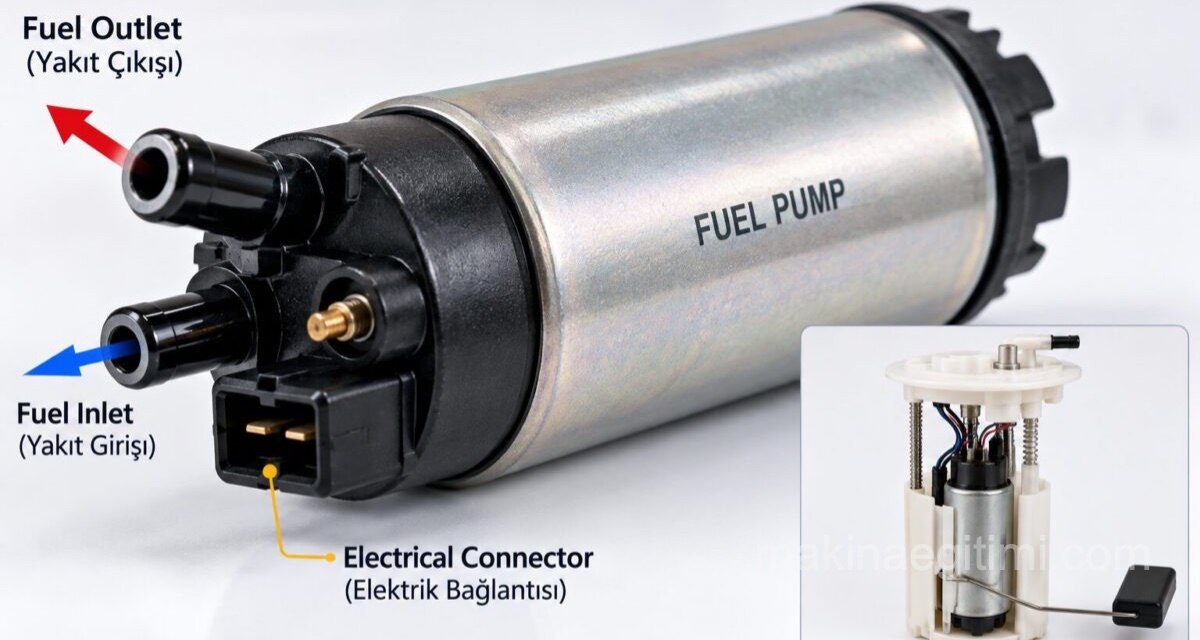
If you want to learn how to tell that the fuel pump has failed, this article can help. In this article we’ll look at diagnosing a fuel pump fault.

First, let’s look at where the fuel pump is located in the vehicle: the fuel pump is usually under the back seat, and replacing it is done by removing the seat.
Now let’s look at how to tell the fuel pump has a fault.
The Sound When You Turn the Ignition On
If the vehicle doesn’t start when you turn the key, the ignition system (spark plugs, plug wires, etc.) should be checked first; if there’s no issue there, the fuel pump should be suspected.
The first thing you need to check is whether you hear a sound from the pump when you turn the ignition on. If there’s no sound at all, it means the pump isn’t running.
Fuel pumps controlled by the ECU run for 1-2 seconds when you turn the ignition on (turn the key) and build up pressure. During this time, a sound can be heard from under the back seat. The moment you turn the starter, the engine sends fuel due to this pressure and the vehicle starts. When this pump fails, the vehicle generally won’t start and you’ll only hear the starter motor cranking.
If you’re in a quiet place right when you turn the ignition on and the lights come on, you can hear the fuel pump run for a few seconds.
If you’ve tried starting your vehicle a few times without success, you need to wait a bit to check this. The sound heard when you turn the key in a fuel pump fault is given in the video below.
If there’s no fault in the starting system, you’ll hear a brief sound the moment you turn the key. If you can hear this sound, which shows the pump has kicked in, the problem lies elsewhere.
Checking Fuel Pump Pressure

While the engine is idling, compare the gauge readings to the engine’s technical specifications. Fuel pressure should be within the acceptable range given by the vehicle manufacturer. If it’s low, the cause could be a weak pump, low voltage, a clogged fuel filter, rust and debris inside the fuel tank, a faulty fuel pressure regulator, or a completely empty fuel tank.
The video above shows how to check the fuel pump relay and how a fuel pump pressure test is done.
Depending on driving conditions, the fuel pump needs to build 30 to 80 psi of fuel pressure. Injected engines are quite sensitive to fuel pressure. Even a 1-2 psi drop in the engine’s fuel pressure can cause it to not start or to misfire.

Operating Pressure
Fuel pumps typically produce pressure ranging from 3-4 bar (gasoline) to over 2000 bar (common-rail diesel), depending on the engine type.
Ignition-On Sound
The brief whirring sound heard when the ignition turns on shows the fuel pump is doing a few seconds of pre-pressurization.
Sign of a Relay Fault
A faulty fuel pump relay can show up as the vehicle not starting at all, or stalling once it warms up.
Checking Fuel Pump Voltage and the Relay

If pressure is lower than normal, the cause can be a weak pump, a blockage in the fuel line, debris in the fuel filter or tank, or a faulty pressure regulator. Low voltage can also affect building normal pressure. The pump’s voltage should be checked.
Sometimes, even if the fuel pump itself hasn’t failed, there can be a problem with its fuse or relays. It’s worth checking the fuse box in these cases.
Checking with Test Fluid
This video shows a quick and easy way to test a faulty fuel pump using a fluid called Starting Fluid. This won’t fix your problem, but it’ll save you a lot of time diagnosing it.
The fault location can be identified by connecting the vehicle to an OBD scanner and reading the fault codes.
• Testing the fuel pump’s pressure in bar can tell you whether there’s a fault.
• The fuel pump’s connector, fuse, and electrical components can be checked by a mechanic to test whether it’s working.
Possible Problems Other Than a Fuel Pump Fault
If the pump is running and normal pressure is reaching the engine, but the engine still won’t start:1- The fuel injectors aren’t getting power (injector fuse or faulty relay) 2- A communication problem between the ECU and the injectors (wiring or software issues) 3- A short circuit in the injectors
If the engine won’t start, the reason may be a problem in the ignition system — meaning there’s an issue with the ignition module, ignition coil, or spark plugs.
A clogged fuel filter can lead to the problems listed above.
The engine not starting at all, or running with a loss of power, can also be due to a belt-related problem (timing belt or V-belt). Loose or worn belts turn the crankshaft weakly. Consequently, they can’t properly control the pistons, and a compression problem arises.
Related Links
Finally, for those wondering how to tell the fuel pump has a fault, we’d like to share a few videos. Even though the videos below are in English, they’re footage that will help you get a sense of fuel pump faults.
Toyota Avensis 2009 1.8i ValveMatic Fuel Pump Failure and repair:
Toyota Avensis 2009 1.8i ValveMatic Fuel Pump Failure
Repairing a Kia Sportage fuel pump fault:
Fix fuel pump – delay to start car _ Kia sportage
How to properly test and diagnose a faulty fuel pump:
How to Properly Test and Diagnose a Bad Fuel Pump
2016 Polaris Ranger EFI fuel pump troubleshooting and repair:
2016 Polaris Ranger EFI Fuel Pump Troubleshooting And Repair
How to clean or replace a fuel pump, disassembly and assembly:
How to clean or replace fuel pump, disassemble and assemble.
Related Questions
A properly working fuel pump runs briefly and builds pressure as soon as the ignition turns on, and this is heard as a faint sound from under the back seat. This sound not occurring at all is an important sign that the pump isn’t getting power or has failed completely.
The engine needs fuel to run, and the pump is what delivers this fuel. When the pump doesn’t work, fuel doesn’t reach the cylinders, so even though the starter motor turns, the engine can’t fire and won’t start.
Related Posts
 Why Does an Engine Misfire? Engine Misfire Problem
  Fuel Pump Failure Symptoms
  Engine Noises and What They Mean
  Inspection and Replacement Times for Vehicle Parts
  How Is Engine Oil and Oil Filter Change Done?
  White Smoke Coming from the Exhaust and Its Causes
  When Is Shock Absorber Replacement Time?
  How to Prevent an Engine From Burning Too Much Oil