
Although casting is one of the oldest known manufacturing methods in human history, it remains an indispensable production technique in today’s industry. Engine blocks, pump housings, valve parts, and many other parts with complex geometries are produced by casting. In this article, we examine the main casting methods and their advantages and disadvantages.
What Is Casting?
Casting is a method of producing a part by pouring molten metal into a mold that carries the negative shape of the desired part and letting it solidify. Casting allows parts with especially complex internal and external geometries to be produced in a single step, with much less material loss than machining.
Main Casting Methods
1. Sand Casting
This is the oldest and most common casting method. A pattern (a copy of the part) is pressed into sand to form the mold cavity, the pattern is removed, and molten metal is poured into the cavity. Sand molds are generally single-use (broken when the part is removed). Due to its low cost and applicability to nearly any size and alloy, it is the most preferred method for single-unit or small-batch production.

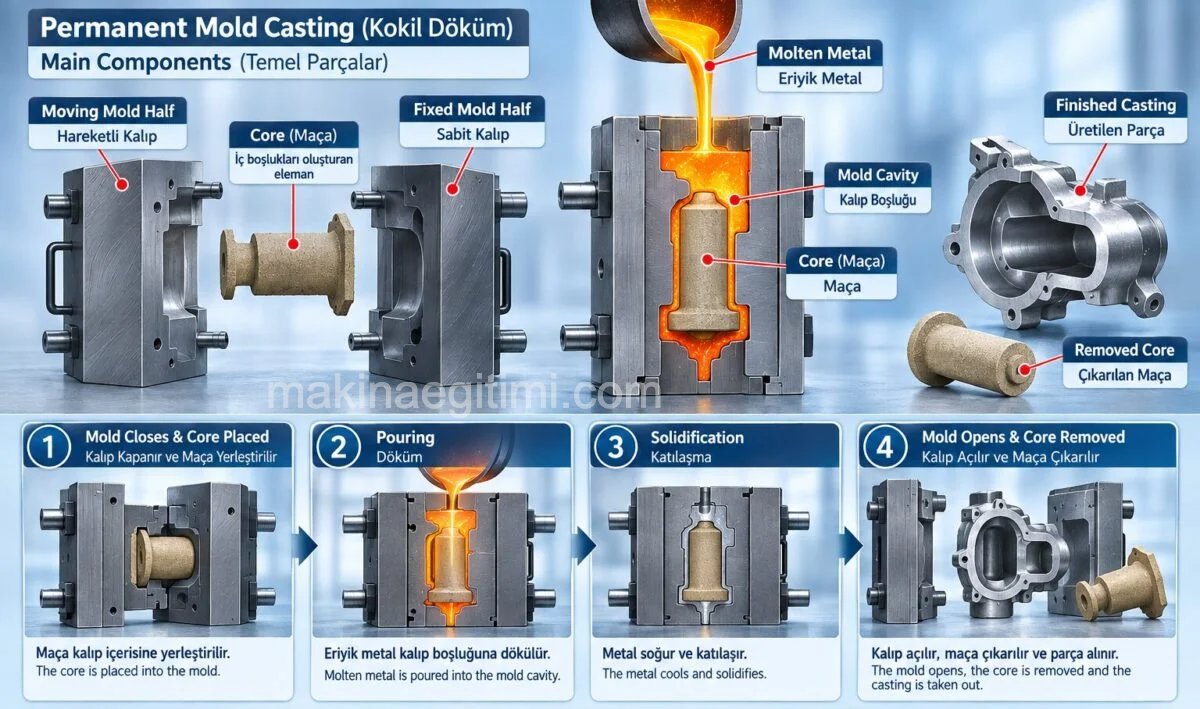
2. Permanent Mold (Gravity Die) Casting
The mold is made from reusable metal (usually steel) instead of sand. Molten metal fills the mold by gravity or low pressure. It offers better surface quality and dimensional precision than sand casting, and is preferred for medium-to-high volume production.
3. Die Casting (Injection Casting)
Molten metal (usually low-melting-point alloys such as aluminum, zinc, or magnesium) is injected into a steel mold under high pressure. It offers very high dimensional precision, excellent surface quality, and high production speed. It is the primary method preferred for high-volume parts such as automotive components, appliance housings, and electronic enclosures.

4. Investment (Lost-Wax) Casting
A wax model of the part is made, this model is coated with a ceramic shell, heated to melt out and drain the wax (lost wax), and metal is poured into the remaining ceramic mold. Because it provides very high dimensional precision and complex internal geometries, it is used for precision parts such as turbine blades, medical implants, and jewelry.

5. Centrifugal Casting
Molten metal is poured into a rotating mold; the centrifugal force generated pushes the metal toward the mold walls. It is used especially for producing hollow, cylindrical parts (such as pipes, bushings, and gear blanks), and the risk of porosity/voids forming in the casting is lower compared to other methods.
Comparison of Casting Methods
| Method | Surface Quality | Cost | Typical Use |
|---|---|---|---|
| Sand casting | Medium | Low | Single-unit / small batch, large parts |
| Permanent mold casting | Good | Medium | Medium-to-high volume production |
| Die casting | Very good | Medium-high (mold cost) | High volume, thin-walled parts |
| Investment (lost-wax) casting | Excellent | High | Precise and complex parts |
| Centrifugal casting | Good | Medium | Cylindrical / hollow parts |
What Should Be Considered When Choosing a Casting Method?
- Production quantity: Sand casting is more economical for small quantities, while die casting is more economical for high quantities.
- Desired surface quality and tolerance: Investment casting or die casting is preferred for precision parts.
- Alloy to be used: High-melting-point alloys (such as steel) are generally better suited to sand or investment casting, while low-melting-point alloys (aluminum, zinc) are better suited to die casting.
- Part geometry: Investment casting offers an advantage for complex internal cavities, while centrifugal casting offers an advantage for cylindrical/symmetrical parts.
Conclusion
Despite their thousands-of-years-old history, casting methods remain an indispensable part of modern manufacturing. Each method has its own advantages and limitations; the right method should be chosen based on production quantity, part geometry, material type, and cost considerations. Machining, casting, and additive manufacturing are all complementary production techniques that meet different needs.