
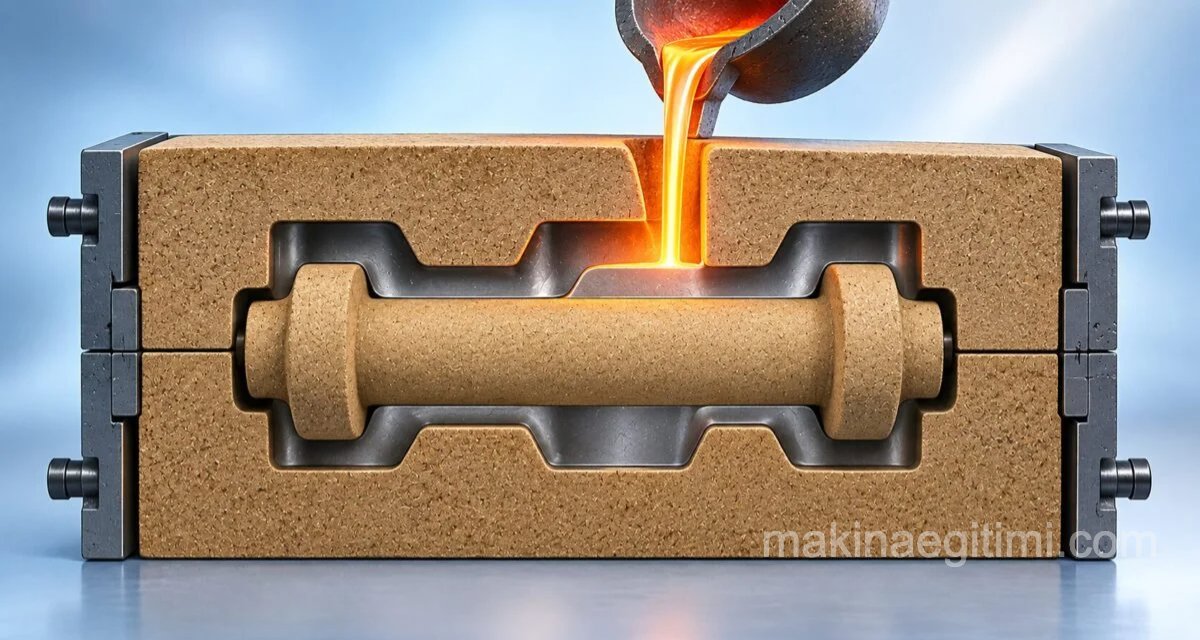
In most parts produced by casting, the internal structure is just as much a part of the design as the outer surfaces. The water passages in an engine block, the flow path in a valve body or the bore in a pipe are geometries that the mould cannot create on its own. This is where the core comes in. In this article we look at the job the core does in the casting process, the properties it needs to have, the main types of core, and how it is used in different casting methods.
What Is a Core?
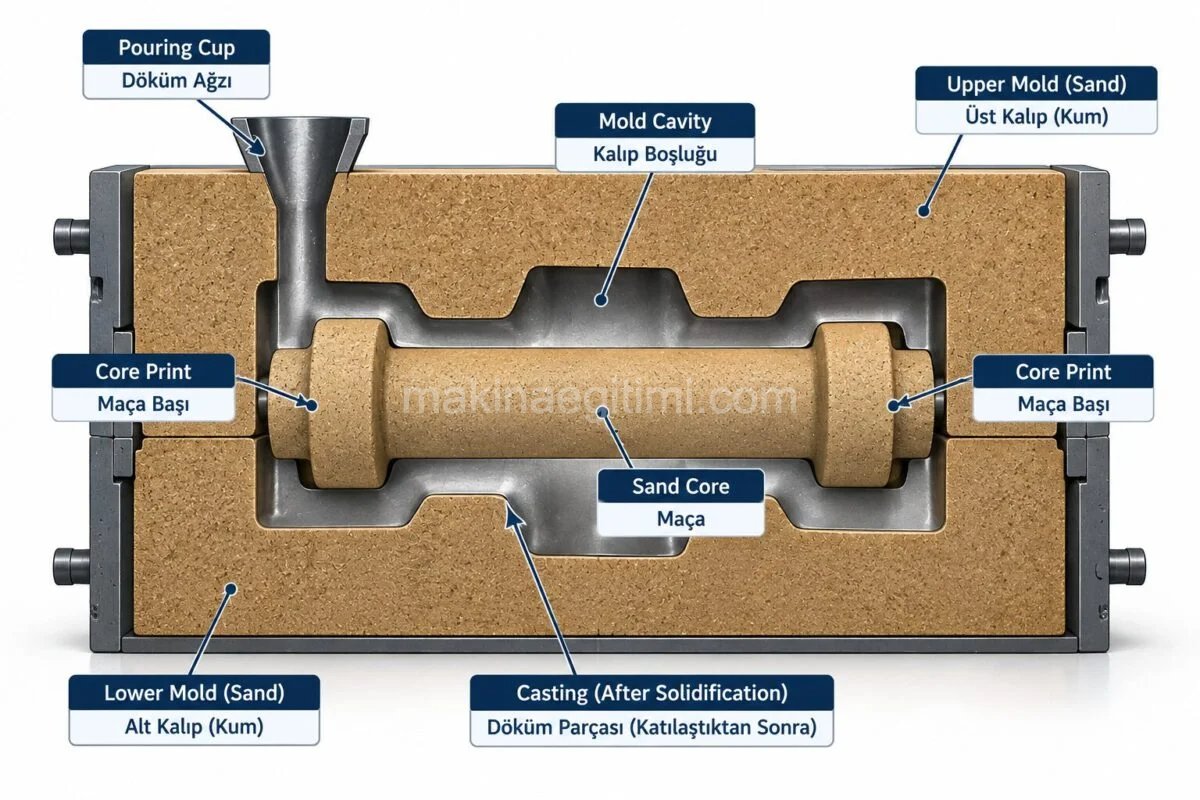
A core is a separate element placed inside the mould in order to form the cavities, holes or hard-to-reach internal geometries that are meant to remain inside the casting. While the mould shapes the outer surface of the part, the core occupies the regions inside the part where the molten metal must not flow, so that these cavities appear once the casting is finished.
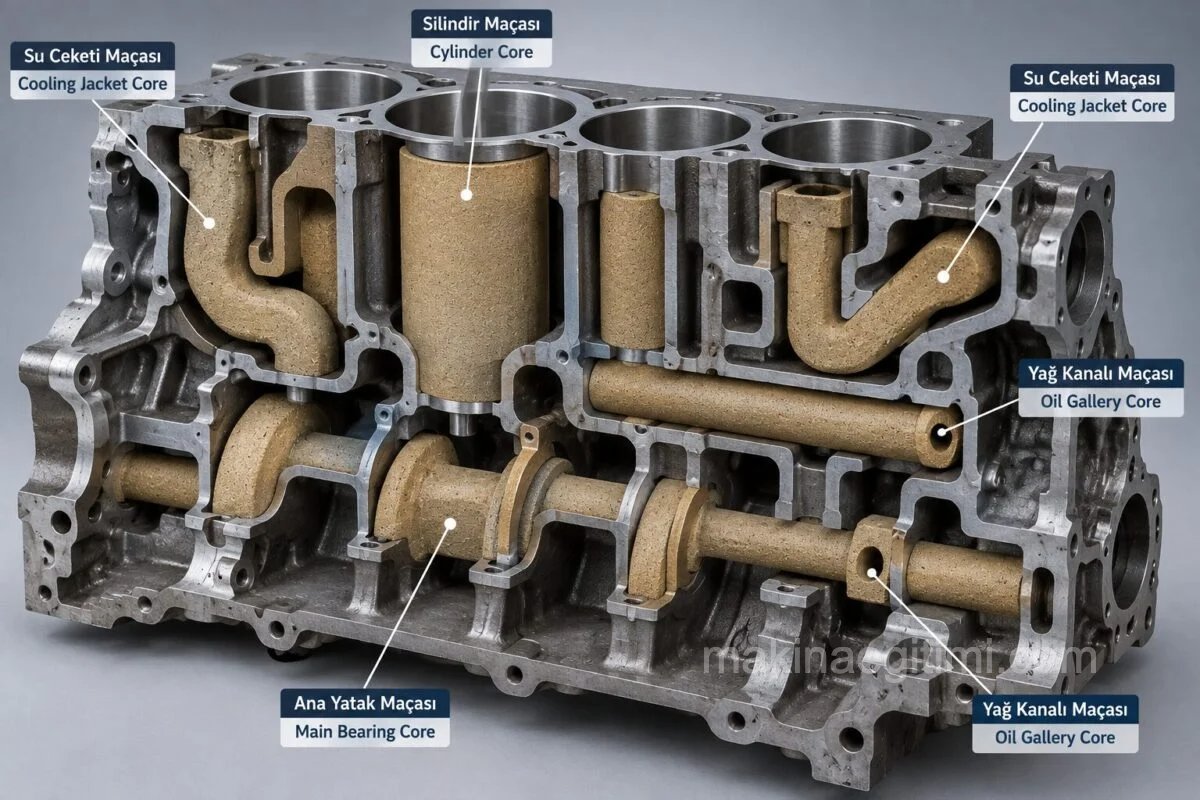
The easiest way to understand the idea of a core is to think of an engine block. While the outside of the engine block is shaped by the mould, complex internal cavities such as the coolant passages and oil galleries inside it are formed thanks to cores placed in those regions beforehand. Without cores it would not be possible to cast parts with this kind of internal cavity in one piece.
The Basic Functions of a Core
The job of a core in the casting process can be grouped under a few headings.
Forming internal cavities: Geometries such as holes, passages or recesses inside the part are obtained by placing a core in that region.
Shaping undercut surfaces: Some parts have projecting or recessed surfaces that could not be released while the pattern is drawn out of the mould. Surfaces of this kind are formed with a separate core rather than as part of the pattern.
Protecting delicate regions of the mould: In some cases the core supports and protects thin or fragile mould regions that could easily be damaged while the pattern is withdrawn from the sand.
Directing the flow of the molten metal: A core can also be positioned so that it makes the molten metal flow in a particular direction inside the mould cavity, which helps the filling to be more controlled.
Properties Required in a Core
The conditions a core faces during casting are far harsher than those in other regions of the mould, because the core is usually surrounded entirely by molten metal. For this reason the following properties are required in cores:
- It should be easy to form.
- It should have high gas permeability, because the gases generated during casting need to escape.
- It should withstand high temperature and thermal shock.
- It should have adequate mechanical strength both in the green and in the dry state.
- It should withstand the pressure and the buoyancy force applied by the molten metal.
- It should break down easily after casting is complete and be easy to clean out of the part.
- It should be economical to produce.
Of these properties, resistance to the buoyancy force in particular is a critical subject that is often overlooked. Molten metal tries to push a core immersed in it upwards with a force that can reach several times the weight of the core itself. If this force is not balanced, the core shifts out of position and the internal geometry of the part comes out wrong.
What Are Core Prints and Chaplets?
Two important supporting elements are used so that a core can stay in the correct position inside the mould.
Core print: The projecting sections added to the ends of the pattern, in order to let the core sit in a balanced and correct position inside the mould, are called core prints. Thanks to these prints the core seats on specific points of the mould and is held in place. A well-designed core print both keeps the core correctly aligned and allows the gases generated inside the core to escape easily out of the mould.

Chaplet: With long or large cores in particular, relying on the core prints alone may not be enough. In these cases metal supports are used to centre the core inside the mould and hold it steady against the buoyancy force of the molten metal. Chaplets fuse with the molten metal around them during casting and become part of the casting, which is why they have to be chosen from an alloy compatible with the metal being poured.
Types of Core
Cores are divided into different groups according to the material and the method used to produce them.
Sand cores: This is the most widely used type of core. Silica sand is mixed with various organic or inorganic binders and formed in moulds called core boxes. Sand cores are single-use; after casting they are broken up and cleaned out of the part.
Shell cores: These are produced by blowing resin-coated sand into a heated core box. Because they form a thin but strong shell, they are preferred for complex parts that require high dimensional accuracy and a smooth surface finish.

Cold box cores: These are obtained by hardening a mixture of sand and resin rapidly at room temperature with the help of a catalyst gas. They are widely used in series casting work that requires high production volumes.
Metal cores: These are generally preferred in methods that use a permanent mould, such as gravity die casting. They are suitable for simple internal cavities on a straight axis; once the part has solidified they are withdrawn and can be used over and over again.
In Which Casting Methods Are Cores Used?
The idea of a core is not specific to a single casting method; it appears in some form in almost all of the main casting methods.
Sand casting: This is the method in which cores are most widely used. Sand cores are produced from the same or a similar material as the mould itself and placed in the mould cavity.
Gravity die (permanent mould) casting: Metal cores are used for simple internal geometries, and sand cores for more complex or undercut geometries.
High pressure die casting: Because the work is carried out under high pressure, metal cores are generally preferred, as sand cores may not withstand that pressure.
Investment casting (lost wax process): When complex internal passages are required, ceramic-based cores can be used. These cores are removed from the part by chemical means after casting.
Although the material and the production method of the core change with each method, its basic purpose stays the same: to make possible the internal geometries that the mould could not create on its own.

Related Post What Are the Casting Methods? Sand, Die, and Investment Casting
Compare the main casting methods, sand, permanent mold, die, investment (lost-wax), and centrifugal casting, with their pros, cons, and typical uses.
Conclusion
The core is an invisible but indispensable component of casting technology. Every cavity, passage or hard-to-reach geometry inside a part in fact reflects the position and shape of a core inside the mould. Choosing the right material, designing suitable core prints and using chaplets where necessary all directly affect both casting quality and production efficiency. For this reason core design is a part of foundry engineering that deserves just as much care as mould design.
Related Videos

casting : What is core | functions of core | types of core | Casting process explained |engineering

What is a core in Sand Casting? | Skill-Lync

CORE MAKING
Frequently Asked Questions
The mould shapes the outer surface of the casting, while the core forms the internal cavities or the undercut geometries of the part. Together the two complete the full geometry of the part.
A sand core is designed to be broken up and dispersed so that it can be removed from inside the part after casting. For this reason a new sand core has to be prepared for every casting.
A chaplet fuses with the molten metal surrounding it during casting and becomes part of the casting. If it is made from a different alloy, weak points or quality problems can appear at the joint region.
No. Parts that are completely solid or have a simple external geometry may not need a core at all. A core is only necessary when there is a cavity, a passage or an undercut geometry inside the part.
If the core print is inadequate, the core cannot seat in a balanced way inside the mould and may shift under the buoyancy force of the molten metal. This leads to dimensional errors in the internal geometry of the part.
Related Posts
