
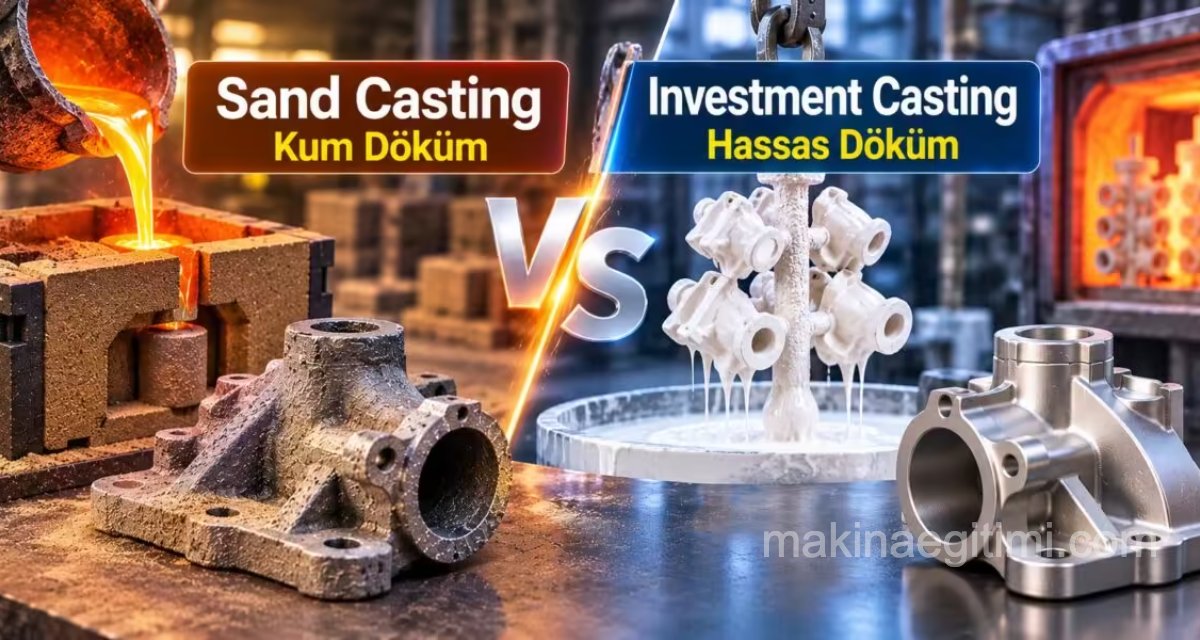
Sand casting and investment casting are two of the oldest and most widely used metal casting processes in the world. Both involve pouring molten metal into a mold and letting it solidify into the shape of the final part. Beyond that basic principle, however, they differ in almost every way that matters to an engineer or buyer: accuracy, surface finish, cost, lead time and the kind of parts they are best suited for.
In this guide, we explain how each process works, compare them side by side, and answer the question most people are really asking: should I use sand casting or investment casting for my part?

What Is Sand Casting?
Sand casting is a process in which molten metal is poured into a mold made of compacted sand. The mold is created around a pattern, which is a replica of the final part. After the metal solidifies, the sand mold is broken apart to release the casting. Because the mold is destroyed each time, a new one is made for every part, but the pattern can be reused many times.
Sand casting is responsible for a large share of all metal castings produced worldwide. It is the go-to method for large, heavy and relatively simple parts, and for low-volume or prototype production.
How Sand Casting Works
1. Pattern making: A pattern is made from wood, plastic or metal. It is slightly larger than the final part to allow for metal shrinkage during cooling, and includes draft angles so it can be removed from the sand.
2. Core making: If the part has internal cavities, such as the passages in an engine block or pump housing, sand cores are made separately and placed inside the mold.
3. Mold making: Sand mixed with a binder (clay and water in green sand, or chemical resins in no-bake sand) is packed around the pattern in a two-part box called a flask. The upper half is the cope and the lower half is the drag.
4. Gating system: Channels called sprues, runners and gates are formed to guide molten metal into the cavity, along with risers that feed extra metal as the casting shrinks.
5. Pouring: Molten metal is poured into the mold.
6. Cooling and shakeout: Once solidified, the sand is broken away from the casting.
7. Fettling and finishing: The gating system and risers are cut off, and the casting is cleaned, ground and often machined to final dimensions.

What Is Investment Casting?
Investment casting, also known as lost-wax casting or precision casting, uses a ceramic shell built around a wax pattern. The wax is melted out, leaving a precise cavity into which metal is poured. The process dates back thousands of years, when it was used to make jewelry and sculptures, and today it is used to produce some of the most demanding components in aerospace, medical and energy industries.
Investment casting is known for its ability to produce complex, highly detailed parts with excellent surface finish and tight tolerances, often reducing or eliminating the need for machining.
How Investment Casting Works
1. Wax pattern production: Wax is injected into a metal die to create an exact replica of the part.
2. Tree assembly: Multiple wax patterns are attached to a central wax sprue, forming a cluster often called a tree.
3. Shell building (investing): The tree is repeatedly dipped into a ceramic slurry and coated with fine refractory sand. Each layer is dried before the next is applied, building up a strong ceramic shell.
4. Dewaxing: The wax is melted and drained out, usually in a steam autoclave, leaving a hollow ceramic mold. This is why the process is called lost-wax casting.
5. Firing: The ceramic shell is fired at high temperature to strengthen it and burn out any remaining wax.
6. Pouring: Molten metal is poured into the hot shell.
7. Shell removal and finishing: After cooling, the ceramic shell is broken off, individual parts are cut from the tree, and minimal finishing is carried out.

Sand Casting vs Investment Casting: Side-by-Side Comparison
Dimensional Accuracy
Sand casting: Lower accuracy. Typical tolerances are in the range of roughly ±0.5 to ±2 mm (about ±0.02 to ±0.08 in), depending on part size and sand system.
Investment casting: High accuracy. Typical tolerances are around ±0.13 mm per 25 mm (about ±0.005 in per inch).
Winner: Investment casting.
Surface Finish
Sand casting: Rough, grainy surface, typically around Ra 6.3 to 25 µm (250 to 1,000 µin).
Investment casting: Smooth surface, typically around Ra 1.6 to 3.2 µm (63 to 125 µin).
Winner: Investment casting.
Part Size and Weight
Sand casting: Practically no upper limit. Sand casting can produce parts from a few hundred grams to many tonnes, such as large machine bases, ship components and turbine housings.
Investment casting: Best suited to small and medium parts. Most investment castings weigh from a few grams up to a few tens of kilograms, although larger parts are possible with specialized equipment.
Winner: Sand casting.
Design Complexity and Thin Walls
Sand casting: Minimum wall thickness is typically around 3 to 5 mm (about 0.12 to 0.2 in). Draft angles of 1 to 3 degrees are usually needed. Fine details and sharp edges are difficult to reproduce.
Investment casting: Walls can be as thin as around 1 mm (about 0.04 in). Little or no draft is required, and intricate details, undercuts, lettering and complex internal shapes can be produced.
Winner: Investment casting.
Materials
Sand casting: Works with almost all castable metals. It is especially common for gray and ductile iron, carbon steel, aluminum, bronze and brass.
Investment casting: Also works with a wide range of alloys, and excels with stainless steels, tool steels, nickel-based superalloys, cobalt alloys and, with vacuum processes, titanium.
Winner: Tie. Sand casting dominates cast iron and very large parts, while investment casting is preferred for high-performance alloys.
Tooling Cost
Sand casting: Low. Patterns can be made from wood or plastic at relatively low cost, which makes sand casting ideal for prototypes and small batches.
Investment casting: Higher. A metal injection die for the wax patterns is required, which is a significant upfront investment.
Winner: Sand casting.

Unit Cost and Machining
Sand casting: The casting itself is cheap, but parts often need substantial machining to reach final dimensions and surface quality.
Investment casting: Each casting costs more to produce, but near-net-shape accuracy can greatly reduce or eliminate machining. For complex parts, the total cost per finished part can be lower.
Winner: Depends on the part. Simple parts favor sand casting, while complex parts that would need heavy machining often favor investment casting.
Lead Time
Sand casting: Fast. Patterns can be made quickly, and the molding process itself is short. Prototypes can often be delivered in a few weeks.
Investment casting: Slower. Die making, multiple shell-building layers with drying time, and firing add significant time to the process.
Winner: Sand casting.
Production Volume
Sand casting: Flexible. It is economical from single pieces up to very high volumes, especially with automated green sand molding lines.
Investment casting: Most economical at medium to high volumes, where the die cost can be spread across many parts.
Winner: Sand casting for low volumes and prototypes, investment casting for medium to high volumes of complex parts.

Typical Applications
Sand Casting Is Commonly Used For
Engine blocks and cylinder heads
Pump and valve housings
Gearbox housings
Machine tool bases and frames
Large pipe fittings
Brake drums and rotors
Agricultural and construction machinery parts
Investment Casting Is Commonly Used For
Turbine blades and vanes in jet engines and gas turbines
Medical implants and surgical instruments
Golf club heads
Firearm components
Impellers and pump components
Valve parts for the oil, gas and chemical industries
Dental and jewelry applications
Advantages and Disadvantages
Sand Casting
Advantages:
Low tooling cost
Suitable for very large and heavy parts
Fast lead times for prototypes and small batches
Works with nearly all castable metals
Economical across a wide range of production volumes
Disadvantages:
Rough surface finish
Lower dimensional accuracy
Usually requires significant machining
Limited ability to produce thin walls and fine details
Investment Casting
Advantages:
Excellent surface finish
High dimensional accuracy
Ability to produce complex shapes, thin walls and fine details
Near-net shape, reducing or eliminating machining
Ideal for high-performance and difficult-to-machine alloys
Disadvantages:
Higher tooling and per-part process costs
Longer lead times
Practical limits on part size and weight
Less economical for very low volumes
How to Choose: Sand Casting or Investment Casting?
Ask yourself these questions:
How big is the part? : If it weighs more than a few tens of kilograms, or is physically large, sand casting is usually the practical choice.
How tight are the tolerances? If the part needs precise dimensions and a smooth surface straight from the mold, investment casting is the better fit.
How complex is the geometry? Thin walls, fine details, undercuts and intricate internal shapes point toward investment casting.
How many parts do you need? For prototypes and small batches, sand casting’s low tooling cost usually wins. For medium to high volumes of complex parts, investment casting becomes more economical.
How much machining will be needed? If a sand casting would require extensive machining, compare the total cost of a finished part, not just the casting price. Investment casting often comes out ahead.
What material are you using? Large cast iron parts are a natural fit for sand casting, while superalloys, stainless steels and titanium are often investment cast.
What is the main difference between sand casting and investment casting? In practice, many manufacturers use both processes. A common approach is to prototype a part using sand casting, then switch to investment casting once the design is finalized and production volumes justify the tooling cost.

Frequently Asked Questions
Sand casting uses a mold made of compacted sand formed around a reusable pattern, while investment casting uses a ceramic shell built around a wax pattern that is melted out. Investment casting gives much higher accuracy and a smoother finish, while sand casting is cheaper to tool and better suited to large parts.
Sand casting has much lower tooling costs and is usually cheaper for large, simple parts and small quantities. For complex parts produced in larger volumes, investment casting can be cheaper overall because it reduces or eliminates machining.
Because the wax pattern is melted and drained out of the ceramic shell before the metal is poured. The wax is “lost” in the process, leaving a precise cavity in the shape of the part.
Most investment castings weigh from a few grams to a few tens of kilograms. Larger parts are possible with specialized foundries, but sand casting is usually more practical for very large components.
A wide range of metals can be investment cast, including carbon and stainless steels, tool steels, aluminum, copper alloys, nickel and cobalt superalloys, and titanium using vacuum processes.
Yes. Low pattern costs and short lead times make sand casting one of the best options for prototypes and small production runs.
Often very little. Investment castings are near-net shape, so many parts need only minimal finishing, although critical features such as threads or sealing surfaces may still be machined.
Related Posts

