
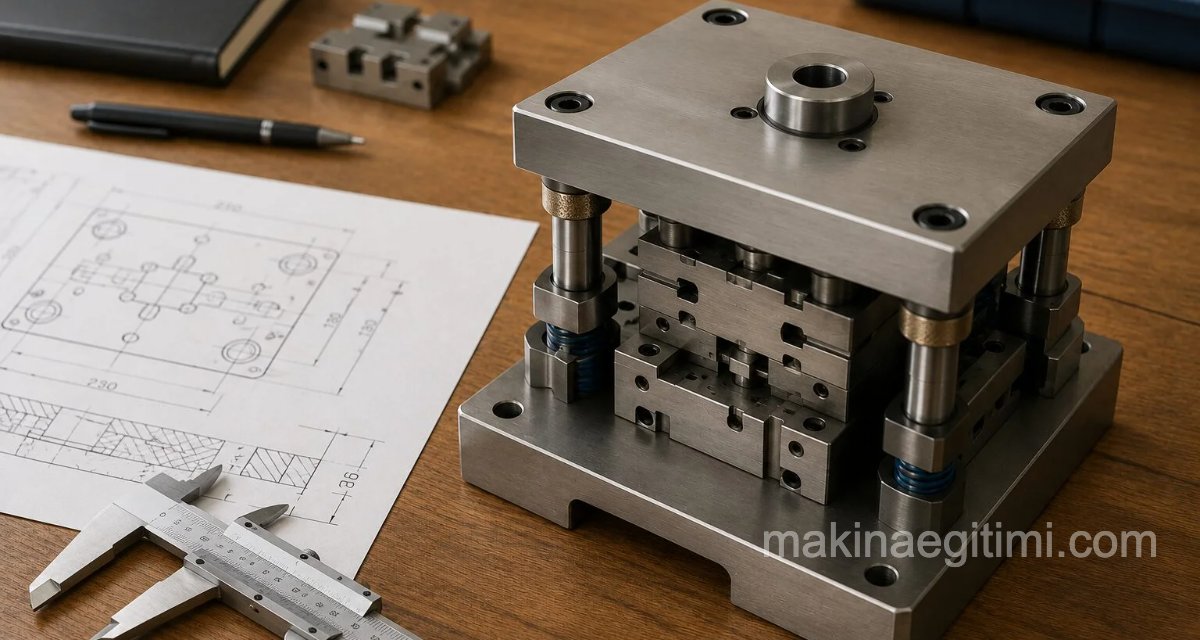
Stripper plates are used to separate the strip skeleton material off the punch, and are also used as a punch guide plate. Sometimes stripper plates also act as a side gauge for the strip material. For this reason, based on the function they perform, we can use stripper plates for the following purposes.
- As a stripper plate,
- As a punch guide plate,
- As a side-guided (combination) stripper plate.
Depending on the forming operations, stripper plates are used as;
- Open stripper plates,
- Semi-open stripper plates,
- Stripper plates closed on both sides.
Open stripper plates are generally used in cases where the forming operations need to be visible.
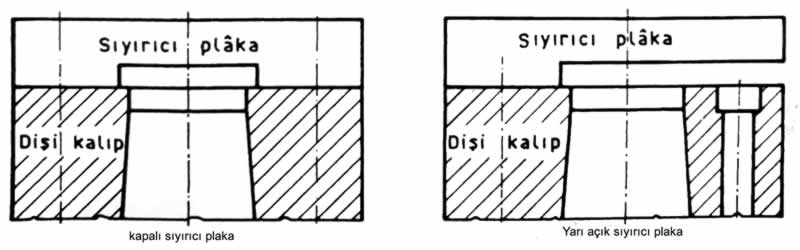
Stripper plates closed on both sides are used in single-row forming operations, while semi-open stripper plates are used in reverse-flip forming operations for short strip material with two or more rows. (Figure above)
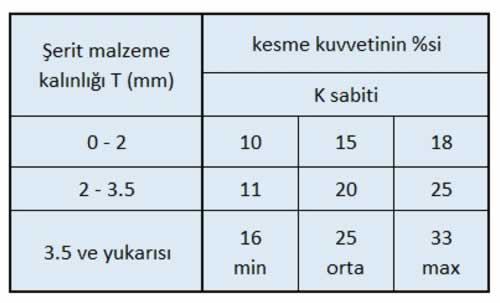
In practice, stripper plate thickness is taken as the cube root of the stripping force. The stripping force is found using coefficients based on strip material thickness, given in the chart above.
Worked Example: Finding Stripper Plate Thickness

For the part shown above, to be formed from St 42 stainless steel, the total cutting force is P = 14280 kg. Given that the strip material thickness is T = 2 mm, find the maximum and minimum stripper plate thickness to be used in the die.
Solution:
From the chart above; K(min) = 11% K(max) = 25%
Stripping force:
Ps (min) = K(min) . P kg
Ps (min) = 11% . 14280
Ps (min) = 1570 kg
Ps (max) = K(max) . P kg
Ps (max) = 25% . 14280
Ps (max) = 3750 kg
Stripper plate thickness h:
h (max) = cube root of Ps (max)
h (max) = cube root of 3750
h (max) = 15.5 mm
h (min) = cube root of Ps (min)
h (min) = cube root of 1570
h (min) = 11.6 mm
Related Posts


