
In this article, in the die-making training section, we’ll cover what a spinning mandrel is, how it works, how production is done with spinning mandrels, and its advantages and weaknesses.
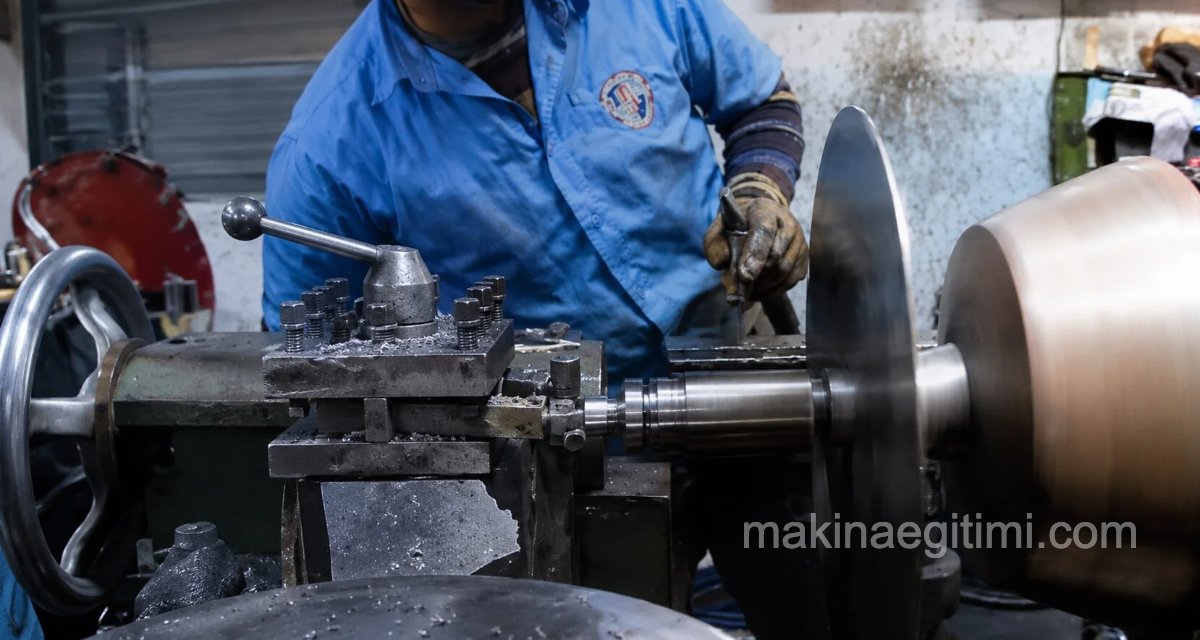
Metal spinning is a production method for making seamless tubes and similar parts, as well as truncated cones, spheres, or spherical parts, from sheet material. Simple spinning operations are generally performed on lathes. On spinning lathes, a template (form tool) suited to the shape of the part being spun is used. This template controls the movement of the roller against the part.

Spinning rods and rollers that don’t require making a template are held freehand against the part being spun. The spinning rod is also supported by a pin fixed in the upper or lower rest.

Mandrels used for spinning parts produced in large quantities are made of steel. These mandrels are made from plain carbon or alloy steel that can be hardened when needed, and are then hardened. The mandrels are also ground, polished, and, when desired, their working surfaces are plated with chromium, nickel, or similar materials.

For spinning parts with a wide base and a narrow neck section, a multi-piece spinning mandrel is used. When the center shaft of this type of segmented mandrel is removed, the wedge-shaped segment among the surrounding mandrel sections is removed first. Then the remaining segments are removed in sequence, leaving the interior of the spun vessel empty.

Advantages and Disadvantages of Spinning Mandrels
The advantages of spinning mandrels are as follows:
Low production cost of the part,
Short setup time,
Easy mandrel design and manufacturing,
Sheet material thicknesses can be easily changed.
The weaknesses of spinning mandrels are as follows:

a view of the spinning process
With classic spinning machines, the process requires a skilled die-maker,
Since it’s generally shaped by hand, the forming (spinning) process is difficult,
It’s not well suited to mass production.

Spinning parts with a wide base and a narrow mouth can also be done with press dies. Spinning performed with press dies is also called necking (press-die spinning). Mass production is high with this type of die-based spinning (necking) process. However, compared to parts produced on spinning lathes, parts produced with press dies have a higher production cost.
Related Video 1 – process performed with a classic spinning machine
Related Video 2
Related Video 3 – Copper Spinning
Related Video 4 – Process Performed with a CNC Spinning Machine
The Spinning Principle
Spinning is the process of gradually shaping sheet material pressed against a rotating mandrel.
Low Tooling Cost
Spinning mandrels require much lower-cost tooling than traditional deep-drawing dies.
Limited to Symmetric Parts
Due to the nature of the process, spinning is generally limited to producing rotationally symmetric parts.
Related Questions
The template predetermines the path the profile roller will follow, reducing the precision the operator would otherwise need to control by hand. This makes it especially easier to reproduce complex profiles consistently, over and over.
The mandrel is subjected to constant friction and pressure during spinning. Hardening and coatings such as chrome or nickel increase the surface’s resistance to wear, extending the mandrel’s service life.
Related Posts
 Blank Diameter Calculation in Drawing Dies
 Deep-Drawing Dies
 Plastic Injection Molds: Injection System
 Drawer Rail Piercing Die Assembly and Detail Drawings
 Die Clamping on Eccentric Presses
 Side Rails and Their Mounting in Blanking Dies
 Preventing Wrinkling and Determining Draw Stages in Drawing Dies
 Compression Molds and Their Types