Close Menu
  • MAKİNELER ve İMALAT
    • Tools & Equipment
    • Computer-Aided Drawing
    • CAD/CAM Education
    • CNC Machine Programming
    • Casting Technologies
    • Electrical & Electronics Technologies
    • Hydraulics & Pneumatics
    • Manufacturing Processes
    • Manufacturing Technologies
    • Occupational Safety
    • Mold & Die Design
    • Solid Modeling
    • Welding Technology
    • Machine Elements
    • Mechanical Trade Drawing
    • Materials Science
    • Automotive & Vehicle Technologies
    • Robotics Technologies
    • Health Technologies
    • Defense & Aerospace Technologies
    • Descriptive Geometry
    • Technical Drawing
    • Software & Hardware Technologies
    • Innovative Manufacturing Methods
  • TEKNOLOJİ ve YAŞAM
    • OTOMOBİLLER ve TAŞIT
      • Vehicle & Engine Knowledge
      • Safe Driving
      • Sürüş Destek Sistemleri
    • Genel Kültür
      • Movies & TV Shows
      • Görsel ve Grafik Sanat
      • Books & Literature
      • Music
      • Sports
      • History
      • History of Technology
    • GÜNDELİK YAŞAM TEKNOLOJİLERİ
    • Hobbies & Entertainment
    • Internet Technologies
    • Health
    • Mobile Technologies
Makine Eğitimi
  • Machines & Manufacturing
    Machine Elements
    Hydraulics & Pneumatics
    Technical Drawing
    Computer-Aided Design & Manufacturing
    Basic Manufacturing Processes
    Manufacturing Processes
    Industry Technologies
    Other Technical Courses
    Motion & Power Transmission
    Simple Machines
    Chains & Sprockets
    Shafts & Journals
    Gears
    Cams
    Couplings
    Belts & Pulleys
    Springs
    Bearings
    Keys
    Fastening Joining
    Retaining Rings
    Screws, Bolts & Nuts
    Cotter Pins
    Flanges
    Welding
    Rivets
    Pins & Bolts
    Washers
    Calculators
    Gear Ratio Calculator
    Spring Constant Calculator
    Belt Pulley Ratio Calculator
    Other Machine Elements
    Slides & Linear Guides
    Brakes
    Flywheels
    Clamps
    Shock Absorbers
    Gaskets & O-Rings
    Seals & Sealing Elements
    Hydraulics
    Introduction to Hydraulics & Principles
    Hydraulic Systems & Applications
    Accumulators
    Filters
    Motors
    Pumps
    Valves
    Pneumatics
    Introduction to Pneumatics & Principles
    Pneumatic Systems & Applications
    Pneumatic Circuit Components
    Valves
    Cylinders
    Silencers
    Motors
    Compressors
    Dryers
    Conditioning Units
    Common Topics & Maintenance
    Hydraulic & Pneumatic Maintenance
    Study Notes, Exams & Tests
    Technical Drawing
    Introduction to Technical Drawing
    Geometric Drawings
    Perspective & Projection
    Orthographic Views
    Dimensioning
    Sectioning
    Assembly & Detail Drawings
    Tolerances
    Surface Finish Symbols
    Mechanical Engineering Drawing
    Screws, Bolts & Nuts
    Pulley Drawings
    Gear Drawings
    Shafts & Journals
    Bearing Drawings
    Pins & Bolts
    Spring Drawings
    Welds in Technical Drawing
    Washers
    Cotter Pins
    Technical Drawing Exercises
    Mechanical Drawing Exercises
    Gear Exercises
    View Extraction Exercises
    Pulley Exercises
    Pin & Bolt Exercises
    Threaded Fastening Exercises
    Descriptive Geometry
    Computer-Aided Drawing
    AutoCAD Drawing Lessons
    Computer-Aided Drawing Exams
    Solid Modeling & Animation
    Solid Model Drawing Files
    Solid Model Assembly Examples
    Solid Model Drawing Lessons
    3D CAD Software Reviews
    Solid Modeling Exercises
    CNC Programming
    CAM
    Measurement & Inspection
    Dial Indicators
    Calipers
    Gauges
    Micrometers
    Materials Science
    Steels
    Cast Iron
    Aluminum
    Plastics
    Material Testing & Hardness Measurement
    Occupational Safety
    Workshop Safety
    Safety When Working With Electricity
    Machine Safety Rules
    Hand Operations
    Filing
    Marking
    Cutting Operations
    Reaming
    Tapping
    Threading With a Die
    Drill Bit Sharpening
    Working With Machines
    Basic Turning Operations
    Basic Milling Operations
    Shaper Machine
    Machining
    Turning
    Milling
    Grinding
    Innovative Manufacturing Methods
    EDM (Electrical Discharge Machining)
    Laser Machining
    Waterjet Machining
    3D Printing
    3D Scanners
    Welding
    Rolling
    Casting
    Mold & Die Design
    Mechanical & Hydraulic Presses
    Blanking & Piercing Dies
    Bending Dies
    Drawing Dies
    Plastic Injection Molds
    Extrusion Dies
    Compound Dies
    Progressive Dies
    Blow Molds
    Spinning Dies
    Spray Molds
    Manufacturing of Machine Parts
    Automotive & Vehicle Technologies
    Motor Vehicle Manufacturing
    Raw Material Production
    History of Technology
    Health & Medical Technologies
    Defense & Aerospace
    Robotics Technologies
    Software & Hardware Technologies
    Mechanics - Strength of Materials
    Physics Topics
  • Technology & Life
    Hobbies & Entertainment
    Sports
    Music
    Vehicle & Engine Knowledge
    Vehicle Maintenance & Repair
    Safe Driving
    Driver Assistance Systems
    History
    Movies & TV Shows
    Books & Literature
    Computers & Internet
    Computer Tips
    Software Reviews
    Hardware & Peripherals
    Practical & Safe Internet Use
    Visual & Graphic Art
    Mobile Technologies
    Travel
    Science
    Health
    First Aid Knowledge
    Everyday Technologies
Makine Eğitimi
Home»Materials Science»Steels by MKE Number and Their Applications
30 August 2026Updated:3 September 2026

Steels by MKE Number and Their Applications

Steels by MKE Number and Their Applications

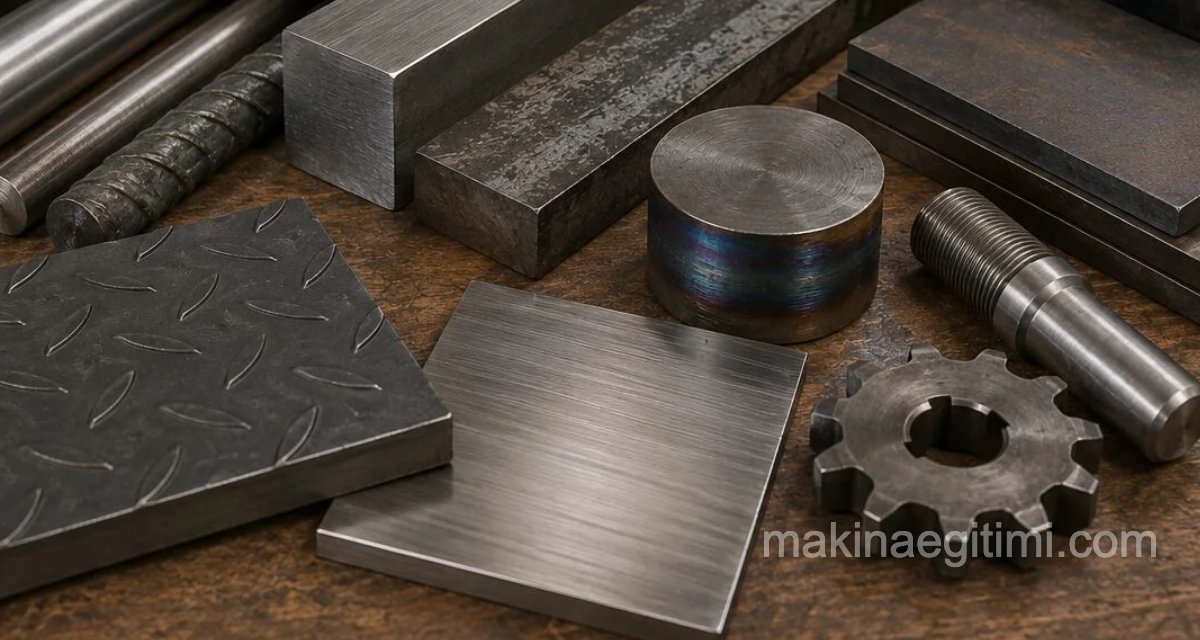
Steels are given standard numbers by the Turkish Mechanical and Chemical Industry Corporation (MKE) according to their carbon content. (Such as C1010 – C1020 – C1030 – C1040 – C1045 – C1050 – C1060 – C1070 – C1090) In this article, we’ll cover where steels are used according to their MKE numbers. We’ll look at which steel is used where, and why it’s preferred.

C1010 Application:
Used in the manufacture of bolts, nuts, and machine parts that can be quenched and tempered when used as a body in a construction.


C1020 Application:
C1020 steel is a low-carbon steel type, and generally has the following properties. Due to its low carbon content, C1020 steel is easy to machine and forge. It can be heat treated. These steels don’t have high strength, but they show good flexibility and durability.

C1020 steel is generally used in environments that are at high temperature or not resistant to corrosion. These steels are generally used in industries such as automotive, machine manufacturing, and construction, for making machines, bolts, and nuts.


C1030
C1030 is a material found among medium-carbon steels and is generally used in the manufacture of low-strength parts. It’s especially often chosen for producing steel rods, nuts, screws, buttons, hooks, ship shafts, axles, bolts, and other similar parts.

C1030’s properties include weldability and machinability. Because it has a high forming capability, it’s used especially in cold working. Also, since it’s a medium-carbon steel, its hardness and durability are also quite high.

It’s used in the manufacture of machines, axles, ship shafts, bolts, etc.


C1035
Used in the manufacture of bolts, load-bearing axles, propeller shafts, and gears. Can be induction or flame hardened.


C1040
Can be used in the manufacture of transmission shafts, rails, gears, etc. Can be induction or flame hardened.


C1045
C1045 is a material found among medium-carbon steels. Its properties, such as high strength, high toughness, and machinability, cause it to be used frequently in the manufacturing sector. Its weldability and hardening properties are also noteworthy. It can be induction or flame hardened.

It’s also a preferred type of steel when cost-effectiveness is taken into account in material selection.

It’s generally preferred in the manufacture of mechanical parts, shafts, gears, hooks, hoes, picks, shovels, and similar surface-hardened parts.


C1050
Can be used in the manufacture of towing hooks, gears, picks, and milled shafts.


C1060
C1060 is a material found among high-carbon steels, and is preferred especially for manufacturing hard, durable, and wear-resistant parts. For example, it can be used in the manufacture of blades, springs, saw blades, shafts, spindles, and bolts.


C1070
Used in the manufacture of coil and leaf springs, shears, simple cutting tools, punches, and blanking dies.


C1090
Excavator bucket teeth, grader blades, high-strength machine parts, files, adzes, wood saws, punches. C1090 steel is also used in weapon and ammunition manufacturing, for example in producing bullets, gun barrels, and other weapon parts.

MKE Numbering System


MKE (Mechanical and Chemical Industry Corporation) steel numbers define the material’s composition and intended use through a standard code system.

Effect of Carbon Content


As the carbon content in steels increases, hardness and strength increase, but machinability and weldability generally decrease.

Alloying Elements


Alloying elements such as chromium, nickel, and molybdenum significantly change a steel’s corrosion resistance, toughness, and response to heat treatment.

Related Questions

Low carbon content makes the steel easy to machine and forge, but limits its strength. This is why it’s preferred for parts (such as bolts and nuts) that don’t require high strength and where easy forming is the priority.

These numbers indicate the carbon content of the steel. For example, C1045 contains more carbon than C1020; as carbon increases, the steel becomes harder but less flexible.

Related Posts
Temper Dökme Demirler Malleable Cast Iron White Cast Iron White Cast Iron polyethylene tape Plastics Used in Packaging laser cutting The Relationship Between Laser Cutting Quality and Material Composition Çeliklerin üretim ölçüleri tabloları Steel Standard Production Size Tables Esmer dökme demirler Gray Cast Iron Forces Acting on the Crankshaft and Crankshaft Material Forces Acting on the Crankshaft. Crankshaft Material Metal Hardening Methods Metal Hardening Methods
Steels
Share. Facebook Twitter WhatsApp Tumblr Email Telegram Copy Link

Leave A Reply Cancel Reply


Don’t Die Without Reading Them: The 10 Best Mystery and Crime Novels
The Life Story of Michael Jackson: The Legendary Journey of the King of Pop
  • Contact
  • Terms of Service
  • Privacy & Cookie Policy

Type above and press Enter to search. Press Esc to cancel.