
Close Menu
  • MAKİNELER ve İMALAT
    • Tools & Equipment
    • Computer-Aided Drawing
    • CAD/CAM Education
    • CNC Machine Programming
    • Casting Technologies
    • Electrical & Electronics Technologies
    • Hydraulics & Pneumatics
    • Manufacturing Processes
    • Manufacturing Technologies
    • Occupational Safety
    • Mold & Die Design
    • Solid Modeling
    • Welding Technology
    • Machine Elements
    • Mechanical Trade Drawing
    • Materials Science
    • Automotive & Vehicle Technologies
    • Robotics Technologies
    • Health Technologies
    • Defense & Aerospace Technologies
    • Descriptive Geometry
    • Technical Drawing
    • Software & Hardware Technologies
    • Innovative Manufacturing Methods
  • TEKNOLOJİ ve YAŞAM
    • OTOMOBİLLER ve TAŞIT
      • Vehicle & Engine Knowledge
      • Safe Driving
      • Sürüş Destek Sistemleri
    • Genel Kültür
      • Movies & TV Shows
      • Görsel ve Grafik Sanat
      • Books & Literature
      • Music
      • Sports
      • History
      • History of Technology
    • GÜNDELİK YAŞAM TEKNOLOJİLERİ
    • Hobbies & Entertainment
    • Internet Technologies
    • Health
    • Mobile Technologies
Makine Eğitimi
  • Machines & Manufacturing
    Machine Elements
    Hydraulics & Pneumatics
    Technical Drawing
    Computer-Aided Design & Manufacturing
    Basic Manufacturing Processes
    Manufacturing Processes
    Industry Technologies
    Other Technical Courses
    Motion & Power Transmission
    Simple Machines
    Chains & Sprockets
    Shafts & Journals
    Gears
    Cams
    Couplings
    Belts & Pulleys
    Springs
    Bearings
    Keys
    Fastening Joining
    Retaining Rings
    Screws, Bolts & Nuts
    Cotter Pins
    Flanges
    Welding
    Rivets
    Pins & Bolts
    Washers
    Calculators
    Gear Ratio Calculator
    Spring Constant Calculator
    Belt Pulley Ratio Calculator
    Other Machine Elements
    Slides & Linear Guides
    Brakes
    Flywheels
    Clamps
    Shock Absorbers
    Gaskets & O-Rings
    Seals & Sealing Elements
    Hydraulics
    Introduction to Hydraulics & Principles
    Hydraulic Systems & Applications
    Accumulators
    Filters
    Motors
    Pumps
    Valves
    Pneumatics
    Introduction to Pneumatics & Principles
    Pneumatic Systems & Applications
    Pneumatic Circuit Components
    Valves
    Cylinders
    Silencers
    Motors
    Compressors
    Dryers
    Conditioning Units
    Common Topics & Maintenance
    Hydraulic & Pneumatic Maintenance
    Study Notes, Exams & Tests
    Technical Drawing
    Introduction to Technical Drawing
    Geometric Drawings
    Perspective & Projection
    Orthographic Views
    Dimensioning
    Sectioning
    Assembly & Detail Drawings
    Tolerances
    Surface Finish Symbols
    Mechanical Engineering Drawing
    Screws, Bolts & Nuts
    Pulley Drawings
    Gear Drawings
    Shafts & Journals
    Bearing Drawings
    Pins & Bolts
    Spring Drawings
    Welds in Technical Drawing
    Washers
    Cotter Pins
    Technical Drawing Exercises
    Mechanical Drawing Exercises
    Gear Exercises
    View Extraction Exercises
    Pulley Exercises
    Pin & Bolt Exercises
    Threaded Fastening Exercises
    Descriptive Geometry
    Computer-Aided Drawing
    AutoCAD Drawing Lessons
    Solid Modeling & Animation
    Solid Model Drawing Files
    Solid Model Assembly Examples
    Solid Model Drawing Lessons
    3D CAD Software Reviews
    Solid Modeling Exercises
    CNC Programming
    CAM
    Measurement & Inspection
    Dial Indicators
    Calipers
    Gauges
    Micrometers
    Materials Science
    Steels
    Cast Iron
    Aluminum
    Plastics
    Material Testing & Hardness Measurement
    Occupational Safety
    Workshop Safety
    Safety When Working With Electricity
    Machine Safety Rules
    Hand Operations
    Filing
    Marking
    Cutting Operations
    Reaming
    Tapping
    Threading With a Die
    Drill Bit Sharpening
    Working With Machines
    Basic Turning Operations
    Basic Milling Operations
    Shaper Machine
    Machining
    Turning
    Milling
    Grinding
    Innovative Manufacturing Methods
    EDM (Electrical Discharge Machining)
    Laser Machining
    Waterjet Machining
    3D Printing
    3D Scanners
    Welding
    Rolling
    Casting
    Mold & Die Design
    Mechanical & Hydraulic Presses
    Blanking & Piercing Dies
    Bending Dies
    Drawing Dies
    Plastic Injection Molds
    Extrusion Dies
    Compound Dies
    Progressive Dies
    Blow Molds
    Spinning Dies
    Spray Molds
    Manufacturing of Machine Parts
    Automotive & Vehicle Technologies
    Motor Vehicle Manufacturing
    Raw Material Production
    History of Technology
    Health & Medical Technologies
    Defense & Aerospace
    Robotics Technologies
    Software & Hardware Technologies
    Mechanics - Strength of Materials
    Physics Topics
  • Technology & Life
    Hobbies & Entertainment
    Sports
    Music
    Vehicle & Engine Knowledge
    Vehicle Maintenance & Repair
    Safe Driving
    Driver Assistance Systems
    History
    Movies & TV Shows
    Books & Literature
    Computers & Internet
    Computer Tips
    Software Reviews
    Hardware & Peripherals
    Practical & Safe Internet Use
    Visual & Graphic Art
    Mobile Technologies
    Travel
    Science
    Health
    First Aid Knowledge
    Everyday Technologies
Makine Eğitimi
Home»Books & Literature»The Age of Feeling, Not Reason: The Romantic Movement and Its Pioneers
30 August 2026

The Age of Feeling, Not Reason: The Romantic Movement and Its Pioneers

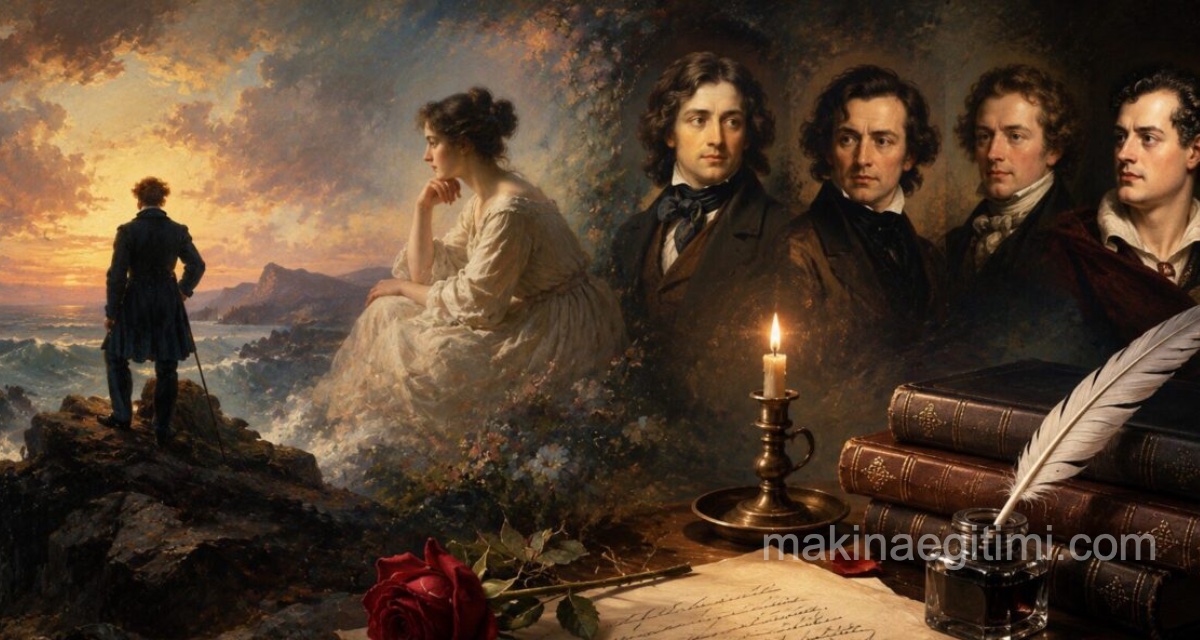
romantic era painting of a lone figure by a stormy sea

In this article, we’ll cover what the Romantic movement is, what traits define it, and which writers it influenced — from Goethe to Victor Hugo, we’ll tell the story of a literary movement in which emotion triumphed over reason.

  • What Is the Romantic Movement, and How Did It Begin?
  • What Are the Characteristics of the Romantic Movement?
  • The Pioneering Writers of Romanticism
    • Johann Wolfgang von Goethe
    • Victor Hugo
    • Lord Byron
    • Mary Shelley
  • Traces of Romanticism in Turkish Literature
  • What Is the Difference Between Romanticism and Classicism?
  • Frequently Asked Questions

Most people who ask “what is the Romantic movement?” confuse it with the everyday sense of the word “romance,” not realizing it was actually a far more fundamental revolution in thought. Romanticism was a rebellion of emotion, imagination, and the individual against an age that worshipped reason and rules.

What Is the Romantic Movement, and How Did It Begin?

Romanticism is a literary and artistic movement that emerged in Germany and England in the late 18th century and spread across all of Europe through the 19th century. It was born as a reaction to the excessive importance the preceding Age of Enlightenment placed on reason, logic, and universal rules. While Enlightenment thinkers viewed the world as a mathematical problem that could be solved, Romantic writers argued that a person’s inner world, emotions, and imagination could never be fully explained by reason.

The social upheaval brought on by the French Revolution also played a major role in the birth of Romanticism. The idea of freedom promised by the Revolution was transformed by artists into a search for individual liberty and self-expression.

What Are the Characteristics of the Romantic Movement?

When asked about the characteristics of Romanticism, a few core elements should come to mind:

  • Emotion is superior to reason. For Romantic writers, what mattered wasn’t whether an event was logical, but the feeling it evoked.
  • Nature is the mirror of the soul. Stormy seas, dark forests, ruined castles; nature was no longer mere backdrop but an element reflecting the character’s inner world.
  • The individual and freedom are placed at the center. Heroes who rebelled against society’s rules and carved their own path were Romantic literature’s favorite figures.
  • A longing for the past and the exotic. The Middle Ages, legends, distant lands; Romantic writers fled the ordinariness of daily life and took refuge in the world of imagination.
  • Interest in nationalism and folk culture. Folk tales, epics, and local traditions gained renewed value during this period.

The Pioneering Writers of Romanticism

Johann Wolfgang von Goethe

Regarded as one of the most important pioneers of Romanticism, Goethe gave the movement one of its groundbreaking examples with “The Sorrows of Young Werther,” published in 1774. The novel tells the story of a young man driven to suicide by the pain of unrequited love, and it had such a powerful impact on Europe at the time that, following a wave of copycat suicides among young readers, the book was banned in some countries. This phenomenon came to be known in history as the “Werther effect.”

Victor Hugo

The strongest voice of French Romanticism, Victor Hugo carried the movement to its peak both through his poetry and through novels like “The Hunchback of Notre-Dame” and “Les Misérables.” The characters in Hugo’s works — outcast by society, flawed yet deeply emotional — most clearly reflect the importance Romanticism placed on the individual and on feeling.

Lord Byron

One of the most colorful figures of English Romanticism, Lord Byron embodied the movement’s rebellious spirit both through his life and his work. The concept of the “Byronic hero” arose from the type of character he created — charismatic yet tragic, at odds with society. This hero type went on to inspire countless literary and cinematic characters in the centuries that followed.

Mary Shelley

The writer who left her mark on the Gothic branch of Romanticism, Mary Shelley created one of the movement’s most striking explorations of the tension between reason and emotion with “Frankenstein,” published in 1818, questioning the limits of science and humanity’s intervention in nature. The novel is regarded today as one of the earliest examples of both Romanticism and the science fiction genre.

Traces of Romanticism in Turkish Literature

The Romantic movement also made its way into Turkish literature during the Tanzimat era, through Ottoman intellectuals. The passionate, emotional narration in Namık Kemal’s novel “İntibah” and his theatrical works carries traces of French Romanticism. Romantic themes concerning nature, death, and love also appear frequently in the poetry of Abdülhak Hamit Tarhan.

What Is the Difference Between Romanticism and Classicism?

To better understand Romanticism, it helps to compare it with Classicism, the movement that preceded it. While Classicism placed importance on reason, rule, and balance, Romanticism placed importance on emotion, freedom, and individuality. In classical works, characters often remained types, whereas in Romantic works, a character’s inner world and inner conflicts came to the fore. The tension between these two movements formed one of the most fertile grounds for debate in 19th-century European literature.

Frequently Asked Questions

Romanticism was born in Germany and England in the late 18th century and spread across all of Europe through the 19th century.

Johann Wolfgang von Goethe, Victor Hugo, Lord Byron, and Mary Shelley are among the best-known pioneers of Romanticism.

Placing emotion above reason, identifying nature with mood, valuing individual freedom, and a longing for the past are counted among the core characteristics of Romanticism.

Namık Kemal and Abdülhak Hamit Tarhan are important figures who carried traces of Romanticism into Turkish literature during the Tanzimat era.

Related Posts

black and white portrait photo of Dostoevsky Dostoevsky: A Life From a Death Sentence to the Summit of Russian Literature portrait photo of Ernest Hemingway, bearded and pensive Master of the Short Sentence: The Life Story of Ernest Hemingway 19th-century Russian duel illustration Two Poets Who Lived the Fate They Wrote: Pushkin and Lermontov Philosophy books for beginners Learning to Think: Beginner’s Books on Philosophy mystery novel covers lined up on a dimly lit library shelf Don’t Die Without Reading Them: The 10 Best Mystery and Crime Novels manuscript page with editing notes marked in red pen What Is Editing? What Does a Book Editor Actually Look At? open manuscript on an old typewriter with a blurred ship silhouette When Fiction Becomes Reality: 6 Novels That Predicted the Future Kate Bush performing on Top of the Pops in 1978 in a red dress From a Novel to a Number One: The Story of the Song Wuthering Heights
Share. Facebook Twitter WhatsApp Tumblr Email Telegram Copy Link

Leave A Reply Cancel Reply

Fuel Cell Electric Vehicles (FCEV)
How Is Spark Plug Cleaning Done. Ways to Clean Spark Plugs
  • Contact
  • Terms of Service
  • Privacy & Cookie Policy

Type above and press Enter to search. Press Esc to cancel.