

We’ll cover hydraulic filtration systems based on where they’re positioned within the circuit. In hydraulic systems, there are basically three types of circuits.
Open-Loop Control Circuit
In open-loop control circuits, fluid is drawn from the tank, pumped into the hydraulic system. It circulates within it and is sent back to the tank.
Main Flow Filter
Main flow filters are used to filter the fluid in the actual hydraulic circuit.
Suction, line, and mounted return-line filters can all be used as the main flow filter.
By-Pass Filters
These filters, used within hydraulic filtration systems, are used to filter the fluid in the tank by circulating it during operation.
Generally, a complete by-pass filtration unit consisting of a pump, filter, and oil cooler is used.
The advantage of by-pass filters is that they can operate independently of the hydraulic system’s working cycle, and the fluid passing through the filter element is steady and free of pulses.
If a fluid’s aging process is slowed down, the fluid’s service life is significantly extended.
Vent Filters
These filters are used to filter the air entering and leaving the tank. Based on their function, they’re divided into two categories: working filters and safety filters.
Working Filters
Working filters consist of filter elements that are stable at low pressure. These filter types have a large filter surface area and high dirt-holding capacity. These filters can also be connected to leak-oil lines if needed.
Safety Filters
These filters, used within hydraulic filtration systems, are used to protect hydraulic components from sudden failures that could arise from very high levels of solid particle contamination. In other words, these filters should only be used to filter particles that could suddenly block hydraulic components.
Another use for safety filters is to protect the system from contamination in the event a pump or motor suddenly fails.
Hydraulic filtration systems using this type of filter can save on the potentially high repair costs of components that could otherwise be damaged.

OPEN-LOOP CONTROL FILTER:
1- Safety filter (line filter)
2- Working filter (return line filter)
3- Working filter (by-pass filter)
4- Vent filter
Filtration Rating
Hydraulic filters typically have a particle-retention capacity of between 3 and 25 microns.
Pressure Line Filter
Filters placed on high-pressure lines prevent contamination from spreading through the system after the pump.
Regular Filter Changes
A clogged hydraulic filter should be replaced regularly, as it can cause pressure drops in the system and pump wear.
Closed-Loop Control Circuit
In closed-loop control circuits, fluid is continuously pumped into the hydraulic circuit. Only leak oil returns to the tank and is pumped back into the circuit by the charge pump.
Application; e.g., hydrostatic transmissions with a hydraulic pump and hydraulic motor.
In a true closed circuit, only the flushing fluid is filtered. Once the system has been cleaned with fluid, the filters are taken out of the circuit.
By using pressure-sensitive sealing systems in motors and pumps, it’s possible to filter only the leak oil using coarse-mesh strainer filters on the return line.
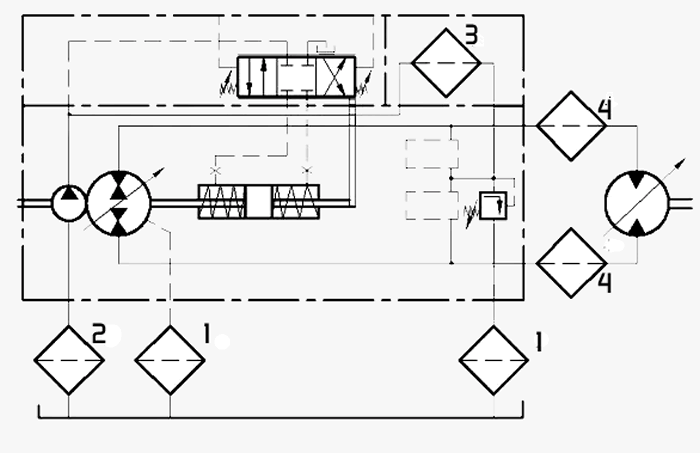
Closed-Loop Control Circuit:
1- Leak line return filter
2- Charge line suction filter
3- Charge line filter
4- Flushing fluid filter in the closed-loop control circuit.
Using Both Control Circuit Types Together
In hydraulic filtration systems that combine both circuit types, the open-loop and closed-loop control circuits are fed by a shared tank.
Application: For example, in mobile machines, working hydraulics and slewing operations are done with an open-loop control circuit, while transmission hydraulics and rotary drive transmission are done with a closed-loop control circuit.
Related Questions
A by-pass filter is a side circuit, separate from the main hydraulic circuit, operating with its own small pump. This independence allows steady, continuous filtration regardless of the system’s normal operating load.
These filters clean not the hydraulic fluid, but the air entering and leaving the tank. As the fluid level changes, if the air entering the tank is dirty, this contamination can mix into the fluid, so the air also needs to be filtered separately.
Related Posts
 What Is a Pneumatic Muffler, What Does It Do?
  How Does a Hydraulic Jack Work?
  What Is Pascal’s Principle? Where It Is Used
  Hydraulic Oil Selection and Properties Required in Hydraulic Oils
  The Operating System of Hydraulic Motors
  How Hydraulic Brakes Work
  Screw Compressors: Construction, Types, Strengths, and Weaknesses
  Pressure Reducing Valve: Working Principle, Types, and Applications