
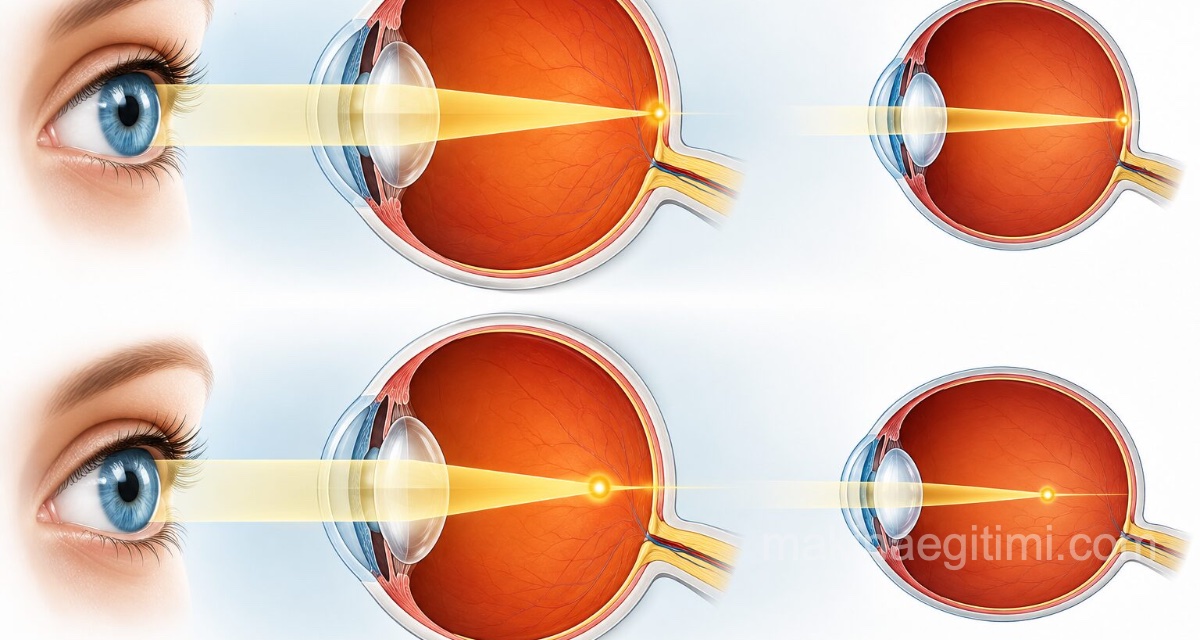
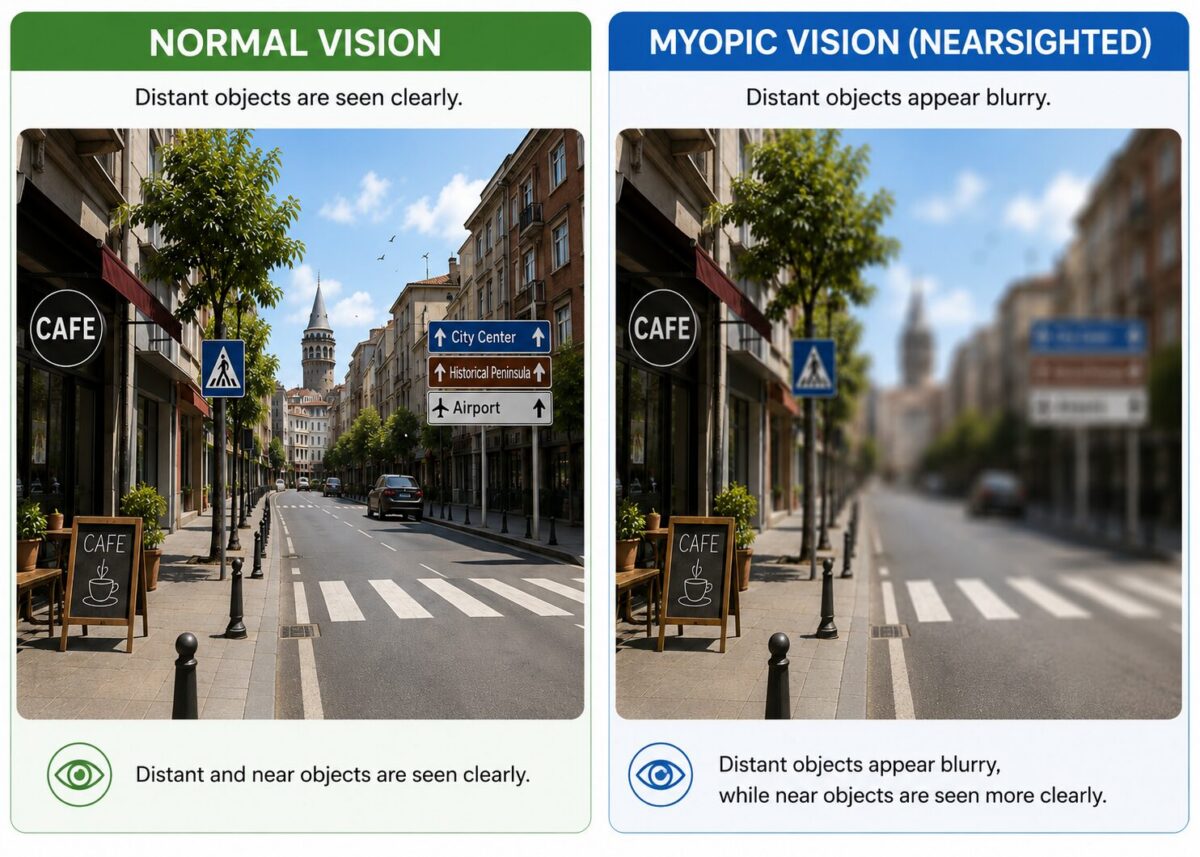
Myopia (nearsightedness) is a refractive error in which distant objects appear blurry while nearby objects are seen clearly. Because the eyeball is longer than normal or the cornea is too curved, light focuses in front of the retina instead of directly on it. It’s not a disease but a correctable vision problem; clear vision can be achieved with glasses, contact lenses, or, in suitable candidates, laser procedures.
You can’t read the sign in the distance. You squint while watching TV. Your child, sitting at the back of the classroom, says they can’t see the board.
These are the most classic signs of myopia — a condition that’s becoming increasingly common in Turkey and around the world, especially among children. And the cause is largely what you’d expect: more screen time and less time spent outdoors.
The good news is that myopia isn’t a disease — it’s a correctable refractive error. In this article, we explain in plain language how myopia develops, which symptoms deserve attention, the treatment options, and what can be done to slow its progression, especially in children.
What is myopia?
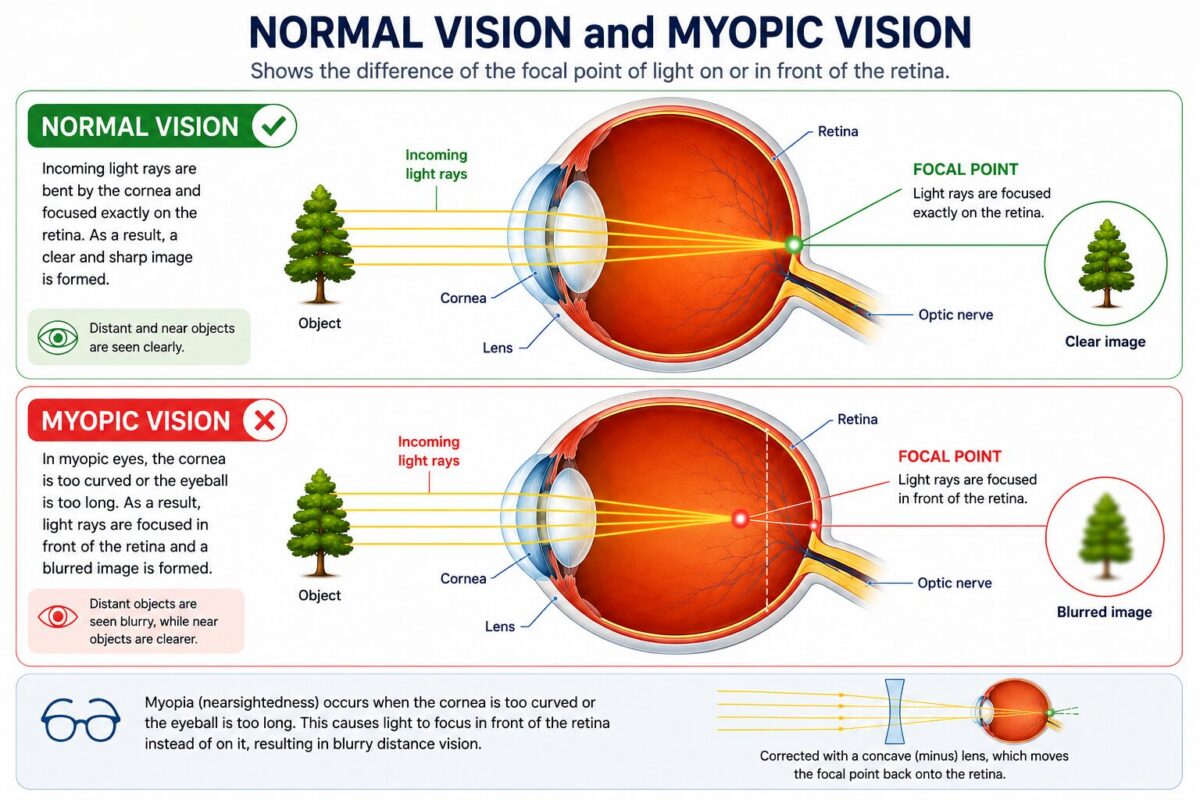
The eye actually works much like a camera. Light first passes through the cornea (the transparent layer at the very front of the eye) and the lens, then focuses on the retina at the back wall of the eye. For the image to be sharp, light needs to focus exactly on the retina.
In myopia, light focuses in front of the retina. The result: distant objects appear blurry.
There are two main causes of this:
- The eyeball being longer than normal (the most common cause) — after focusing, light disperses again before it reaches the retina.
- The cornea being more curved than normal — it bends light more strongly than it should.
Someone with myopia sees nearby objects clearly but distant ones as blurry. The blurriness becomes more pronounced as distance increases.
What do myopia levels mean?
Eyeglass prescription strength is measured in “diopters” and shown with a minus (−) sign in myopia. Roughly speaking:
| Level | Meaning |
|---|---|
| −0.25 to −1.00 | Very mild. Slight blurriness with small text at a distance; glasses usually aren’t necessary. |
| −1.00 to −3.00 | Mild to moderate. Signs and distant faces become blurry; glasses are generally recommended. |
| −3.00 to −6.00 | Moderate to high. Anything more than a few meters away is noticeably blurry; continuous use of correction is needed. |
| −6.00 and above | High (pathological) myopia. Regular follow-up is essential due to the risk of retinal thinning. |
Important: High myopia isn’t just a matter of “thick glasses.” As the eyeball elongates, the retina thins, increasing the risk of complications like retinal tears or detachment. That’s why people with a prescription above −6.00 should have a retinal exam at least once a year.
What causes myopia?
1. Heredity. The strongest factor. If both parents have myopia, the likelihood of it appearing in their child rises noticeably.
2. Prolonged close-up work. Books, phones, tablets, computers. When the eye focuses up close for extended periods, it can trigger the eyeball, still growing at that age, to keep elongating.
3. Spending little time outdoors. This is one of the most studied factors in recent years. Exposure to daylight is thought to slow excessive elongation of the eyeball. Studies report that children who spend an average of two hours a day outdoors show a lower rate of developing myopia.
4. Reading in insufficient light. Prolonged close-up work in dim light strains the eyes.
5. The growth years. Myopia usually starts during school age, progresses through adolescence, and largely stabilizes in the early twenties.
6. Certain health conditions. Fluctuations in blood sugar in diabetes can cause temporary changes in prescription. The development of cataracts can also cause a myopic shift in older age.
A common misconception: “Does looking at your phone in the dark damage your eyes?” Looking at a screen in the dark doesn’t permanently cause myopia, but it does cause eye strain, headaches, and dryness. The real risk is the combination of prolonged close-up work and too little time spent outdoors.
What are the symptoms of myopia?
In adults:
- Seeing distant signs, license plates, and faces as blurry
- Needing to squint when looking into the distance (the most typical symptom)
- Difficulty driving at night, seeing halos around lights
- Eye strain and headaches by the end of the day
- Seeing nearby objects without any problem
In children (what parents should watch for):
- Wanting to sit very close to the TV or the classroom board
- Frequent squinting
- Frequent eye rubbing
- Holding the page close to the face while reading
- Complaints of “my head hurts,” especially by the end of the school day
- An unexplained drop in academic performance
- Not mentioning that they can’t read the board in class — children often don’t complain because they assume blurry vision is normal
How is myopia diagnosed? Which department should you see?
The department you should see: Ophthalmology.
What happens during the exam?
- Visual acuity test: Reading letters off a distant chart. The best-known method.
- Autorefractor: A device that measures the eye’s refractive power.
- Retinoscopy: Shining light into the eye and assessing how it’s refracted.
- Cycloplegic (dilated eye drop) exam: Especially important in children. Eye drops temporarily relax the focusing muscles so the true prescription can be measured. Without this, a child’s prescription can come out different from the actual value.
- Retinal exam: Examination of the back of the eye, especially important in high myopia.
How often should checkups happen?
- Children: An eye exam should be done before starting school without fail. If myopia is detected, follow-up is needed at intervals set by the physician (usually every 6–12 months), since the prescription can change rapidly during the growth years.
- Adults: An annual checkup is enough if the prescription is stable.
- People with high myopia: Regular checkups are essential for retinal monitoring.
How is myopia treated?
Myopia isn’t something that “heals” — it’s something that’s corrected. The goal is to make light focus properly on the retina.
1. Glasses
The most common, safest, and most practical method. Usually the first choice for children.
A common misconception: “If I wear glasses, my eyes will get used to them and my prescription will get worse.” This isn’t true. Glasses don’t worsen your prescription. A worsening prescription comes from the eye’s own growth process. In fact, not wearing glasses when they’re needed causes eye strain, headaches, and, in children, learning difficulties.
2. Contact lenses
They provide a wider field of view and are practical for sports. However, since they touch the eye directly, hygiene rules are critical:
- Always wash your hands before putting in or taking out lenses
- Lens solution should be replaced fresh each time, never topped up
- Never sleep in your lenses (unless specifically approved for that)
- Never let lenses come into contact with tap water
- Discard lenses once their wear period has expired
Not following these rules can lead to serious corneal infections.
3. Laser treatments
Corrects the refractive error by reshaping the cornea. Certain conditions must be met to be eligible:
- Generally being over 18
- The prescription being stable for at least 1 year
- Adequate corneal thickness
- The absence of certain eye conditions
Not everyone is a candidate for laser surgery; this can only be determined after a detailed eye exam and corneal mapping.
4. Implantable lens procedures
For people who aren’t candidates for laser surgery or whose prescription is very high, placing a permanent lens inside the eye may be considered. The decision depends entirely on the physician and the structure of the eye.
5. Methods to slow progression in children
This is the most heavily researched area in recent years. The goal isn’t to correct the prescription but to slow how quickly it gets worse. For children they consider suitable, physicians may evaluate methods such as specially designed eyeglass lenses, certain types of contact lenses, or hard lenses worn overnight (orthokeratology). Very low-dose eye drops can also be used for this purpose.
All of these methods are applied under an ophthalmologist’s evaluation and follow-up.
⚠️ See an eye doctor immediately if you notice these symptoms
The following can be signs of an emergency retinal problem. This is especially important for people with high myopia:
- Suddenly seeing a large number of floaters (black spots, hair-like shadows)
- Flashes of light like lightning in your field of vision
- A feeling of a curtain or shadow creeping in from one side of your field of vision
- Sudden vision loss or a sudden distortion in your vision
- Eye pain along with redness, nausea, and halos around lights
Don’t wait for an appointment if you notice these symptoms; hours matter with a retinal tear or detachment.
What should you watch out for during treatment?
Wear your glasses consistently. Wear them as your physician recommends. The idea of “if I strain my eyes, they’ll get better” doesn’t work — it only creates eye strain.
Have your prescription monitored. It can change quickly, especially in children. Don’t skip checkups.
Follow the 20-20-20 rule. Every 20 minutes at the screen, look at something roughly 6 meters (20 feet) away for about 20 seconds. This lets the eye’s focusing muscles rest.
Pay attention to lighting. Make sure the room is adequately lit while reading and working. Looking at a bright screen in a dark room increases eye strain.
Screen distance. Books and screens should be roughly an arm’s length from your eyes.
Don’t forget to blink. Blink frequency drops noticeably while looking at a screen, which causes dryness.
Wear sunglasses. Make sure they’re UV-protective and certified. Cheap, unprotected dark lenses can dilate the pupil and let in even more harmful light.
Diet, herbal supplements, and lifestyle: what can help?
First, an honest disclaimer: no food, herb, or exercise reduces a myopia prescription. Claims circulating online like “carrots cure myopia” or “get rid of your glasses with eye exercises” have no scientific basis. The following don’t correct the prescription; they support general eye health.
Foods that may help
- Vitamin A sources (carrots, sweet potato, squash, spinach, liver) — necessary for retinal function, especially night vision.
- Lutein and zeaxanthin sources (spinach, broccoli, kale, egg yolk, corn) — pigments that play a role in protecting the central area of the retina.
- Omega-3 sources (salmon, mackerel, anchovy, walnuts, flaxseed) — can help with dry eye complaints.
- Vitamin C and E sources (citrus fruits, red peppers, rosehip, almonds, sunflower seeds) — provide antioxidant support.
- Zinc sources (pumpkin seeds, red meat, legumes) — necessary for vitamin A to be used properly in the retina.
- Enough water — reduces eye dryness.
Lifestyle: what actually makes a difference
Time spent outdoors. This is currently the strongest and cheapest tool we have for slowing the onset and progression of myopia in children. Target: an average of two hours of daylight exposure a day. Playing at the park after school, weekend walks — no special program needed.
Limit screen time. Especially for younger children.
Quit smoking. Smoking is a well-established risk factor that negatively affects the eye’s blood vessels and the retina.
Keep your blood sugar and blood pressure under control. Both directly affect the retinal blood vessels.
A note on herbal supplements
Herbs like bilberry and ginkgo biloba are frequently recommended for eye health. They may offer general antioxidant benefits, but:
- They don’t change a myopia prescription.
- Ginkgo biloba interacts seriously with blood-thinning medications.
- Always tell your doctor before using them.
Frequently asked questions about myopia
Myopia doesn’t go away on its own. It usually starts during school age, progresses through the growth years, and stabilizes in the early twenties. Clear vision is achieved with glasses, contact lenses, or, in suitable candidates, laser procedures; these correct the prescription rather than restoring the eye’s original shape.
No. Glasses don’t worsen your prescription. A worsening prescription comes from the eye’s own growth process. Not wearing glasses when they’re needed, on the other hand, causes eye strain, headaches, and, in children, a decline in school performance.
The strongest and easiest method is increasing time spent outdoors; an average of two hours of daylight exposure a day is recommended. Limiting screen time and close-up work, the 20-20-20 rule, and regular eye checkups also matter. If your physician sees fit, they may consider special eyeglass lenses or lens options designed to slow progression.
No. Generally you need to be over 18, have a prescription that hasn’t changed for at least a year, have adequate corneal thickness, and not have certain eye conditions. Eligibility can only be determined after a detailed eye exam and corneal mapping.
You should see Ophthalmology. In children, the first exam should be done before starting school; children often don’t complain because they assume blurry vision is normal.
Videos you can watch on this topic
MİYOP NASIL OLUŞUR ve TEDAVİSİ NEDİR?
MİYOPİ, HİPERMETROPİ VE ASTİGMATİZMA: GÖZ KUSURLARINIZI NE KADAR TANIYORSUNUZ?
Miyop Nasıl Görür
Excimer Lazer ile Göz Kusurları (Miyopi, Hipermetropi ve Astigmatizma) Tedavi Edilebilir
Medical disclaimer: This article is for general informational purposes only; it does not replace examination, diagnosis, or treatment. Always consult a physician about your symptoms. Do not stop or change any medication you are taking without consulting your doctor.
Related Posts
 Cataract: Symptoms, Causes and Surgery
 What Is a Herniated Cervical Disc? Symptoms, Causes and Treatment
 What Is Reflux? Symptoms, Causes, and Treatment Methods
 What Is Migraine? Symptoms, Triggers and Treatment Options
 Femur Fracture: Symptoms, Treatment, and Recovery Process
 What Is Sinusitis? Symptoms, Causes, and Treatment
 What Is Sciatica? Symptoms, Causes and Treatment Options
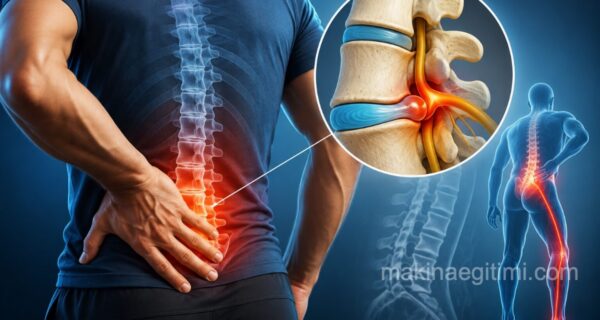 What Is a Herniated Lumbar Disc? Symptoms, Causes and Treatment